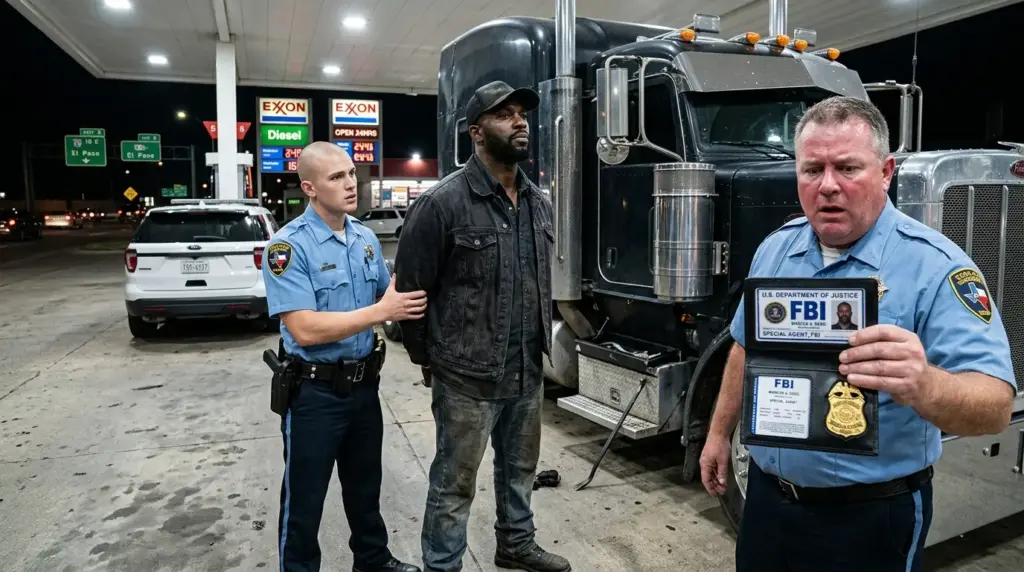
The interstate didn’t care about justice. It only understood momentum and weight, eight massive tires hummed on the expansion joints of the bridge that separated Texas from Louisiana. Marcus shifted down two gears, the big diesel engine of the Peterbilt 389 rumbling low through the floorboards like an old hunting dog clearing its throat.
The heat hit them as soon as they crossed the line—not the dry, brittle heat of the West Texas pans, but a thick, soup-like humidity that smelled of diesel smoke, swamp water, and rotting cypress roots.
“De Soto Parish,” Adrian Voss said, checking a heavily annotated tablet resting on his knees. “Population twenty-four thousand. Sheriff’s Department budget last year was twelve million dollars. For comparison, the entire town’s municipal tax revenue was less than nine hundred thousand.”
Marcus didn’t look over. His hands were loose on the giant wheel, two fingers resting on the horn ring. The dent on the driver’s side door—where Pierce had slammed him during the final raid in Ridgefield—catches the late afternoon sun. He hadn’t pulled the aluminum back into place. He liked the jagged silver crease; it reminded him of what happens when a man forgets to look in his blind spots.
“Twelve million,” Marcus muttered, his voice coarse from cheap coffee and hours of silence. “Where’s the surplus going?”
“Officially? Asset forfeiture and traffic safety modernization,” Voss said, tapping the screen. “Unofficially? It disappears into three shell entities registered in the Cayman Islands, owned by a holding company out of New Orleans. Sheriff Thomas ‘Tomahawk’ Boudreaux has held the office for twenty-two years. In that time, not a single state auditor has completed an inspection without either resigning or suffering a sudden, unexplainable career-ending scandal.”
“Sounds familiar,” Marcus said.
“It’s worse than Ridgefield,” Voss replied softly. “Ridgefield was greed. This is an industry. They aren’t just pulling over out-of-state drivers for five-mile-an-hour infractions. They’re using automated plate readers, spoofed cell towers, and state-line surveillance to select high-value targets—mostly long-haul truckers, small business owners moving cash, and minorities—before they even hit the parish line.”
Marcus shifted into top gear, watching the dark wall of pine trees close in on both sides of Interstate 20. The sky above Louisiana was the color of a fresh bruise, purple and bruised yellow at the edges where a summer storm was baking in the gulf.
“What’s the rig?” Marcus asked.
“Standard haul. Empty forty-eight-foot reefer back there, but the paperwork says you’re hauling forty thousand pounds of frozen poultry bound for Atlanta,” Voss said. He reached down to the floor between his feet and pulled up a small, heavy aluminum briefcase. He popped the latches. Inside sat two stacks of non-sequential fifty-dollar bills, neatly banded in paper wrappers, alongside three small, black anodized boxes with magnetic bases.
“We need them to take the bait, but we need them to take it their way,” Voss continued. “The trap is set on Highway 171, just south of Mansfield. Boudreaux’s boys run a six-mile stretch where the speed limit drops from seventy to forty-five with no transition sign. They’ve tucked the forty-five-mile sign behind a clump of invasive kudzu vine. If you’re pulling forty tons, you can’t drop twenty-five miles an hour without locking your air brakes and causing an jackknife. You either take the ticket or you hit the shoulder.”
“And if you hit the shoulder?”
“They bring out the dogs,” Voss said grimly. “The dogs always ‘alert.’ Once the dog alerts, they seize the vehicle, the cargo, and whatever cash you have on you under civil asset forfeiture. You don’t get a lawyer because it’s a civil proceeding against the property, not the person. State of Louisiana v. Forty-Two Thousand Dollars in US Currency.”
Marcus looked out at the passing trees. His jaw flexed. “Vanessa back in D.C. ready for the digital end?”
“She’s plugged directly into the federal grand jury in Shreveport,” Voss said. “The moment we get the physical proof of the payoff or the illegal seizure, she triggers the injunctions. But Marcus… this isn’t Ridgefield. Ridgefield was a small-town department playing big-city crooks. Boudreaux’s men are former military, former state troopers, and they’re armed better than some national guard units. If they figure out what this truck is loaded with…”
“It’s loaded with air,” Marcus said, his eyes fixed on the long white line stretching into the gloom. “And eighty thousand pounds of momentum.”
The storm broke just as the Peterbilt passed the sign for Mansfield. Rain didn’t fall so much as dump, turning the windshield into a blurred sheet of gray water. The heavy wipers slapped a steady, rhythmic cadence against the glass: thwack-thwack, thwack-thwack.
Voss had slid down into the sleeper berth, hidden behind the heavy thermal curtains with his bank of encrypted monitors and high-frequency receivers. From the outside, the truck looked like every other worn-out long-haul rig grinding down the Gulf Coast—salt-crusted rims, faded blue paint, a cracked bug deflector, and a driver who looked like he hadn’t slept more than four hours at a stretch since the Carter administration.
Marcus eased his foot off the accelerator. Up ahead, through the gray curtain of rain, the dark green wall of the pine forest choked both sides of two-lane highway.
Then he saw it.
It was subtle—most drivers would have missed it entirely. Tucked twenty feet back from the shoulder, draped in heavy, wet strands of ivy and kudzu, was a yellow circle. Not a standard speed limit sign, but a rusted temporary marker. Fifty yards past it sat the official white post: SPEED LIMIT 45.
Marcus looked in his side mirror. A dark shape had slid out from a gravel logging road behind him. No lights on, no sirens—just a matte-black Dodge Durango with dark-tinted windows, riding so close to his rear bumper that the SUV’s grille disappeared beneath the tailgate of the trailer.
“He’s in position,” Marcus muttered into his lapel mic.