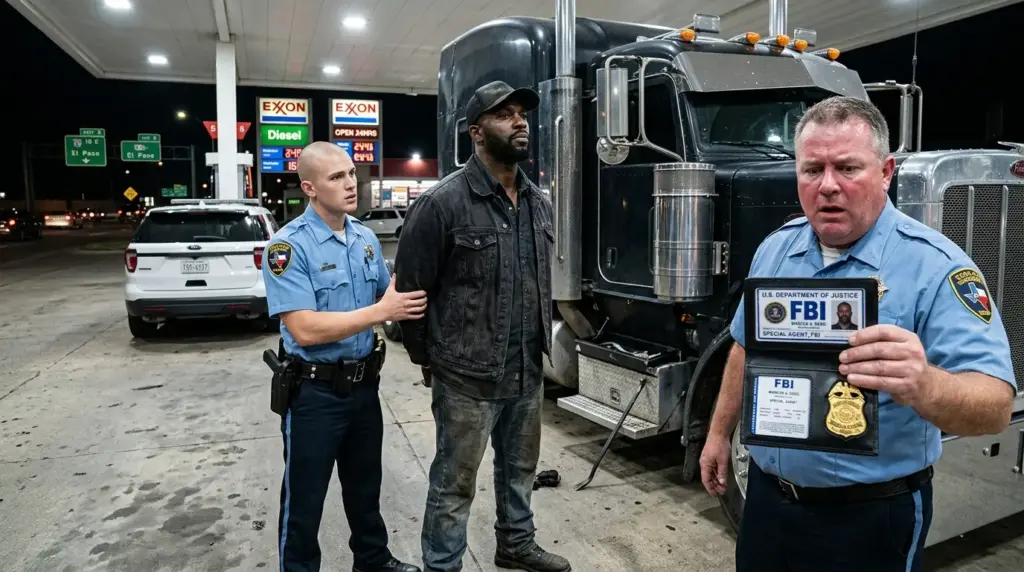
“You know there’s nothing in that truck,” Marcus said quietly.
“Hands on the hood!” Callow barked, drawing his weapon halfway from its holster.
Marcus turned and placed his hands flat on the wet, warm hood of the Durango. Callow moved in behind him, kicking his feet apart with a sharp boot to Marcus’s ankles. He patted down Marcus’s thick jacket, sliding his hands expertly down his waistband, his pockets, and into his vest.
His fingers caught on the heavy lump in Marcus’s inner pocket.
Callow pulled out the thick canvas pouch Voss had packed an hour earlier. He unzipped it. Inside, wrapped in clear plastic, were four stacks of hundred-dollar bills. Twenty thousand dollars in cold, crisp cash.
Callow’s breath hitched slightly—a tiny, involuntary sound of satisfaction.
“Well, well,” Callow whispered, stepping back so Marcus couldn’t turn on him. “Look what we have here. Unreported currency in excess of ten thousand dollars crossing parish lines during a commercial transport.”
“That’s my repair money,” Marcus said, turning his head slightly. “I’m an independent contractor. I pay for my own fuel, my own tires, and my own repairs. You can’t take that.”
“I’m not taking it, driver,” Callow said, his voice dropping into a smooth, icy purr. “The State of Louisiana is seizing it as suspected proceeds of illegal narcotics trafficking.”
“I don’t deal drugs!”
“The dog says otherwise,” Callow said, stuffing the canvas pouch into his tactical vest pocket. “Now, you got two choices here, driver. Choice number one: I arrest you right now for felony speed evasion, reckless endangerment, and transport of illicit funds. You go to the parish jail in Mansfield. Bail is fifty grand cash. You sit there till your trial date in November. Your truck goes to the impound yard—impound fees are five hundred bucks a day. By the time you get out, your rig is sold at auction to pay the storage fees.”
Marcus let out a slow, heavy breath. “What’s choice number two?”
Callow leaned in close, his voice barely audible over the drumming rain. “Choice number two: You sign a voluntary asset abandonment waiver. You acknowledge that the currency seized was not yours, that you have no claim to it, and you walk away. I write you a warning for the speed, you get back in your tractor, and you get the hell out of my state. You got three minutes to decide.”
Inside the sleeper berth of the Peterbilt, hidden behind sound-dampening insulation and dark glass, Adrian Voss was watching the entire exchange on three synchronized monitors.
The lapel microphone hidden in Marcus’s collar was picking up every word—crystal clear, uncompressed 24-bit audio. The micro-camera embedded in the truck’s side mirror had recorded the handler pulling the Malinois directly to the door without allowing it to perform a sweep. And the secondary camera in the cab had captured Callow sliding the twenty thousand dollars directly into his vest, rather than placing it in an official evidence bag.
“Vanessa,” Voss said into his headset, his fingers flying across his keyboard. “Did you get that?”
Five hundred miles away, in a windowless basement office in the Department of Justice building in Washington, D.C., Vanessa Vance pushed her glasses up her nose and adjusted her headset. Her screens were glowing with live telemetry, asset databases, and high-resolution satellite imagery provided by a federal liaison office.
“Got it, Adrian,” Vanessa said, her voice sharp and icy. “The audio is clear. The demand for a voluntary waiver under duress constitutes extortion under the Hobbs Act. But we need Boudreaux. Callow is just the hound dog. If we hit Callow now, Boudreaux claims it’s a rogue officer, burns the paper, and walks away.”
“Marcus can’hold out much longer,” Voss said, watching the monitor. Callow was holding a yellow clipboard out to Marcus in the rain. “If Marcus signs that waiver, Callow might let him go, but we lose the immediate link to the Sheriff’s personal bank accounts.”
“Look at the ledger Callow’s using,” Vanessa said, zooming in on the feed from Marcus’s mirror-cam. “That’s not a state form. That’s a pre-numbered receipt book from a local printer in Shreveport. Look at the bottom right corner—the printing house code.”
Voss zoomed his screen. “P-R-N-T-3-1-8.”
“Cross-referencing,” Vanessa muttered. Within three seconds, a database flashed yellow on her screen. “Got it. That printer is owned by Boudreaux Holdings LLC. The Sheriff isn’t just taking a cut; he’s running the paper through his own private printing shop to bypass the state auditor’s serial registry. Every dollar seized on 171 is being logged on off-the-books receipts.”
“Marcus,” Voss spoke softly into the driver’s earpiece. “Push him. Tell him you want to speak to the Sheriff before you sign.”
Outside in the storm, Marcus wiped rain from his eyes and looked at the yellow paper Callow was shoving into his hands.
“I’m not signing this,” Marcus said.
Callow’s face hardened. “Excuse me?”
“I said I’m not signing it,” Marcus repeated, standing up straight and stepping away from the Durango. “I want to speak to your supervisor. I want the Sheriff down here.”
Callow sneered. “The Sheriff doesn’t come out to the highway for a haul-driver with a bag full of dirty cash.”
“Then take me to him,” Marcus said, his voice ringing out over the sound of the idling diesel. “You want this money? You take me to the man who signs your paycheck. Because if I’m losing twenty thousand dollars today, I’m going to look the man who’s stealing it in the eyes.”
Callow stared at Marcus for four long seconds. His hand flexed on his thigh. For a moment, it looked as though he might draw his weapon and end the argument right there on the muddy shoulder of Highway 171. But the sheer size of the trucker, combined with the calm, terrifying certainty in his voice, gave Callow pause.
Callow pulled a small tactical radio from his shoulder strap and clicked the transmitter. “Base, this is Unit Four.”





