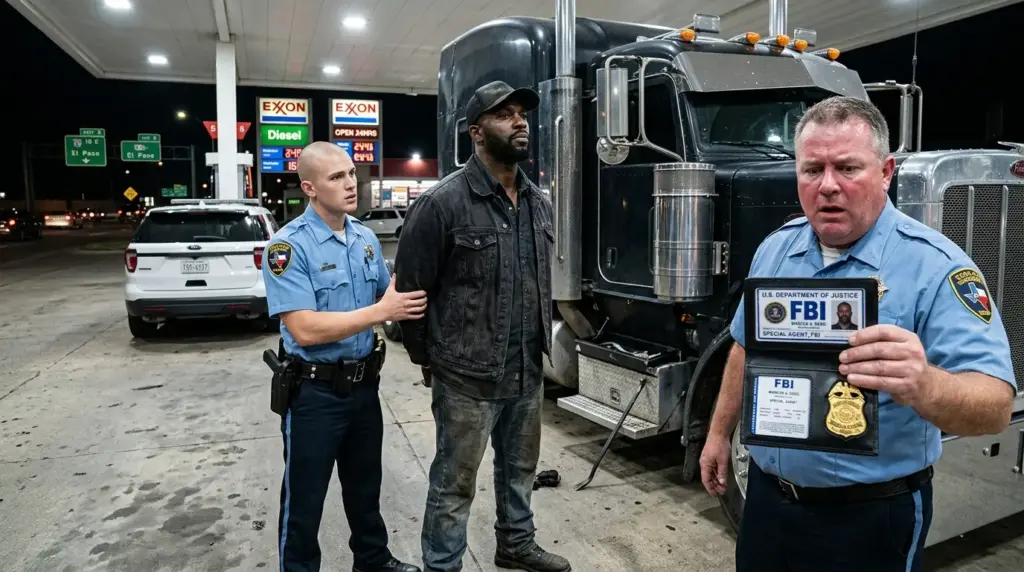
“Go ahead, Four,” a crackling voice replied through the speaker.
“Got a refusal on a 10-92 stop at marker fourteen. Driver’s demanding a face-to-face with the High Sheriff before he executes the paperwork.”
A pause on the radio line. Rain hissed against the warm hood of the police car.
“Bring him to the barn,” the voice replied. It wasn’t a dispatcher. It was a slow, deep, gravelly voice that sounded like river stones grinding together. “Bring the rig too. Miller can drive it.”
“Negative on that,” Callow said into the radio, looking at Marcus. “Driver says the refrigeration unit’s failing. Load’s perishable.”
“I don’t give a damn about his chickens,” Sheriff Boudreaux’s voice boomed back through the speaker. “Bring the driver in the back of Four. Leave the rig on the shoulder with Miller until the transport truck gets here to offload it.”
Callow clicked his radio off. He pulled a set of steel cuffs from his belt. “Turn around, big man.”
Marcus looked at the sleeper windows of his truck. He knew Voss was listening. He knew what leaving the rig behind meant—it meant leaving Voss inside an empty trailer on a dark stretch of highway with a nervous junior deputy standing guard outside.
“Do it, Marcus,” Voss whispered in his ear. “Go with him. I’ll handle Miller.”
Marcus slowly turned around and placed his hands behind his back.
“The Barn” was not a police station.
It was a sprawling, gated compound four miles off the main highway, hidden behind a half-mile driveway lined with towering live oaks draped in spanish moss. The main building was a converted antebellum estate with wraparound porches and white columns, but behind it sat three massive, corrugated-metal pole barns surrounded by an eight-foot chain-link fence topped with razor wire.
As Callow pulled the Durango through the heavy automatic gate, Marcus looked out the rear tinted window.
Inside the compound were dozens of vehicles: high-end sports cars, late-model pickup trucks, speedboats on trailers, and four full-sized commercial tractor-trailers, their logos painted over with rough black primer.
This was the final resting place of every high-value asset seized in De Soto Parish over the last decade.
Callow parked the Durango in front of the main barn. He pulled Marcus out of the back seat by his arm and marched him through a side door into a brightly lit, air-conditioned office that smelled expensive—leather chairs, cedar wood, and premium cigar smoke.
Behind a massive oak desk sat Sheriff Thomas “Tomahawk” Boudreaux.
He was a man in his late sixties, with a thick mane of silver hair swept back from his forehead and a face that looked like tanned leather. He wore a crisp khaki uniform with gold star embroidery on the collar, a massive silver belt buckle shaped like the state of Louisiana, and a gold Rolex on his left wrist.
He didn’t look up when Marcus was brought in. He was using a silver pen to sign a stack of legal documents resting on his desk.
“Uncuff him, Ray,” Boudreaux said softly, without looking up.
Callow hesitated. “Sheriff, he’s a big one. He’s—”
“I said uncuff him,” Boudreaux repeated. His voice had the smooth, deceptive calm of a swamp alligator slipping beneath the water.
Callow clicked the key into the cuffs and pulled them off. Marcus rubbed his thick wrists, his eyes scanning the room. High-resolution security monitors hung on the wall behind Boudreaux’s desk, showing live feeds of the compound gates, the perimeter fence, and the main highway.
“Sit down, driver,” Boudreaux said, gesturing with his silver pen to a heavy leather chair across from him.
Marcus didn’t sit. He stood in the center of the Persian rug, his boots dropping wet mud onto the deep red fibers.
“I prefer to stand,” Marcus said.
Boudreaux finally looked up. His eyes were pale blue, cold, and entirely devoid of heat. He laid the pen down on the desk with a soft click.
“You’ve got a lot of nerve for a guy whose life is currently sitting in the palm of my hand,” Boudreaux said. He leaned back in his chair and picked up a crystal tumbler filled with amber whiskey. “Deputy Callow tells me you were carrying twenty thousand dollars in unregistered cash. He tells me you were evasive. He tells me your dog-alert was positive.”
“The dog was trained to sit on command,” Marcus said flatly. “And the cash is legitimate. I have the bank withdrawal receipts in my truck.”
Boudreaux chuckled—a low, dry sound. “Receipts can be fabricated, son. In this parish, cash found in proximity to a commercial vehicle operating on an unauthorized detour is presumed to be the proceeds of racketeering. That’s not my law. That’s state law.”
“It’s extortion,” Marcus said. “You run a speed trap with a hidden sign, you use a fake alert to seize cash, and you force drivers to sign waivers so they can’t contest it in court.”
Boudreaux’s smile faded. He set the glass down. The room became very quiet, save for the hum of the air conditioner.
“Let me explain something to you, trucker,” Boudreaux said, leaning forward and resting his elbows on the desk. “Look around you. You see this desk? This desk belonged to a governor. You see this building? This building was built before your grandfather was born. Do you know how I’ve stayed Sheriff of this parish for twenty-two years?”
“By buying judges,” Marcus said.
“By keeping my parish safe,” Boudreaux corrected him sternly. “The state doesn’t give us money for roads. The federal government doesn’t give us money for equipment. But every day, hundreds of thousands of dollars in dirty money, haul-money, and tax-evading corporate slush passes right by my front door on I-20. I take a small percentage. In exchange, my taxpayers don’t pay county property tax. My schools have brand-new football fields. My deputies have modern gear. I am the tax collector, the judge, and the provider for twenty-four thousand people.”





