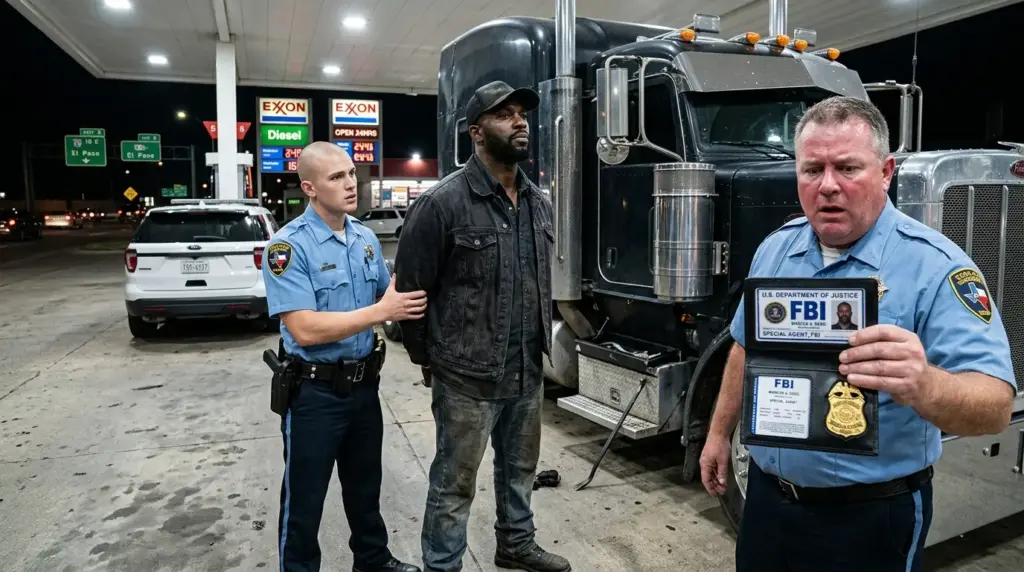
“Copy that,” Voss’s voice came through the earpiece, crisp and low. “That’s Unit Four. Deputy Ray Callow. Former Army MP, discharged after an ‘incident’ in Kandahar. He’s Boudreaux’s primary collector.”
Marcus didn’t slam the brakes. To slam the brakes on an eighty-thousand-pound rig on a wet road meant skidding the trailer across both lanes. Instead, he let the engine brake whine—brrrr-AP-AP-AP-AP—gradually shedding speed, but by the time he cleared the white sign, the Peterbilt was still doing fifty-two miles an hour.
The Durango’s roof lights burst to life—not standard blue and red, but an intense, blinding array of white strobes and deep violet LEDs designed to disorient the driver in the mirrors.
Marcus pulled the heavy rig onto the narrow muddy shoulder, the right-side tires churning through black Louisiana clay. He pulled the yellow parking brake button with a loud, sharp hiss of air: CHHHHH-TSK.
He didn’t open his door. He sat still, both hands placed flat on the top of the chrome steering wheel where they could be clearly seen through the rain-streaked side glass.
In the side mirror, the driver’s door of the Durango opened. A tall, broad-shouldered man in a tan uniform step out into the rain. He didn’t wear a traditional campaign hat; he wore a black tactical cap pulled low, a heavy vest strapped across his chest, and a sidearm holstered on his thigh in a low-slung kydex rig. He moved with the slow, arrogant confidence of a man who owned the county, the road, and every breathing thing on it.
He didn’t approach the cab directly. He walked the length of the trailer first, running a gloved hand along the aluminum skin, checking the latches, feeling the weight.
“He’s checking the suspension,” Marcus whispered. “He knows it’s light.”
“Hold steady,” Voss whispered back from the sleeper. “Audio is recording. Video from the mirror-cams is feeding live to Vanessa’s team.”
The officer reached the driver’s side door. He didn’t tap on the glass with his knuckles; he used the heavy brass butt of a Maglite flashlight, striking the frame with three sharp, metallic clangs.
Marcus rolled down the window two inches. The smell of wet wool, tobacco, and rain filled the cab.
“License, registration, and bill of lading,” Deputy Callow said. His voice was flat, gravelly, devoid of any polite preamble. His eyes were small and hard behind rain-spotted sunglasses, despite the heavy overcast.
“Afternoon, Deputy,” Marcus said smoothly, his voice dropping into the slow, thick drawl of an old-timer who’d spent thirty years behind the wheel. He reached slowly for the vinyl binder resting on the dash. “Rain’s coming down pretty hard back there. Didn’t see the speed drop until I was right on top of it.”
“Sign’s been there five years, driver,” Callow said, taking the papers without looking at Marcus. He flipped through the bill of lading. “Frozen poultry. Out of Fort Worth, headed for Atlanta. You’re a long way off Interstate 20, aren’t you?”
“Construction outside Monroe,” Marcus lied cleanly. “GPS pulled me down through 171 to bypass the backup.”
Callow smiled then, but his eyes didn’t move. It was a cold, practiced motion of the lips. “GPS. Yeah. You guys always blame the satellite.” He shone his flashlight directly into Marcus’s eyes, holding the beam there long enough to test his reaction. Marcus didn’t blink or turn away; he just squinted slightly, staring straight ahead through the windshield.
“Step out of the vehicle, driver.”
“Problem with the paper, Deputy?”
“I said step out of the vehicle,” Callow repeated, his hand dropping casually to rest on the grip of his Glock. “Now.”
Marcus unbuckled his belt and swung his long legs out of the cab. As his heavy boots hit the mud, he felt the cold rain immediately soak through his flannel shirt. He stood six-foot-two, his broad shoulders slightly stooped from millions of miles behind the wheel, but he loomed over the deputy by three inches.
Callow didn’t flinch. He backed up two steps, keeping his hand on his sidearm. “Walk back to the cruiser.”
“What’s this about, Deputy?”
“You’re driving an unregistered commercial haul on a state secondary route with improper permits,” Callow said, walking alongside Marcus while keeping his body angled away. “And your trailer axle weight looks uneven. We got reason to suspect you’re carrying undeclared cargo.”
“It’s chickens, man. Forty thousand pounds of frozen chicken,” Marcus said, letting a touch of frustration bleed into his voice.
They reached the front of the Durango. A second officer had stepped out of the passenger side—younger, nervous, holding a short-barreled shotgun at his waist. His nametag read K. MILLER.
“Miller, run his driver’s license,” Callow ordered. “And get K-9 out here.”
“Deputy,” Marcus said, stepping closer to the hood of the patrol car. “I’m on a tight schedule. The refrigeration unit on that trailer has a bad compressor. If I sit here for two hours, that load spoils and my company docks my entire run.”
Callow stepped into Marcus’s personal space. “You don’t have a schedule anymore, driver. You’re in De Soto Parish. Our schedule is the only one that matters.”
From the back of the Durango, a Belgian Malinois began to bark—a high, frantic, rhythmic yelp. Miller opened the rear hatch and pulled the dog out on a short lead. The dog didn’t circle the truck. It didn’t sniff the tires. It walked straight up to the driver’s side door of the Peterbilt, jumped twice against the running board, and sat down, looking directly back at Callow.
It was a completely manufactured alert. The dog hadn’t even smelled the air under the cab.
“Alert,” Callow said instantly, a small, triumphant grin twitching at the corner of his mouth. “That gives us probable cause under Louisiana Revised Statute 40:966. Step against the vehicle and put your hands on the hood.”
Marcus didn’t move right away. He looked at the dog, then at Miller, who looked away, unable to meet his eyes.





