“And what about the innocent drivers you ruin?” Marcus asked. “The guys who lose their trucks, their businesses, their homes because you stole their operational capital?”
Boudreaux stood up. He walked over to the window looking out into the compound. “Collateral damage. The road takes its toll. You pay it, or you don’t drive on my road.” He turned back to Marcus. “Now. You’re going to sign the waiver. Ray is going to take you back to your truck. You’re going to drive to the state line, and you’re never going to set foot in De Soto Parish again.”
“And if I refuse?”
Boudreaux walked back to his desk. He reached into a drawer and pulled out a clean sheet of paper. He slid it across the desk along with his silver pen.
“If you refuse,” Boudreaux said softly, “Deputy Callow is going to find ten kilos of high-purity methamphetamine hidden inside the sleeper berth of your Peterbilt. You will be charged under federal drug trafficking statutes. You will be held without bail in the regional detention center. By the time your public defender gets around to looking at your file, you’ll have served two years just waiting for a motion hearing.”
Boudreaux looked at his gold watch. “You have sixty seconds.”
Marcus looked down at the silver pen lying on the dark wood.
Then he looked at the security monitor behind Boudreaux’s head.
On the screen showing the section of Highway 171 where his truck was parked, something was happening.
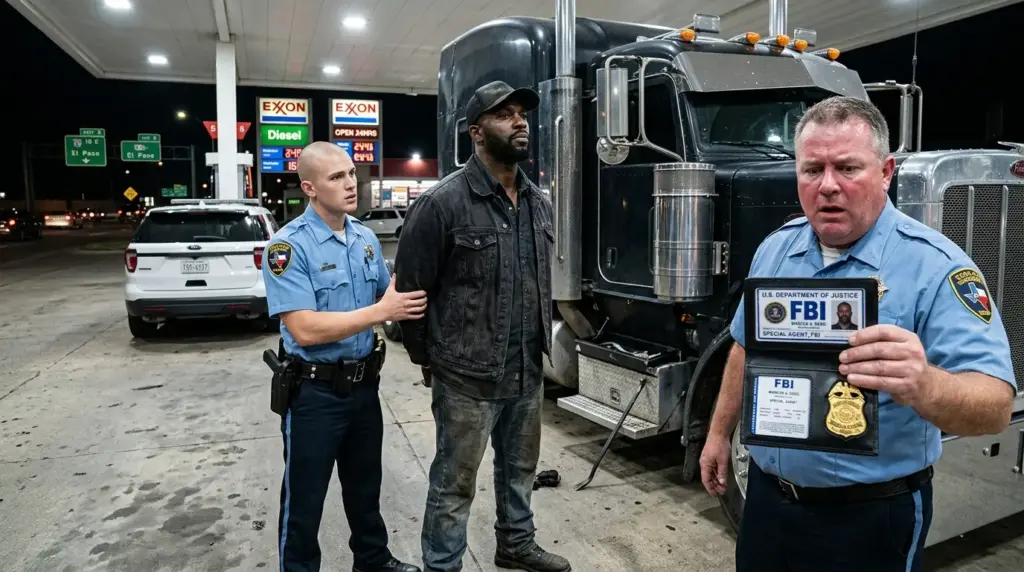
Deputy Miller was standing near his cruiser, holding his slicker over his head to block the rain. Behind the Peterbilt, a dark grey SUV pulled up—not a police car, but a heavy Ford Excursion with blacked-out windows.
Two men in plain clothes stepped out. They didn’t talk to Miller. One of them handed Miller a white envelope. Miller looked at it, looked around at the empty highway, and quickly slipped the envelope into his coat. Then he got into his patrol car, turned off his lights, and drove away, leaving the Peterbilt sitting on the shoulder with the grey Excursion.
Boudreaux noticed Marcus staring at the screen. He turned his head, squinting at the monitor.
“What the hell is Miller doing?” Boudreaux muttered, picking up his radio. “Miller! Unit Seven, report!”
Silence on the radio.
Then, the center monitor on Boudreaux’s wall—the one displaying the compound’s main gate—flickered. The live feed vanished, replaced by a dark blue background with a silver logo: UNITED STATES DEPARTMENT OF JUSTICE – OFFICE OF THE INSPECTOR GENERAL.
Boudreaux froze. His face drained of color.
A voice came over the speaker system in the office—not the crackling radio voice, but a clear, perfectly balanced digital stream.
“Good evening, Sheriff Boudreaux,” Vanessa Vance’s voice filled the room. “This is Special Assistant United States Attorney Vance. I am currently monitoring this conversation alongside District Judge Robert Mercer of the Western District of Louisiana.”
Callow reached instantly for his gun.
“I wouldn’t do that, Deputy Callow,” Marcus said quietly. He didn’t move toward Callow; he just stood there, his shadow falling long across the desk. “There are sixteen federal marshals currently entering your compound.”
“You’re lying!” Callow spat, drawing his Glock.
Before he could raise the barrel, the main double doors of the office were blown off their hinges with a deafening CONCUSSION BOOM.
A wave of pressure slammed through the room, shattering the glass in the windows and knocking Callow off his feet. Flashbang smoke—thick, grey, and smelling of sulfur—rolled into the office.
“FEDERAL AGENTS! DOWN ON THE GROUND! DOWN ON THE GROUND!”
Screaming voices filled the hallway. High-intensity weapon lights cut through the thick smoke, pinpointing Callow as he scrambled on the floor. Three tactical officers in dark blue vests bearing the letters FBI / US MARSHAL swarmed over him, disarming him and pinning his face into the rug.
Sheriff Boudreaux didn’t run. He backed up until his spine hit the wall behind his desk, his hands raised slowly into the air, his silver hair wild, his eyes wide with disbelief.
Through the shattered doorway walked Adrian Voss. He was wearing a heavy dark raincoat over his suit, his hair wet from the storm, holding an encrypted laptop in his left hand. Behind him came two senior FBI tactical team leaders with rifles raised.
Voss walked straight up to Boudreaux’s desk. He picked up the silver pen Marcus had refused to touch.
“Sheriff Boudreaux,” Voss said smoothly, stepping over the writhing form of Deputy Callow on the floor. “As of six minutes ago, a federal grand jury in Shreveport issued a forty-two-count indictment charging you, Deputy Callow, and nine other members of your department with Conspiracy to Commit Extortion under the Hobbs Act, Civil Rights Violations under Title 18, and Money Laundering.”
“This… this is my jurisdiction!” Boudreaux stammered, his voice trembling, all his cold authority evaporated. “You can’t do this! The state governor—”
“The governor was briefed two hours ago,” Voss interrupted. “He signed the executive order suspending your authority thirty minutes ago. Louisiana State Police units are currently taking over your dispatch center in Mansfield.”
Voss turned to Marcus. “You okay, driver?”
Marcus straightened his grease-stained baseball cap and wiped a smear of mud from his sleeve. “I’m fine, Adrian. How’s the truck?”
“Miller tried to sell the load to Boudreaux’s private liquidation crew,” Voss smiled faintly. “Federal agents intercepted them five minutes ago. Your Peterbilt is sitting outside right now, running fine.”
By dawn, the storm had passed.
The sky over De Soto Parish was a brilliant, washed-out blue, cold and clear. The compound that had served as Sheriff Boudreaux’s personal kingdom for two decades was now choked with federal vehicles, mobile command centers, and flatbed tow trucks hauling away dozens of seized luxury cars.
Marcus sat on the open tailgate of his trailer, drinking black coffee from a foam cup.





