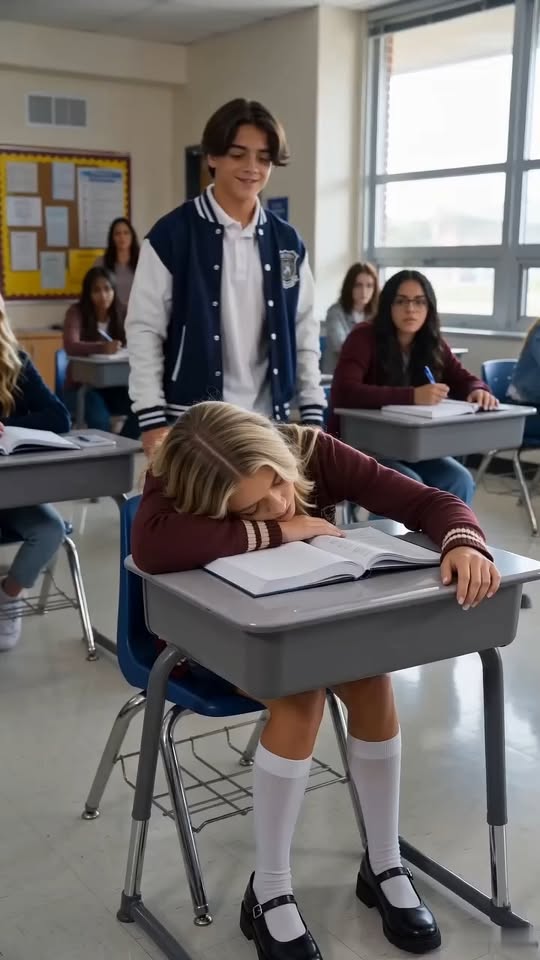
Perhaps it was because Detective Morales had been a rookie patrol officer on the riverbank six years ago when Rachel Bennett’s car was winched out of the current. Perhaps it was because, by 2:30 PM, Hannah Chen had already texted two classmates about what happened in Room 204, and Mason Miller—terrified when he saw two black-and-white cruisers pull onto the front lawn with their strobes flashing—had walked straight down to the lobby and voluntarily handed his phone over to the first deputy he saw so he wouldn’t be charged as an accomplice.
By three o’clock, the main office had been cleared of student aides.
Inside Conference Room A, Ethan Mercer sat slumped in a plastic chair beside his mother, Diana Mercer, who had arrived twenty minutes earlier in her white Range Rover smelling of tennis-club sunscreen and indignation, only to watch Detective Morales serve an immediate judicial preservation order for Ethan’s iPhone right out of Arthur Calder’s desk drawer.
Ethan wasn’t smiling anymore. His varsity jacket was bunched around his shoulders like an oversized shell, his fingernails picking endlessly at a loose thread on his knee while Detective Morales laid three printed screenshots from Mason’s video and a preliminary extraction log on the laminate table between us.
“I want an attorney if you’re going to keep badgering him like a criminal,” Diana Mercer said sharply, resting a manicured hand on Ethan’s arm, though her voice had lost half its certainty over the last twenty minutes. “He’s seventeen. Two kids jostled over a chair in study hall. Why is a county detective asking about text messages?“
“Because Mason Miller’s phone started recording forty-five seconds before Ethan walked down the aisle toward Clara’s desk, Mrs. Mercer,” Detective Morales said evenly. She was a compact woman in her forties with sharp dark eyes and her hair pulled back in a tight knot that looked like it hadn’t moved since dawn. “And because even though someone deleted the primary message thread on Ethan’s phone at 2:09 PM inside Mr. Calder’s office, our mobile reader just pulled the cached notification logs directly out of the operating system’s memory buffer.“
Morales slid a single sheet of printer paper across the table toward Ethan.
“Four messages between 1:15 PM and 1:47 PM from an encrypted burner relay,” Morales read aloud, her eyes pinned to Ethan’s pale face. “Wait until she’s asleep or distracted. Public setting preferred. Do not seriously injure her. Provoke, document, report. And then: If Bennett reacts like her mother, call me immediately. Who is on the other end of that relay, Ethan?”
Ethan stared fixedly at a water stain on the carpet. “I don’t know.”
“You don’t know who was texting your personal cell phone?“
“It was an anonymous account on Telegram,” Ethan mumbled, his voice barely audible. “They messaged me six weeks ago. Said they were doing some kind of behavioral prank blog on kids from the class of ’27. It was supposed to be a joke.“
“What’s the punchline, son?” Dad asked from the chair beside mine. He hadn’t taken off his welding jacket, and his arms were folded across his chest like two iron bars. “Throwing a hundred-and-ten-pound girl onto a tile floor while she’s sleeping? Explain to me what part of that was funny.“
Ethan flinched, his shoulders hunching higher.
what struck me sitting across from him—watching the sweat bead along his upper lip—was that Ethan didn’t look like a boy trying to cover his own tracks to stay on the lacrosse team. He looked like a boy who had stepped into water he thought was ankle-deep, realized there was something massive moving beneath the surface, and was now terrified to point at it.
“Why did the sender ask if Clara reacted like her mother, Ethan?” Detective Morales pressed, leaning both palms on the table.
For a fraction of a second—so fast that anyone who wasn’t watching his eyes would have missed it—Ethan’s gaze flicked through the interior glass partition of the conference room toward the hallway where Vice Principal Arthur Calder was standing beside the water cooler with his arms crossed.
Detective Morales caught the glance. Dad caught it. And so did I.
Outside in the hall, Arthur Calder realized all four of us were looking straight through the glass at him.
A subtle, chilling transformation passed over the vice principal’s face. The warm, concerned educator vanished like a mask slipping off a hook, leaving behind something remarkably still, cold, and calculating. He walked to the conference room door, pushed it open without knocking, and stepped inside.
“Detective, I’m going to have to step in here as the building administrator,” Calder said, his voice smooth and measured as he folded his hands over his gray cardigan. “This questioning is becoming entirely inappropriate.”
Detective Morales didn’t take her eyes off him. “In what way, Mr. Calder?”
“Both of these students are minors, and you are pursuing speculative questions about family history inside an educational facility without a clear predicate offense,” Calder said calmly. “You are pressuring Mr. Mercer without understanding the broader institutional context.”
Morales straightened up slowly, her hand resting beside her badge clip. “Then by all means, Mr. Calder—grab a chair and explain the institutional context of why an encrypted number texted your student about Rachel Bennett five minutes before you deleted the thread off his phone.“
Silence dropped over the room like a lead curtain.
Calder didn’t sit down. His eyes moved once to me—a strange, lingering look behind his silver-rimmed glasses that made my skin crawl with the sudden certainty that he wasn’t seeing a frightened junior; he was cataloging my heart rate, my posture, the way my left hand protected my bruised elbow—and then he looked back at Morales.
“I touched Ethan’s phone only to turn off the ringer during a disciplinary intake,” Calder said smoothly. “If you have further questions for me, Detective, you may direct them through the school district’s legal counsel.“





