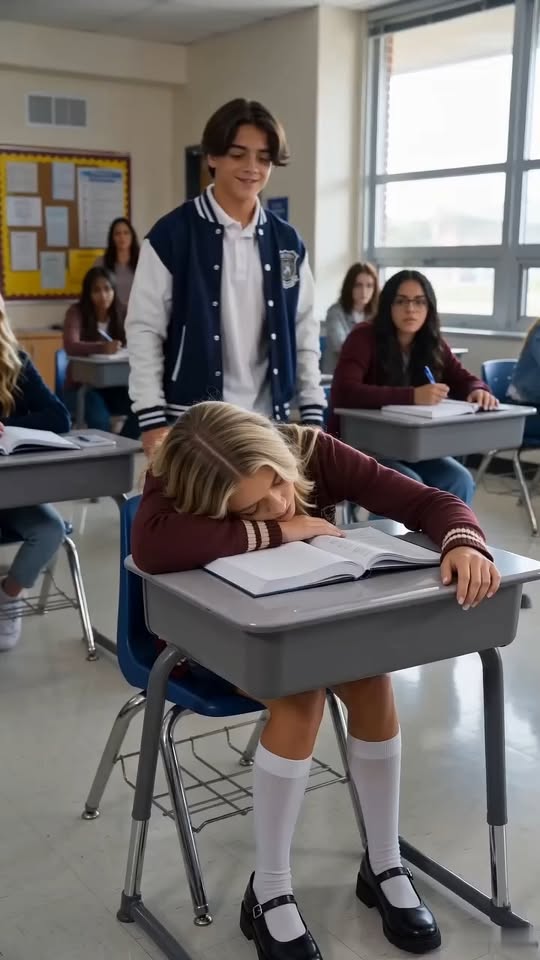
Someone wanted to know whether I would fight back.
And apparently the answer mattered enough that somebody was waiting for a report in real time.
My father was the first person I called.
Technically, he was my uncle.
My mother’s older brother, Daniel Bennett, had become my legal guardian after she died.
I had called him Dad since I was twelve because that was what he became in every way that mattered.
He arrived at the school twenty-seven minutes later.
I know because I watched the clock.
He entered the main office still wearing his work jacket.
“What happened?”
I showed him the bruise beginning to form near my elbow.
His jaw tightened.
Then I told him about the messages.
Every word.
DID SHE FIGHT BACK?
WE NEED VIDEO OF THE RESPONSE.
IF BENNETT REACTS LIKE HER MOTHER, CALL ME IMMEDIATELY.
His expression changed at the third message.
I saw it.
“What?”
“Nothing.”
“That wasn’t nothing.”
He looked toward the receptionist.
“Where’s the vice principal?”
She pointed down the hall.
Mr. Calder’s office door was closed.
Ethan and his mother were apparently inside.
Dad walked toward it.
The receptionist stood quickly.
“Sir, you’ll need to wait.”
He stopped.
Not because she told him to.
Because through the narrow glass beside the door, we could see Mr. Calder.
He was standing behind his desk.
Ethan sat across from him.
Mr. Calder was not angry.
He was leaning toward Ethan.
Speaking quietly.
Urgently.
Then Ethan handed him the phone.
Dad saw it too.
He looked at me.
“What exactly did the message say?”
I repeated it.
This time he did not pretend it meant nothing.
He pulled out his own phone.
“Who are you calling?”
“The police.”
The receptionist looked alarmed.
“That’s not necessary. The school is handling—”
Dad turned.
“A student was physically assaulted because somebody instructed another student to test her response.”
The woman stopped talking.
Then he added, “And the message referenced her dead mother.”
That got attention.
Everything after that moved quickly.
Faster than schools usually move.
Maybe because Dad called directly.
Maybe because another parent had already called about the fight.
Maybe because students had recorded part of it.
Within an hour, two officers were at the school.
Ethan’s phone became evidence.
He stopped laughing completely.
His mother kept asking what kind of trouble he was in.
Ethan would not answer.
The strange part was that he did not look like a boy protecting himself.
He looked like a boy protecting someone else.
One officer asked him who had sent the messages.
Ethan said he did not know.
Then they asked why the sender had asked whether I fought back.
He said it was a joke.
They asked what was funny.
He stopped talking.
Then they asked why my mother was mentioned.
That was when Ethan looked toward Mr. Calder.
Only for a second.
The officer saw it.
So did Dad.
And so did I.
Mr. Calder noticed too.
His face changed.
He folded his arms.
“This is becoming inappropriate.”
One officer turned toward him.
“How?”
“These are minors.”
“We know.”
“You’re questioning him without understanding the context.”
The officer looked at Ethan.
“Then perhaps you can provide the context.”
Mr. Calder did not.
That was the beginning.
At first, I expected the investigation to stay focused on Ethan.
Maybe some cruel online challenge.
Maybe somebody who knew my family.
Maybe some sick attempt to provoke me because of something my mother had done years earlier.
I had questions about her.
Every child who loses a parent young has questions.
My mother, Rachel Bennett, died when I was eleven.
I was told it was an accident.
There had been a car crash outside the county.
Late at night.
Rain.
She died before I reached the hospital.
At least, that was the version I knew.
I remembered pieces of her.
Her perfume.
The old song she played while cleaning.
How she always checked windows twice before bed.
How she hated people standing behind her.
That detail returned to me later.
At the time, it meant nothing.
The police asked Dad about her.
He became guarded.
“What does Rachel have to do with a high school assault?”
“We don’t know yet.”
“Then why ask?”
“Because the message did.”
Dad rubbed his forehead.
He looked tired.
More than tired.
Afraid.
I had never seen him afraid when talking about my mother.
Sad, yes.
Angry sometimes.
But not afraid.
“What are you not telling me?” I asked.
He looked at me.
“Nothing you need to worry about.”
I almost laughed.
That sounded exactly like something adults say shortly before a child learns she should have been worried years ago.
The police examined Ethan’s messages.
They found more instructions.
Not many.
Most had been deleted.
But enough remained to show that the classroom incident had been planned.
A message from earlier that morning said:
WAIT UNTIL SHE’S ASLEEP OR DISTRACTED.
Another:
PUBLIC SETTING PREFERRED.
Another:
DO NOT SERIOUSLY INJURE HER.
And another:
PROVOKE. DOCUMENT. REPORT.
Ethan had been told to trigger a response.
He had chosen the shove.
He later admitted that much.
He claimed he did not know why.
He said someone had contacted him weeks earlier through an account he believed belonged to a former student.
At first, they paid him to report small things.
Whether I got angry during arguments.
Whether I flinched when someone shouted near me.
Whether I avoided physical confrontation.
Then the requests became more specific.
They wanted video.
Reaction.
Stress response.
My skin crawled listening to it.
I asked him why he agreed.
He looked down.
“Money.”
“How much?”
He did not answer.
Dad did.
“Enough to make a stupid kid think it was harmless.”
I turned on him.
“Stop defending him.”
“I’m not.”
“You sound like it.”
Ethan whispered, “I didn’t think anyone was going to get hurt.”
I looked at my bruised elbow.
Then at him.
“You threw me out of a chair.”
He had no answer.





