Adult language for there is something terrible here and we are not ready to tell you all of it.
I looked at the folder.
“Then tell me what you do know.”
The investigator folded her hands.
“Your mother’s name appears throughout the older records.”
I waited.
“So does yours.”
I had expected that.
Then she continued.
“There are references to another child.”
I stopped breathing.
Dad made a sound beside me.
Barely audible.
But I heard it.
I turned.
He was staring at the folder.
Not confused.
Destroyed.
“What child?”
Nobody answered immediately.
I looked at Dad.
“What child?”
His eyes filled.
I had seen him cry at my mother’s funeral.
I had seen him cry when his own father died.
But this was different.
This looked like recognition.
I stood.
“You knew.”
He shook his head.
“Not this.”
“What does that mean?”
“I knew there were things Rachel never explained.”
“That is not an answer.”
The investigator interrupted gently.
“The records indicate your mother gave birth before the period covered by most of the documents we already reviewed.”
I stared at her.
“That’s impossible.”
She said nothing.
“My mother only had me.”
Dad covered his face with one hand.
I turned toward him.
“You told me that.”
He lowered his hand.
“I believed that.”
The investigator opened the folder.
Not enough for me to see the contents.
Just enough to remove one photocopied page.
She placed it face down.
“There is documentation suggesting another child existed.”
“Suggesting?”
“Birth-related records. Medical references. Later observation logs.”
My knees felt weak.
“A brother or sister?”
She looked at me.
“A boy.”
The room became very quiet.
“How old?”
“We’re still confirming identity.”
I heard my own voice change.
“Is he dead?”
The investigator did not answer quickly enough.
That terrified me.
Then she said, “We have no evidence that he is dead.”
Dad looked up sharply.
I gripped the edge of the table.
My mother had been dead for six years.
I had spent those six years believing the greatest unanswered question in my life was why somebody wanted to know whether I reacted like her under attack.
Now police were telling me she had another child.
A son.
A child nobody had ever mentioned.
And somewhere inside records hidden beneath an old athletic wing were documents connecting him to the same study that had followed me since I was six years old.
I looked at the investigator.
“Where is he?”
She turned the photocopied page over.
Most of it had been redacted for the active investigation.
But one line remained visible.
STATUS: ACTIVE.
I stared at the word.
Then at Dad.
Then back at the investigator.
“What does active mean?”
She closed the folder.
“We’re trying to determine that now.”
Outside the office, school continued.
A bell rang.
Lockers slammed.
Students changed classes.
The ordinary building kept moving around us as if nothing underneath it had changed.
But everything had.
Ethan had not shoved me because he hated me.
He had been instructed to test me.
Mr. Calder had not simply kept inappropriate school records.
Someone had documented my reactions since childhood.
The messages had not mentioned my mother accidentally.
She had apparently been part of the same pattern.
And the words second generation no longer looked like abstract research language.
They looked like a family tree.
One that included someone I had never known existed.
A brother.
The radiator beside the third-row window hissed with a wet, rhythmic rattle, pumping dry October heat against the side of my face until the words in my AP European History textbook blurred into gray ribbons.
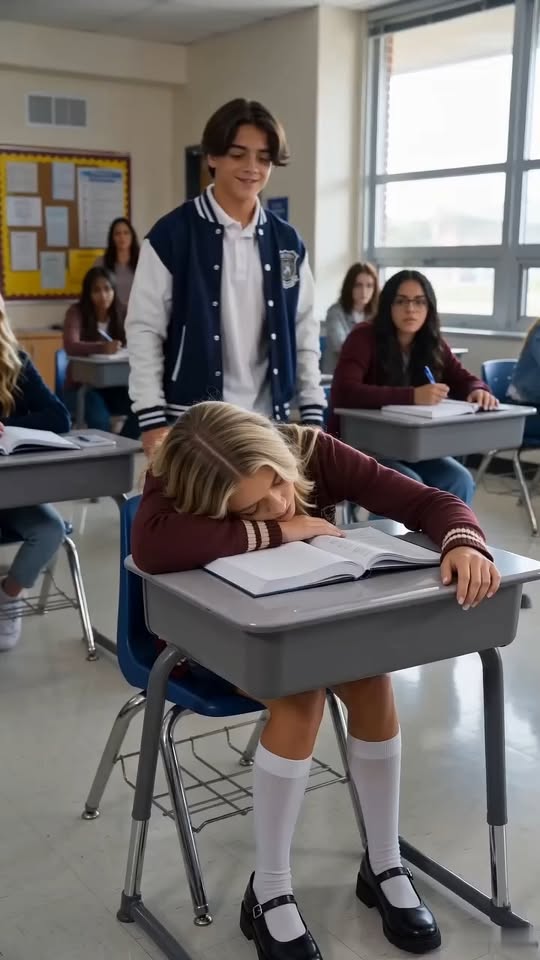
I had been asleep for less than four minutes. I knew the exact margin because at 1:42 PM, when Mr. Holloway stepped out into the B-wing corridor to sign an equipment requisition form for the department chair, I had glanced at the round wall clock above the whiteboard, folded my forearms across the cool wood-grain laminate of my desk, and rested my forehead against the sleeve of my faded navy cardigan.
Since Tuesday, I had slept maybe seven hours total. Whenever the wind came off the ridge and rattled the aluminum storm windows of our house on Elm Street, my brain replayed the same sensory fragments I had carried since I was eleven: the smell of rain on hot engine steel, the squeal of wet brakes, the empty chair across the kitchen table where my mother used to sit with her tea mug held in both hands. In Mr. Holloway’s sixth-period study block, surrounded by the low murmur of twenty-four juniors trading quiz notes and the scratch of mechanical pencils, my nervous system had finally let go of the rope.
Then two heavy hands seized the back frame of my tubular steel chair and yanked sideways.
There was no warning shift of weight—just a violent, scraping wrench that tore the rubber floor glides out from beneath my center of gravity.
For half a heartbeat, I was suspended in air, my stomach dropping into my shoes as my fingers clawed uselessly at the polished edge of the desktop. Then my left shoulder slammed into the hard vinyl floor tiles. My hipbone took the second impact with a dull, sickening thud, and as the chair tipped over behind me, its cold chrome leg clipped the point of my left elbow hard enough to send a white-hot current of numbness shooting down to my ring finger.
My dark hair spilled across my face like a curtain. Above the ringing in my ears, a boy’s laugh barked out across the room—loud, theatrical, and pitched for an audience.
“Wake up, princess. Drool’s bad for the resale value on those textbooks.”
I pushed the tangled hair back from my eyes with my right hand, my palm trembling slightly against my cheek, and looked up.





