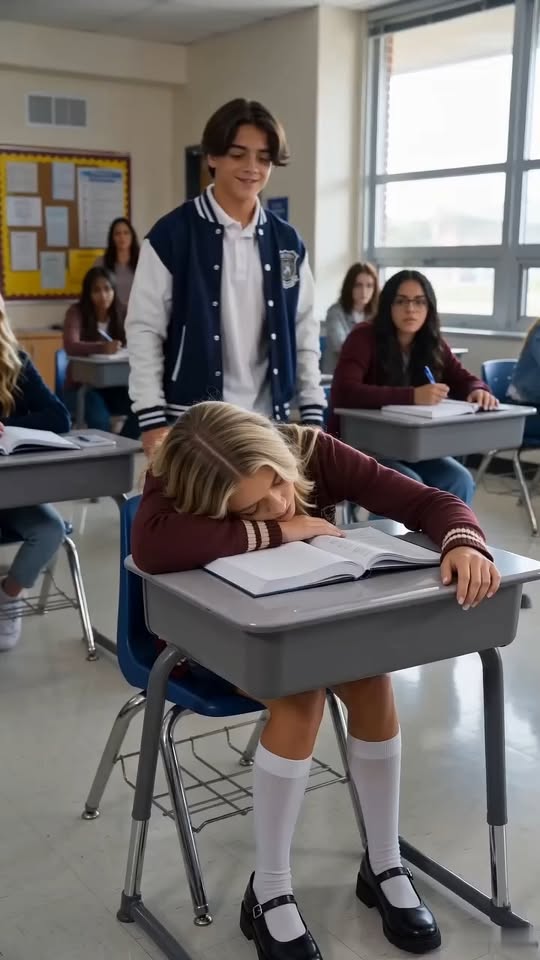
Ethan Mercer stood straddling the narrow aisle between my overturned chair and Mason Miller’s desk. He was wearing his forest-green Oakridge High varsity lacrosse jacket with the white leather sleeves, his thumbs hooked casually inside the front pockets of his jeans. At six-foot-one and nearly a hundred and ninety pounds, Ethan occupied space the way rich kids in small towns always did—as if the air within five feet of his shoulders had been leased in advance by his family name. He was wearing the exact half-smile a boy wears when he has already checked the room to make sure the right people have their heads turned.
Around us, the low hum of sixth period had curdled into an uneasy hush.
Near the pencil sharpener, two boys from the JV squad were snickering behind their knuckles. By the radiator, Chloe Vance clapped a hand over her mouth, whispering “Oh my God” in a tone that was half-shocked and half-thrilled that a boring Thursday afternoon had turned into theater. Mr. Holloway’s shadow wasn’t even visible beneath the frosted glass of the hallway door yet. Apparently, a hundred and twenty seconds of unsupervised air was all Ethan Mercer had needed.
I pulled my right knee underneath me, bracing my weight on my good hand while my left elbow throbbed with a hot, deep ache beneath my sweater sleeve.
Ethan looked down at me on the linoleum, his smile widening as he waited for the script to play out the way it always did with girls like me.
For two and a half years at Oakridge High, I had cultivated invisibility like a second skin. On every progress report since ninth grade, the comment boxes read like a template: Clara is exceptionally quiet, conscientious, and reserved. Turns assignments in early. Never disrupts the learning environment. I sat in the back row near the masonry wall where nobody could stand behind my shoulder; I spoke when called upon in low, neutral sentences; I ate my lunch on the library steps and walked straight home when the 3:05 bell rang. After my mother died when I was eleven and her older brother Daniel took me in, I had learned that drawing attention in a town like Oakridge only invited questions about why my mother’s car had gone off the Old County Bridge at two in the morning in a rainstorm.
Ethan Mercer—eighteen months older than me because he’d repeated eighth grade after transferring in, the kind of starting attackman whom teachers called Mercer with a fond chuckle and coaches defended at disciplinary hearings as “just wired too hot between the whistles”—had clearly looked at my quietness and translated it as spinelessness.
“Did you just shove my chair out from under me?” I asked. My voice wasn’t loud, and it didn’t shake.
Ethan gave an exaggerated, one-shouldered shrug, glancing sideways at Mason’s desk to collect another laugh. “What does it look like, Bennett? You were snoring like a chainsaw. Consider it a public service.”
Slowly, I rose to my feet, ignoring the sharp twinge in my hip.
Standing up didn’t make Ethan back off; it made his grin stretch wider, showing his teeth. He took half a step forward into the narrow gap between the desks, invading my personal perimeter until I could smell the sharp cedar aftershave on his neck. He expected me to shrink back against the radiator pipes and look at my shoes.
“What?” Ethan murmured, dropping his voice just enough to sound intimate while still projecting to the middle rows. “You gonna cry to Holloway, or what are you gonna do about it?”
Something cold and crystalline clicked into place behind my sternum.
It wasn’t anger. It was a sudden, hyper-acute clarity that made the fluorescent tubes overhead seem twice as bright and the tick of the wall clock twice as loud. When I was tiny—before the crash, back when my mother still lived with me in the little yellow house on Birch—she used to play an old cassette tape in the living room while we folded laundry and make me practice what she called the door game. Whenever someone grabbed your arm from the front, she had shown me, you never pulled backward against their thumbs; you stepped into their elbow, dropped your hips below their belt line, and turned like a heavy oak door swinging on a greased hinge. Never fight a heavy man’s muscle, Clara, she had whispered, her fingers cool and firm on my eight-year-old wrists. Borrow his arrogance and let the floor hit him for you.
I hadn’t thought about the door game in six years.
Then Ethan’s right hand lifted from his jean pocket, his fingers spreading wide as he reached out to give my bruised left shoulder a condescending little shove back toward the wall.
My body moved before my conscious mind even finished reading the motion of his wrist.
As his palm grazed the wool of my cardigan, my right hand shot across my chest and clamped onto his right wrist, pinning his hand against my collarbone so he couldn’t pull it back. Simultaneously, my left hand—ignoring the scream of the bruised nerve in my elbow—seized a thick fistful of the heavy white leather lapel of his varsity jacket. I didn’t push him away. I dropped my knees four inches, stepped my right foot deep between his planted sneakers, pivoted one hundred and eighty degrees on the ball of my heel, and snapped my hips upward while pulling his lapel straight down toward the linoleum.
Ethan’s forward lean did ninety percent of the work.
A wooden student desk shrieked across the waxed tiles as his thigh clipped the corner. Somebody in the second row let out a sharp yelp.
Then one hundred and ninety pounds of varsity lacrosse captain rotated cleanly over my hip and slammed flat onto his back in the center aisle with a concussive BOOM that rattled the glass panes in the cabinet doors.





