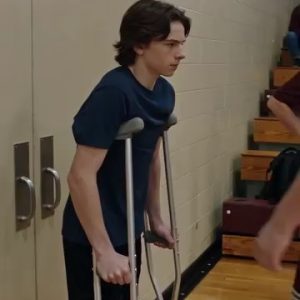
The school was quiet; the last yellow buses had long since departed, their diesel fumes replaced by the sharp, clean smell of lemon floor wax and the cold draft coming off the winter fields outside.
Elias stood on the baseline of the auxiliary court.
He did not have the crutch. It stood in the corner of the room, leaned against an unused equipment cart, its gray rubber foot resting quietly on the concrete.
On his left leg, the heavy, hinged titanium brace had been replaced by a sleek, black compressive neoprene sleeve with twin lateral spiral stays—a functional rehabilitation brace designed for light, non-contact kinetic movement.
Dr. Karras had signed the phase-two clearance forty-eight hours earlier: Patient may engage in stationary ball-handling, progressive proprioceptive balancing, and closed-kinetic-chain shooting drills from twenty feet and under. No cutting. No jumping. No contact.
Coach Miller stood at the free-throw line, a leather basketball held between his palms.
“Ten shots,” Miller said. “Set shots only. You don’t leave the floor. You push from the right hip, you transfer forty percent of the load through the left heel, and you follow through. If I see that left heel lift half an inch, we shut it down and you go to the ice tub.”
“Understood,” Elias said.
Miller bounced the ball across the paint.
The leather hit Elias’s palms with that ancient, perfect thwack that he had dreamed about through eight weeks of fever, codeine, and physical therapy. The texture of the pebble-grain leather against his fingertips felt like an old language he hadn’t spoken since summer.
He stood twenty feet from the iron rim.
He did not look at his knee. He looked at the back of the iron hoop, at the tiny white nylon loops where the net was secured to the metal.
He dipped his hips three inches. He felt the tension in the left hamstring—tight, guarded, but holding. The titanium screws inside the bone tunnels of his tibia and femur were silent, solid, locked into the living architecture of the joint.
He rose onto the ball of his right foot, his left foot staying planted, flat, honest, bearing its share of the earth.
He released the ball.
It hung in the dusty, cathedral air of the gym for one long, suspended second, rotating with three clean revolutions of backspin, before dropping straight through the center of the white cords with a soft, clean snap.
The ball bounced twice, rolling away toward the bleachers.
From the doorway of the auxiliary gym, a figure shifted in the shadows.
Marcus Bell stood there, his varsity backpack slung over one shoulder, his winter coat unzipped. He held an apple in his hand, a slow, wry grin touching the corners of his mouth.
“Still flat on the release, Metronome,” Marcus called out, his voice echoing off the concrete walls.
Elias retrieved the ball with a slow, careful walk—a slight hitch in his gait, an honest, working limp that didn’t hide from the light—and turned back to his friend.
“It went through the iron, Bell,” Elias said, a faint smile breaking through the quiet of his face.
“Yeah,” Marcus said, stepping onto the wood, his boots making a dull, clean sound on the floor. “It sure did.”
Behind them, Harlan Miller picked up his clipboard, checked his watch, and gave a single, slow nod of his chin toward the court.
“Nine more, Reed,” the coach said, his voice quiet, steady, and certain as the winter outside. “Let’s see if that graft can count to ten.”





