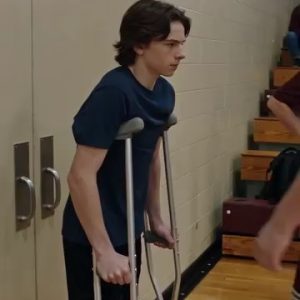
“After you, Hop-along,” Trent would say, holding the heavy fire door open with an exaggerated, mock-chivalric bow.
Then it became “One-Leg.”
Then Trent began “testing the structural integrity” of Elias’s gear. A casual bump with an elbow in the crowded corridor between fourth and fifth period that sent the aluminum crutch clattering against the metal lockers. A locker combination mysteriously spun to zero while Elias was in the bathroom, leaving him standing on one foot for six minutes while the hallway cleared and the warning bell sounded.
Once, in late October, Trent had taken the crutch from the corner of the library table while Elias was in the stacks searching for a microfiche reel. He had placed it on top of the eight-foot reference atlas shelving, leaned against a globe, and walked out laughing with his friends.
Elias had not reported it to the principal. He had reported it to Coach Miller.
Miller had called both boys into the small, windowless office off the locker room that smelled of mildew, laundry detergent, and forty years of athletic tape.
“Trent says he thought it was Marcus’s crutch from when he pulled his calf,” Miller had said, leaning back in his swivel chair, his reading glasses low on his nose. “He says he was just moving it out of the aisle so the study-hall proctor wouldn’t trip.”
“It has my name on the hospital tag, Coach,” Elias had said, his voice level, his hands resting on his knees. “Right under the handle.”
Miller had looked at Trent, then at Elias, then out through the reinforced wire glass toward the empty court. “You two have played ball together since fifth-grade travel league. We’re four weeks out from the sectional tournament. We don’t have time for personality friction in the backcourt. Trent, keep your hands off his gear. Elias, if you need accommodations in the halls, use the freight elevator by the cafeteria. Let’s focus on the team.”
They had walked out of the office together.
In the dark of the locker room tunnel, out of Miller’s line of sight, Trent had stepped in close, his shoulder pressing Elias back against the cinder blocks.
“You like running to the old man, don’t you?” Trent had whispered. “You think because your leg is busted, you get to carry tales? Keep your mouth shut, Reed. Or next time, I’ll kick the other one.”
Danielle Reed smelled of alcohol wipes and cold rain when she came through the back door at six-thirty that evening.
She was forty-one, with the same sharp, observant gray eyes as her son, but the skin beneath them was dark with that chronic, bone-deep exhaustion that comes from twelve-hour rotations in an underfunded county emergency room. She set her plastic lunch cooler on the counter, kicked off her white nursing clogs, and stood there in her blue scrubs, listening to the house.
The house was too quiet.
Upstairs, the rhythmic, muffled thump of a rubber resistance band against the baseboard sounded like a dying heart: pull… hold… release. Pull… hold… release.
She climbed the stairs with a mug of black coffee in her hand.
Elias was sitting on the edge of his mattress, his left leg extended straight out before him on an ottoman. A thick blue elastic band was looped around the forefoot of his running shoe, the other end anchored to the heavy oak leg of his desk. His gray t-shirt was soaked through at the chest; sweat was dripping from the tip of his nose onto his kneecap.
The brace lay on the floorboards beside the bed, its titanium hinges gleaming under the sixty-watt bulb of his desk lamp.
Danielle leaned against the doorframe, watching him. She didn’t speak until he finished the set—twenty slow, agonizing repetitions of eccentric quadriceps contractions, his teeth clenched until the muscles in his jaw stood out like walnuts.
He let the band go slack, his head falling back against the wall, his chest heaving.
“The doctor said three sets of fifteen, Elias,” she said gently. “Not five sets of thirty.”
“Dr. Karras doesn’t have to walk the halls at Westlake,” Elias replied, not opening his eyes. His voice was hoarse.
Danielle walked into the room, set her mug on the desk, and knelt beside the ottoman. Her professional fingers—cool, dry, and terrifyingly perceptive—moved over the surgical scar.
The incision was six inches long, running straight down the center of the patella, a purple, puckered ridge that was still hot to the touch. She pressed two fingers into the suprapatellar pouch.
“There’s fluid,” she said, her voice dropping into her triage register. “The joint is swollen. What happened today?”
“Nothing.”
“Elias.”
He opened his eyes. He looked at the posters on his wall—Allen Iverson stepping over Tyronn Lue in the 2001 Finals; a faded, autographed picture of his father wearing a navy flight-line jacket at the Wright-Patterson Air Force base hangars; a framed certificate from the state regional track meet.
“Trent Parker kicked my crutch across the gym,” Elias said.
The room went dead silent.
Danielle’s hands stopped on his knee. She did not gasp. She did not yell. Her shoulders simply lowered half an inch, that terrible, dangerous stillness settling over her that Elias had seen only when an unruly drunk in the emergency department tried to spit on an intake nurse.
“Did he touch you?” she asked.
“He grabbed my shirt.”
“And?”
“I took his balance,” Elias said. He looked down at his own right hand, opening and closing the fingers. “I used the wrist lock Coach Vance showed us in the wrestling room two years ago. I didn’t hit him, Mom. I didn’t even push him down. I just held the arm until he had to let go.”
Danielle sat back on her heels, her scrub pants rustling against the braided rug. “Did Miller see it?”
“He saw the end. He saw Trent on the wall. He sent Trent to the bike and gave me the crutch back.”
“And the principal?”





