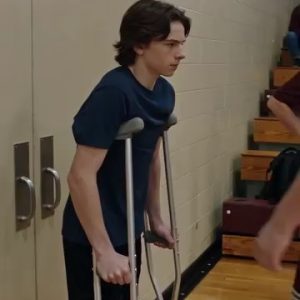
His doctor had cleared him for limited basketball drills. He still had to follow a rehabilitation plan, and he wasn’t ready for full contact or competitive play.
Coach Miller handed him a ball.
“Your pace. Your limits. If anything hurts, you stop.”
Elias nodded.
The gym was almost empty except for a few teammates who had stayed after practice.
He stood near the free-throw line.
For a moment, he remembered the championship qualifier, the sudden pain, the long weeks on crutches, and the metallic crack that had echoed through the gym when Trent kicked his support away.
He dribbled once.
Twice.
Then he took a gentle shot.
The ball hit the rim and bounced out.
Marcus groaned dramatically.
“Come on, Reed!”
Elias laughed.
“First shot back, man.”
“Still counts.”
Elias retrieved the ball and tried again.
This time, it dropped through the net.
The small group cheered.
Coach Miller clapped once.
“Good shot. That’s enough for today.”
Elias looked at the hoop.
He had imagined this moment many times during rehabilitation. In his imagination, he returned stronger, faster, and completely unafraid.
The real moment was quieter.
His knee still ached a little.
His shot wasn’t perfect.
He wasn’t sure when he’d be able to play a full game again.
But he was back on the court, doing the work that would give him a chance.
That was enough.
As he gathered his things, Marcus pointed toward the gym doors.
“Hey. You know what the best part of this whole thing was?”
“What?”
“You never gave Trent the fight he wanted.”
Elias slung his bag over his shoulder.
“I didn’t want to hurt him.”
“You could’ve.”
“Maybe. But that wouldn’t have fixed anything.”
Marcus nodded.
Then he grinned.
“Still, the look on his face when he lost his balance? Legendary.”
Elias shook his head.
“You’re impossible.”
They walked out together.
Behind them, the gym lights clicked off one row at a time.
Elias wasn’t a superhero.
He hadn’t defeated a bully with a secret fighting technique, and his injury hadn’t magically disappeared because he stood up for himself.
He was a teenager who had been hurt, intimidated, and ignored for too long.
What changed everything was that the truth was finally documented, witnesses spoke up, and adults took responsibility for protecting the student who had been targeted.
Trent had wanted the entire gym to laugh at Elias.
Instead, the gym saw what he had done.
And Elias learned that standing up for yourself doesn’t always mean knocking someone down.
Sometimes it means protecting yourself, telling the truth, asking for help, and refusing to let another person’s cruelty define who you are.
The hollow clang of the aluminum crutch struck the far double doors thirty feet away, a harsh, metallic rattle that sheared through the ambient clamor of fifth-period gym class and cut it dead.
A heartbeat earlier, the room had hummed with the routine violence of adolescent noise: rubber sneakers squealing against polyurethane, basketballs thudding off the fiberglass backboards, the sharp, rhythmic snap of jump ropes whipping against the maple floor. Then came the kick. It was not an accidental stumble, not the careless brush of a passing foot. It was a measured, place-kick strike from the heavy sole of a brand-new training shoe, launched straight into the gray rubber tip of Elias Reed’s right crutch while his weight was momentarily balanced between strides.
The crutch skittered across the painted free-throw line like a discharged rifle casing.
Elias did not go down. He could not afford to.
His left leg was encased in a hinged titanium-and-neoprene orthopedic brace that ran from mid-thigh to four inches above the ankle bone, locked at a rigid fifteen-degree angle of flexion to prevent the reconstructed anterior cruciate ligament from shredding against the femoral notch. To hit that hardwood on an unsupported left plant meant six months of graft work tearing like wet parchment. His right leg—the only sound limb he possessed—slammed downward, his heel skidding two inches across the high-gloss varnish before finding purchase. The sudden deceleration wrenched his lumbar spine, sending an electric bolt of agony straight into his hip.
His left shoulder dropped toward the wall, but before his knuckles could graze the vinyl protective padding, a hand seized the collar of his faded gray physical education t-shirt.
“Look at him wobble,” Trent Parker barked. The laugh was theatrical, calibrated for the semi-circle of spectators already gathering three deep along the baseline. “Look at the flamingo. One gust of wind and the whole season blows away.”
Trent stood six feet one, broad in the chest, with the thick, ropy forearms of an athlete who spent four afternoons a week under the bench press in his family’s climate-controlled basement gym. He wore his varsity track jacket unzipped, the gold-and-black cougar emblem swelling across his chest with every breath. In his left hand, angled with casual, practiced vanity, he held an iPhone, its dual-lens array pointed directly into Elias’s sweating face.
“Say something for the highlight reel, Reed,” Trent sneered, twisting the fabric of Elias’s shirt until the cheap cotton bit into the hollow beneath his collarbone. “Tell ’em how the second string is treating you.”
Ten feet away, two junior track sprinters laughed on cue—that thin, nervous sound kids make when they want to ensure the predator knows they are cheering for the kill. A girl in the front row lifted her own device, the red recording glyph blinking on her screen.
Elias did not look at the camera. He did not look at the boys laughing by the bleachers.
He looked at the base of Trent’s left thumb, where the tendon stood out like a dry reed under freckled skin.
“Let go of the shirt, Trent,” Elias said. His voice was not loud. It lacked the theatrical tremor of anger or the high, pleading pitch of panic. It had the dry, rhythmic flatness of a coach reading a split-time off a stopwatch.
“Or what?” Trent leaned in, his breath sour with the cinnamon gum he chewed during roll call. “You gonna run away? You gonna drive to the basket on that knee? Go ahead, man. Make a move.”
He shoved. It was intended to be the signature flourish—the final, humiliating jolt that would send the cripple sliding down the wall while the gallery caught the tumble on forty separate feeds.
He never finished the extension.
Elias did not pull back. Pulling back was an instinct born of fear, and fear always gave the larger body leverage. Instead, Elias let his torso yield half an inch to absorb the initial thrust, shifting his entire center of mass over the right heel, which was planted squarely between Trent’s wide-set sneakers.
Before Trent’s pushing arm could lock out at the elbow, Elias’s right hand came up from his hip. It was not a punch; it was a clamp. His fingers—calloused from four thousand hours of ball-handling drills and eight weeks of resistance-band therapy—hooked over the outside of Trent’s wrist, pressing the median nerve against the bone with the precision of a machinist setting a caliper. At the same fraction of a second, Elias’s left palm caught the triceps tendon just above Trent’s elbow, levering the joint upward and inward.
It was a standard, defensive balance-break—the kind of joint lock wrestling coaches demonstrated on the first day of winter clinic to show one-hundred-and-forty-pounders how to neutralize a heavyweight who leaned too far over his toes.
Trent’s forward momentum did the rest.
The larger boy’s elbow jammed into hyperextension, his shoulder rolling inward as the mechanical advantage shifted instantly. Trent’s chin jerked downward. His knees, robbed of their forward base, buckled as his sneakers shrieked against the maple, searching for a friction that was no longer there.
“Let go!” Trent gasped, his face instantly mottling from smug bronze to a violent, blotchy plum.
“You first,” Elias said.
He did not wrench the arm. He simply held the lock at the exact threshold where movement meant injury, his right heel bearing every ounce of his weight, his locked left brace hovering an inch above the floorboards like an undropped anchor.
Trent tried to rip his forearm back by main force. The torque caught his shoulder socket with a dull, wet pop, and a sharp yelp tore out of his throat. He stumbled sideways two paces, his boots tangling in his own sweatpants, before crashing heavily against the blue vinyl wall padding. His iPhone slipped from his fingers, bouncing twice on the wood before coming to rest face-down near the free-throw line.





