Trent leaned down, snatched his phone from the maple boards, and marched toward the tunnel. The heavy steel fire door slammed shut behind him with a dull, concussive bang that rattled the mesh wire in the glass.
Miller stood in the center of the paint for ten seconds, his whistle resting between his fingers.
“The rest of you,” Miller called out toward the bleachers, his voice flat and dismissive. “Baseline. Line drills. Three-minute intervals until the whistle blows. Move.”
The squad scrambled off the wood like soldiers under mortar fire.
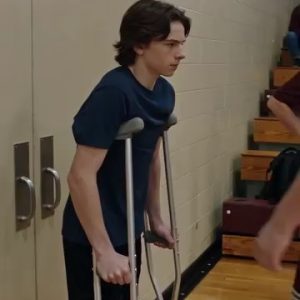
Elias sat on the bottom bench, his hands still pressed against the cold titanium hinge of his brace, watching the red digital numbers on the shot clock tick down toward zero. His shoulder ached where he had absorbed the impact against the wall, but deeper than the ache was that cold, familiar sickness in the pit of his stomach: the realization that tomorrow morning, the hallway would still be ninety yards long, the floors would still be slick with tracked-in November slush, and he would still be the boy with the metal on his leg.
Ninety days earlier, Elias Reed had been the fastest thing on two feet between the Ohio River and the Pennsylvania border.
He was not tall for a varsity guard—five feet eleven in his court shoes, with the narrow hips and broad, wiry shoulders of an eighth-mile runner—but he possessed that rarest of athletic gifts: anticipation. He did not react to the ball; he arrived where the ball was going to be four-tenths of a second before the passer made the decision to release it.
In the local sports page of the Courier-Gazette, they called him “The Metronome.” Coach Miller, who had coached two division-one guards in the late nineties, was more precise: “Elias doesn’t play the man in front of him. He plays the rhythm of the five men on the floor. You can teach a boy to shoot eighty percent from the stripe; you cannot teach a boy to feel where the defense is leaning before they take their first step.”
Then came the district semifinal against Oak Ridge.
There were forty-two seconds remaining on the clock. Oak Ridge had cut the lead to three. Elias took the inbound pass at the three-quarter mark, crossed over against their senior captain, and drove down the left side of the key. The lane was open. The help defender was late, rotating from the weak-side corner with his hands down.
Elias gathered for the plant.
It was an ordinary deceleration step—a two-foot jump stop he had executed ten thousand times on concrete, asphalt, and parquet since he was seven years old.
His right sneaker bit the varnish. His left sneaker hit a patch of condensation near the baseline where a junior varsity cheerleader had spilled a sports drink forty minutes earlier.
The left shoe did not slide. It caught, twisted forty-five degrees outward, and stopped dead while the momentum of his upper body carried forward at twelve miles per hour.
The sound was not an explosion. It was the dry, internal pop of a fresh spruce twig snapping beneath an iron boot.
The scream that followed had cleared the front row of the bleachers.
The diagnosis from the regional surgical group in Columbus had been delivered four days later by a specialist who smelled of surgical scrub soap and spoke with the detached precision of an insurance adjuster: complete rupture of the anterior cruciate ligament, partial tear of the medial meniscus, bone bruising on the lateral tibial plateau.
“The repair is clean,” Dr. Karras had said, sliding the high-resolution MRI scan across the lightbox. The gray shadow of the joint looked like a topographical map of a disaster area. “We used a patellar tendon autograft. The fixation screws are titanium. But the graft is living tissue, Elias. It has to revascularize. It takes nine months for that collagen to become a ligament again. If you plant on it before the remodel is complete, the bone tunnel widens and the joint turns to soup.”
“Can he run?” his mother, Danielle, had asked. She was sitting in the corner of the examination room, her scrub-nurse badge still pinned to her cardigan, her fingers white around the handles of her purse.
“In April,” the doctor said. “He can jog in a straight line on a track in April. If he does the physical therapy. If he doesn’t cut. If he doesn’t jump.”
“And basketball?” Elias had asked. His voice had sounded like it was coming from forty feet underwater.
Dr. Karras had turned off the lightbox with a sharp, plastic snap. “Focus on walking to the bathroom without a limp first, son. One court at a time.”
The transition from the starting lineup to the sidelines of Westlake High had not been an event; it had been an erosion.
For the first two weeks, there were cards. The team signed a basketball in gold paint pen—GET WELL SOON, METRONOME—and left it on his locker shelf. Coach Miller brought two boxes of barbecue to the house on Sycamore Street. Three girls from his AP history seminar sat with him during lunch on his first day back.
Then the season started.
The team had to travel. They had film study at six-thirty in the morning. They had late practices that ended long after the yellow activity buses had pulled away from the curb. Elias, who couldn’t drive because the locked brace on his left leg made it impossible to work the pedals of his mother’s twelve-year-old Civic, sat on the radiator by the athletic wing doors at three-thirty, waiting for Danielle’s shift to end at the municipal clinic.
That was when the nicknames began.
It started with Trent Parker in the hallway outside the chemistry labs. Trent, who had inherited the starting point guard slot by default after the injury—and whose turnovers-per-possession ratio was currently the highest in the conference—would swing past the lockers with his gym bag slung over both shoulders.





