The silence that settled over the North Gymnasium was not the quiet of an empty room; it was the suffocating, atmospheric drop that precedes a transformer explosion.
The sprinters had stopped laughing. The girl with the braided hair lowered her phone by two inches, her mouth hanging slightly open.
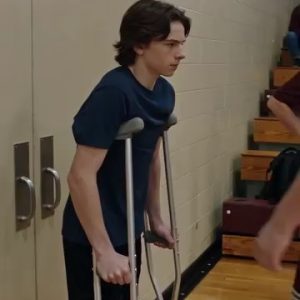
Trent hit the padding, rebounded, and stood there for three seconds with his chest heaving, his fingers twitching against his thigh. He looked down at his arm, then up at Elias, who stood with his back braced lightly against the wall, his breathing slow, his single good foot anchored to the floorboards.
“You piece of—” Trent’s voice cracked, raw with the humiliating fury of a boy who had just been publicly stripped of his gravity. He lowered his head and took one heavy, charging step forward, both hands balling into fists.
“ENOUGH!”
The shout came from the mouth of the tunnel leading to the coaches’ offices. It did not echo; it slammed into the steel girders of the ceiling with the concussive authority of a twelve-gauge round.
Coach Harlan Miller did not run. He walked with the heavy, unhurried, terrifying stride of a man who had spent thirty-four years running high school athletics in a county where every family thought their son was an undiscovered division-one talent. He was fifty-eight years old, his gray crew cut trimmed to the scalp, a brass whistle swinging from a lanyard of olive-drab parachute cord against his faded gray sweatshirt. His clipboard was tucked firmly under his left arm.
The crowd of twenty students dissolved backward, parting like river water around a bridge abutment.
“Get to the bleachers,” Miller said without turning his head. He didn’t point; he didn’t raise his voice a second time.
Nobody argued. The squeak of retreating sneakers was the only sound in the gym as the gallery scrambled up the first three tiers of wooden seating, their eyes still locked on the baseline.
Miller stopped five feet from the wall. His gaze did not go to Trent, who was standing with his chest puffed out, his nostrils flaring, trying to pull his varsity jacket back into shape.
Miller’s eyes went to the double doors thirty feet away.
The aluminum crutch lay against the kick-plate, its gray rubber foot pointed toward the ceiling like a broken axle.
Miller walked over, his sneakers making no sound on the floor. He bent from the waist, picked up the crutch by the foam underarm rest, and inspected the barrel. The aluminum was scratched near the lower adjustment pin where Trent’s cleat-patterned sole had sheared the paint away.
He walked back, his face completely devoid of expression—the stone-carved, terrifying mask he wore when an official made a flagrant call in the fourth quarter of a state semi-final.
“Parker,” Miller said.
“He grabbed me, Coach!” Trent shouted, his voice jumping an octave, pitching toward the bleachers where his teammates were watching. “You saw him! I was just walking past and he caught my arm and twisted it! He tried to break my elbow!”
Miller didn’t blink. “Did you kick that crutch?”
Trent’s eyes flicked to the bleachers, then down to his phone lying on the floor, then back to Miller’s chest. “We were just messing around. It was a joke. I barely touched it.”
“A joke,” Miller repeated. The word came out cold, dry, and flat. “Explain the mechanics of the humor to me, Trent. I’m an old man. I don’t follow modern comedy. Explain to me what part of removing the ambulatory support of an athlete with an active grade-three ligament tear produces laughter.”
The gym was so quiet that the humming of the high-bay metal-halide lamps overhead sounded like a hive of hornets.
Trent’s mouth opened. He looked at Marcus Bell, the starting point guard who sat on the second tier of the bleachers. Marcus did not look back; he was intensely interested in the lacing of his left shoe.
“He shouldn’t have been in the lane,” Trent muttered, his eyes dropping to the floor. “He was blocking the walkway.”
“Sit down, Elias,” Miller said, not looking away from Trent.
“I’m alright, Coach,” Elias murmured.
“I did not ask for a self-assessment of your orthopedic status, Reed,” Miller snapped, his voice dropping into that rhythmic, iron cadence that every varsity player feared. “I gave you an instruction. Put your rear end on the bottom bench before that quad goes into spasm.”
Miller handed him the crutch. Elias took it, his fingers sliding into the molded plastic handgrip. He didn’t lean on it immediately; he took one careful, hopping step toward the first riser of the bleachers, swung his locked brace forward, and sat down. The moment the weight came off his left hip, a fine, involuntary tremor ran through his quadriceps muscle—a violent flutter of exhausted nerve endings that he tried to smother by clamping both palms over his knee.
Miller noticed. He didn’t comment. He turned back to Trent.
“Locker room. Now,” the coach said.
“Coach, we have five-on-five scrimmage in twenty minutes—”
“You have five miles on the stationary bike in the auxiliary room,” Miller said. “And if I hear the flywheel stop spinning before the late bell rings, you can turn your jersey in to the athletic director before you go home to your father.”
Trent’s jaw worked. A vein on the right side of his forehead bulged against the pale skin of his temple. For three seconds, he looked as though he might throw his track jacket onto the floorboards—the classic, petulant gesture of a boy whose father’s name was chiseled into the limestone arch of the community library.
Then he looked at Miller’s eyes.
Whatever he saw there—perhaps the thirty years of state tournament banners hanging from the rafters, or the cold certainty of an educator who had seen five hundred boys just like him fade into local beer-league obscurity—broke the circuit.





