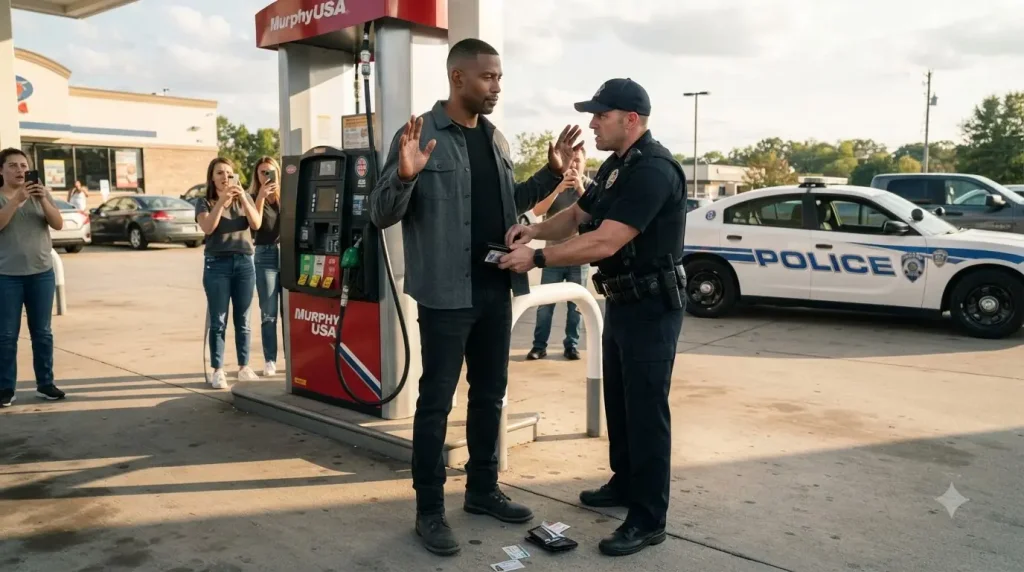
Harmon was beside him in two steps. “Could we get a copy?”
“Yes.” She looked back at Adrian, her expression troubled. “I should’ve said something earlier. When he pushed you.”
“You did say something when he threw my phone.”
“Not before.”
Adrian nodded slowly. She looked like someone searching for absolution. He wouldn’t hand out easy absolution—that wasn’t his to give—but he wouldn’t punish candor either. “You stayed.”
She frowned slightly. “You recorded.”
“Yes.”
“That matters.”
A faint sheen gathered in her eyes. “I was scared.”
“So was I.”
She looked surprised. “You didn’t look scared.”
Adrian smiled faintly. “That isn’t the same thing.”
She gave a small nod and handed Harmon her contact details. Across the lot, other investigators were speaking with the gas-station clerks and preserving the store’s surveillance hard drive. When the store manager grumbled about the disruption, Harmon mentioned that the footage could easily become subpoenaed evidence; the manager’s annoyance evaporated on the spot. People always adjusted quickly when consequences stopped being theoretical.
Near the curb by the patrol car, Officer Mason sat alone on the concrete, shoulders hunched. Adrian watched him. Harmon watched Adrian watching him.
“No,” Harmon said quietly.
Adrian smiled. “You know me too well.”
“He has counsel rights.”
“I’m not interrogating him.”
“You’re going to psychologically adopt another conflicted young officer.”
“Not my hobby.”
“It absolutely is.”
Adrian walked over to the curb anyway. Mason looked up and started to stand.
“You don’t have to,” Adrian said, stopping a few feet away.
Mason hesitated. “Have to what?”
“Talk to me.”
“I know.” Mason looked down at the pavement, miserable.
Adrian glanced toward the cruiser. “How long have you worked with Rourke?”
“Four months.”
“Seen that before?”
Mason didn’t answer. The silence said enough. Adrian waited without pushing. Mason glanced toward Harmon, then back up. “I know you’re not supposed to ask me anything.”
“I’m not asking for details.”
“Then what?”
Adrian thought for a second. “I’m asking whether today surprised you.”
Mason swallowed hard. “No.”
There it was. Adrian nodded once.
Mason spoke faster now, almost urgently. “I never saw him take money.”
Adrian held up one hand. “Stop. You need counsel before giving facts.”
Mason closed his mouth, nodding.
“But understand something,” Adrian said, his voice steady and unhurried. “Being uncomfortable is not the same as objecting.”
Mason looked down again.
“You cannot spend a career telling yourself that silently disapproving protects anybody,” Adrian added.
The words settled heavily between them. Mason nodded slowly. “I know.”
“Do you?”
Mason looked up, meeting Adrian’s eyes squarely. “Today I do.”
Adrian believed him. Belief wasn’t clearance, though—he knew how to keep those two things separate. He headed back to Harmon.
She eyed him with mild exasperation. “What did you say?”
“Nothing investigative.”
“I’ll check the audio.”
“Good.”
Despite herself, Harmon smiled.
By six o’clock that evening, Professional Standards had taken over a windowless conference room at department headquarters. Rourke’s badge and service weapon were logged in property; his terminal credentials were suspended, his locker sealed under watch, and his digital footprint locked down.
Chief Warren Maddox arrived in a storm. Not at Rourke—at Internal Affairs. That single detail told Adrian almost everything he needed to know before the chief even reached the table.
Maddox walked in flanked by two patrol captains and a city attorney. At fifty-eight, broad-chested with silver hair and a practiced, gravelly authority, Maddox had the look of a man who knew how to turn anger into political leverage. He pointed a thick finger toward Harmon.
“You ran an integrity operation against one of my officers without notifying command?”
Harmon stayed in her chair. “Notification was restricted.”
“I am command.”
“Exactly.”
The room went quiet. Maddox’s jaw worked as his gaze swept down the table to Adrian, sitting near the far end. “You.”
Adrian looked up.
Maddox’s eyes narrowed. “You’re Cole.”
“Yes.”
“I know your name.”
“That makes one of your officers.”
Maddox didn’t like that. “I’ve read your previous reports.”
“Then you know why I was assigned.”
“I know you like manufacturing scandals.”
Harmon started to speak. “Chief—”
“No.” Maddox tapped the table toward Adrian. “He walks into departments, antagonizes people, waits for a reaction, then calls the reaction culture.”
Adrian studied him with quiet patience. Beside the chief, the city attorney shifted uncomfortably in his chair.
“Did you watch the video?” Adrian asked.
Maddox didn’t answer right away. “Did you?”
“Yes.”
“And what part did I manufacture?”
Maddox’s jaw tightened. “You were carrying bait.”
“Evidence pouch.”
“Same thing.”
“No.” Adrian leaned his forearms onto the table. “The money was not offered.” Nothing from the chief. “The pouch was concealed legally on my person.” Still nothing. “The officer initiated contact based on an unverified complaint.”
Maddox cut in. “There was a real call.”
“Yes.” That part was true—Adrian had already seen the dispatch log. A clerk at the convenience store had reported someone arguing with customers near the pumps. Later review of the security feed showed that person was a white man in his mid-twenties wearing a red baseball cap and a green hoodie. Nothing remotely like Adrian.
“He didn’t ask the store employee for a description before approaching me,” Adrian said. “He selected me instead.”
“Mistakes happen,” Maddox said.
“Then he searched me without articulating cause.”
“Officer safety.”
“He threw my wallet.”
“Unprofessional.”
“He shoved me twice.”
“Potential force-policy issue.”
“He removed my phone.”
“Depends on context.”
“He opened a sealed pouch.”
Maddox paused for a fraction of a second. “Search incident.”
“I wasn’t under arrest.”
Silence stretched across the polished wood. Adrian looked toward the city attorney, who kept his eyes fixed on a notepad in front of him.
Harmon spoke up. “Chief, this is no longer about debating the stop.”
Maddox turned on her. “What is it about?”
She opened a manila folder. “Historical complaints.”
Maddox’s face hardened. “I’ve reviewed complaints.”
“Yes.”
“Most unfounded.”
“By whom?”
“My supervisors.”
“Including Captain Reeves?”
One of the captains beside Maddox went rigid. Harmon caught it. Adrian caught it too.





