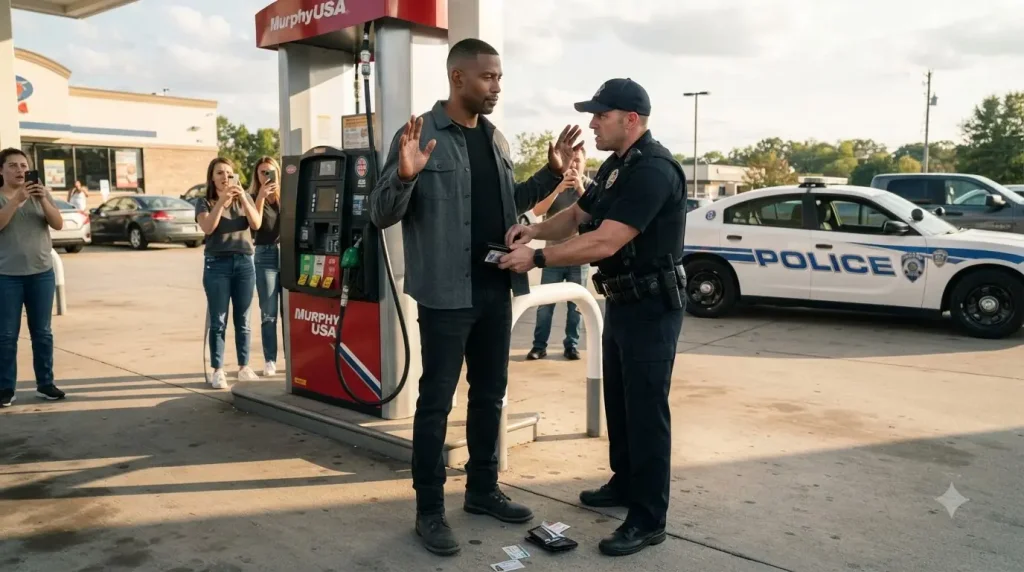
He seized Adrian’s left wrist, twisting it behind his back and pinning it hard against the cold metal of the pump, then began patting him down with rough, heavy slaps. Adrian’s breathing shifted—deeper, slower, measured—not the ragged catch of panic, but the deliberate discipline of someone keeping his pulse inside a narrow channel. Over Rourke’s shoulder, Adrian looked at the patrol cruiser. Sunlight glinted off the windshield, hiding the interior, though he knew the mobile data terminal inside was humming along its encrypted channels. Everything had been built around what happened the moment a name crossed that glass. The only question was whether Rourke would let the sequence play out or lose control first.
Rourke’s hands moved briskly over the outside of the overshirt and T-shirt. “You carrying?”
“No firearm.”
“Knife?”
“No.”
“Drugs?”
“No.”
“Sure?”
“Yes.”
Rourke pressed hard along Adrian’s waist and pockets.
“You haven’t told me why you’re searching me,” Adrian said calmly.
“I don’t need a lecture.”
“I asked for the reason.”
“You fit the situation.”
“What situation?”
Rourke yanked Adrian away from the pump, spun him abruptly, and slammed him back against the metal. The impact rattled the pump’s interior panels and sent a shudder through the concrete beneath Adrian’s boots.
Mason took another step forward. “Rourke.”
“Stay by the cruiser!” Rourke barked without looking back.
Mason halted mid-stride. Adrian caught the younger man’s eye as Rourke leaned in—saw the flush on Mason’s neck, the tight, miserable line of his mouth. He looked ashamed of stopping. That mattered. In rooms and parking lots alike, hesitation always told a story.
Rourke reached into the outer pocket of Adrian’s overshirt and pulled out a worn black leather wallet.
“You can look at my identification without throwing anything,” Adrian said.
Rourke flipped it open with one thumb. A state driver’s license, two bank cards, a health insurance card, and a plain white business card bearing nothing but a name and a ten-digit phone number. Rourke read the license.
“Adrian Cole.”
Adrian didn’t answer.
Rourke studied the address printed beneath the photo, then lifted his eyes to Adrian’s face. “That’s where you live?”
“Yes.”
A short, humorless laugh escaped Rourke’s throat. The address sat inside one of the affluent enclaves three miles down the highway, where cul-de-sacs wound past brick pillars and mature oaks. Adrian knew that look. He had seen it in precinct lobbies, in traffic stops, in cold stares across conference tables—the micro-pause, the mental arithmetic, the quiet assumption that an address like that had to be a mistake, a clerical error, or a front.
Rourke tapped the license with a fingernail. “That house worth about one-point-two?”
“I don’t know its current valuation.”
“You don’t know what your own house is worth?”
“I know what I paid.”
“How much?”
“That has nothing to do with this stop.”
Rourke snapped the wallet shut. “You don’t want to answer?”
“No.”
Rourke flicked his wrist and tossed the wallet onto the concrete. It skidded face-down near the base of the pump, picking up a smear of oil and grit. Adrian looked at it for a second, then back at Rourke.
“Leave it,” Rourke ordered.
Adrian kept his hands open and visible.
Rourke’s hand slid into the inner breast pocket of the overshirt. His fingers brushed something firm and stopped. His expression shifted, sharpening with sudden triumph. “What’s this?”
Adrian said nothing.
Rourke pulled it free: a compact black nylon pouch, roughly the size of a cigarette pack, sealed across the top with a factory tamper strip. From where Rourke held it, no label was immediately visible. He squeezed it between his thumb and forefinger. Something stiff sat inside—folded paper, maybe cash, alongside a small solid block.
Rourke smiled, almost pleased with himself. “There we go.”
Adrian’s voice stayed level. “Put that back.”
“What is it?”
“You should not open it.”
“That sounds like a threat.”
“It’s a warning.”
Mason took a tentative half-step from the cruiser. “Rourke, maybe—”
“Stay there.”
Rourke turned the pouch in his hand. Adrian saw the exact moment Rourke’s thumb pressed over a small printed line along the seam—not enough to block it completely, just enough to keep Rourke from reading what was right under his skin. Rourke hooked a fingernail under the tamper strip and ripped it open.
Adrian closed his eyes for a fraction of a second. There it was. The line had been crossed.
Rourke reached inside and drew out six folded hundred-dollar bills, crisp and flat, followed by a matte-black electronic unit no bigger than a key fob. He held the cash up toward the bright glare under the canopy. Near the convenience store, the man with the milk carton had raised his phone; down the line, the woman by the SUV was angling hers slightly to the left.
Rourke caught the motion and flashed a grin toward the cameras. “See?” He looked back at Adrian. “Guys like you always have something hidden.”
The sentence hung in the warm air over the pavement. Adrian’s face barely moved—not surprise, just quiet confirmation.
“Then you should be very careful with what you just found,” Adrian said.
Rourke barked a laugh. “Oh, I will.” He shook out the bills. “Six hundred.”
Adrian didn’t reply.
“What’s it for?” Silence. Rourke stepped in closer. “Drugs?”
“No.”
“Gambling?”
“No.”
“Buying something?”
“No.”
“Selling?”
“No.”
“Then why are you carrying marked cash in a sealed bag?”
Adrian looked down at the black fob resting in Rourke’s palm. “You tell me.”
Rourke’s jaw clenched. Behind them, Mason’s voice cut across the hum of highway traffic.
“Marked?”
Rourke spun half-around. “What?”
Mason had drifted closer to the cruiser. “Did you say marked?”
Rourke glared. “Get back over here.”
Mason hesitated, then leaned his head toward the open driver’s window. Inside the patrol car, the mobile computer let out a sharp electronic chime. Once. Then a second time.
Rourke paid it no mind. He reached into another pocket of Adrian’s overshirt and pulled out a smartphone.
“Don’t,” Adrian said.





