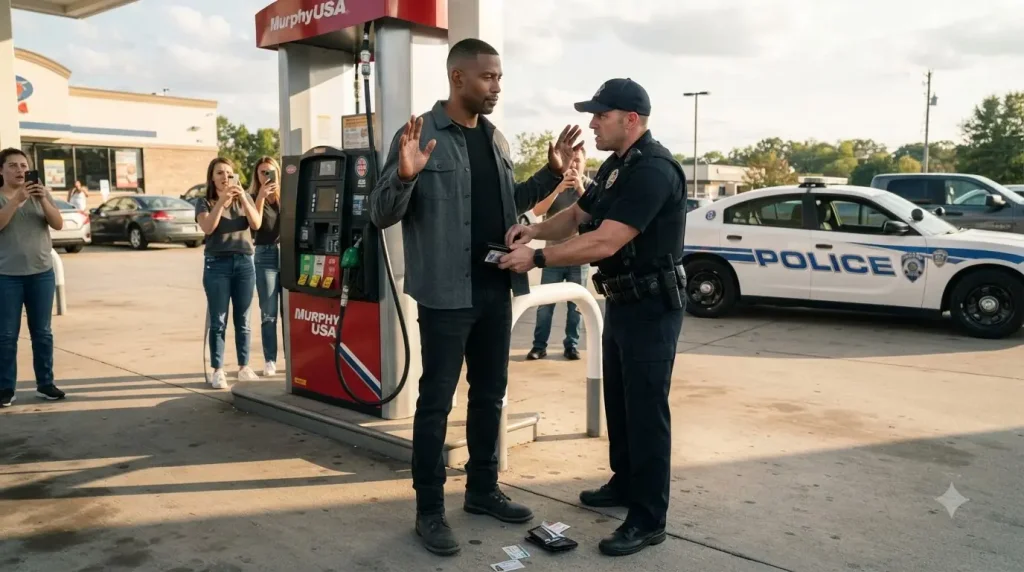
“Reeves runs patrol standards,” Maddox said evenly.
Harmon pulled a second file from the folder. “Six complaints involving Rourke were closed by Captain Reeves.”
“So?”
“Three were closed within forty-eight hours.”
“Efficient investigation.”
“One complainant was never contacted.”
Reeves spoke for the first time, his voice tight. “That isn’t accurate.”
Harmon slid a printed sheet across the table. “Phone logs.”
Reeves looked down at the page, and the color left his cheeks.
Maddox pushed his chair back slightly. “We’re not turning one officer’s misconduct into an attack on command.”
Adrian leaned back in his chair, noting the phrasing. One officer. Before Internal Affairs had wrapped up even its initial review, Maddox was already drawing a chalk circle around Rourke to keep the blast radius from touching the rest of the building. Distance. Insulation.
Harmon closed the folder. “Nobody is attacking command.”
Maddox held her stare. “We are auditing it.”
That ended the meeting, at least out loud. Maddox stood and walked out angry, Captain Reeves trailing right behind him. The city attorney stayed behind, waiting until the door clicked shut before speaking.
“You need to look at vehicle searches,” he said.
Harmon looked up. “What?”
The attorney sat back down, rubbing the back of his neck. Adrian watched him closely. Peter Lang, mid-forties, tailored dark suit, a faint sheen of sweat along his hairline. He glanced toward the closed door. “Not just complaints.”
“Explain,” Harmon said.
Lang swallowed. “There are civil claims.”
“How many?”
“Eight in two years.”
Adrian frowned. “That many?”
“Informal notices. Most settled before filing.”
“For what?”
“Searches. Property damage. One wrongful detention.”
“Rourke?”
“Four involve him.”
Adrian’s expression shifted. “Why weren’t they included in complaint review?”
Lang looked down, looking almost ashamed. “Different database.”
Harmon let out a dry, humorless laugh. “Of course.” It was one of the oldest mechanics in public administration: let truth hide inside fragmentation, where nobody had to falsify a record because no single system ever showed the whole picture.
“One claim alleged cash missing after a vehicle inventory,” Lang continued.
Adrian sat up straighter. “How much?”
“Twenty-two hundred.”
“What happened?”
“Settled for five thousand without admission.”
“Officer?”
Lang hesitated. “Rourke and another.”
“Who?”
“Sergeant Brennan.”
Harmon jotted the name down. “Brennan retired last year,” Lang said.
“Where is he now?”
“Private security.”
“For whom?” Adrian asked.
Lang looked at him. “A chain of fuel stations.”
Nobody spoke for several seconds. Something clicked quietly into place behind Adrian’s ribs. “Which chain?”
Lang named it. It was the exact chain operating the gas station from that afternoon.
Harmon stared at Adrian. Adrian stood up. The integrity test had been scheduled along that highway corridor because complaints had clustered there—not because anyone on the team knew a retired sergeant who once worked alongside Rourke was now doing security for the station operator. Coincidence? Maybe. Probably not.
“Who called police today?” Adrian asked.
Lang shook his head.
Harmon was already on her phone to the evidence unit. Twenty minutes later, they had the call record from the convenience store. The clerk who supposedly made the call hadn’t. The store manager had.
Why? The manager claimed a customer had complained about someone bothering people by the pumps. Which customer? He couldn’t say. The cameras would tell them.
Review of the surveillance video began in earnest. At 7:42 p.m., a forensic analyst pushed open the conference room door. “Found him.”
Harmon, Adrian, and Lang gathered around the monitor as the analyst pulled up the exterior camera from twenty minutes before Rourke’s cruiser arrived. On screen, Adrian’s black pickup rolled in, parked beside pump six, and stayed still while the nozzle pumped fuel. Near the store entrance stood a white man in his sixties wearing a baseball cap and dark sunglasses. He watched Adrian with quiet focus, walked inside, spoke briefly with the manager, and slipped out a side exit before the patrol car ever appeared.
The analyst hit pause on a clean close-up frame. Harmon stared at the screen. Adrian recognized the man’s face from a department mugshot and personnel file pulled forty minutes earlier.
Retired Sergeant Brennan.
The conference room went quiet save for the hum of the monitor.
“He triggered the call,” Harmon said.
Adrian kept his eyes on the frozen image. “Question is why.”
They got the first piece of that answer the next morning. Brennan had recognized Adrian—not as a neighbor or a stranger passing through, but from a law-enforcement bulletin circulated two years earlier after Adrian led an Internal Affairs inquiry in a neighboring jurisdiction. Brennan had spotted an IA investigator standing beside a gas pump on a route Rourke patrolled every shift.
What had Brennan been trying to do? Set Rourke up to get caught? Test Adrian’s nerve? Or pass a quiet warning down the line?
Call detail records answered part of it. Brennan had dialed Rourke’s cell eleven minutes before the stop—a call lasting forty-eight seconds. Then, minutes later, Brennan had placed another call. To Chief Warren Maddox. Two minutes and twelve seconds long.





