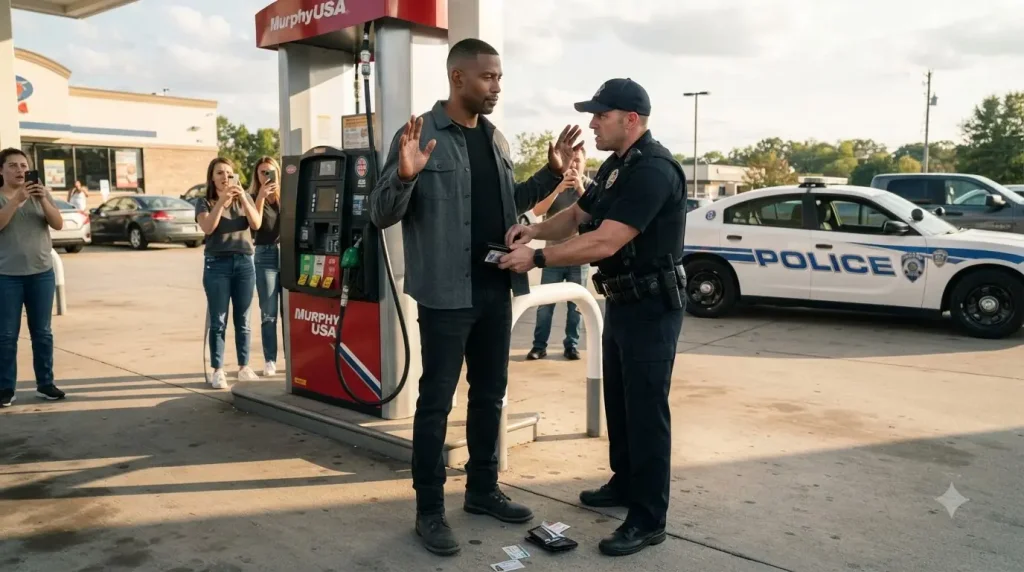
“The pouch was concealed legally on my person.”
Silence.
“The officer initiated contact based on an unverified complaint.”
Maddox interrupted.
“There was a real call.”
“Yes.”
That mattered.
The call existed.
A convenience-store employee had reported a man arguing with customers near the pumps.
Security video later showed that man was white, mid-twenties, red baseball cap, green hoodie.
Nothing like Adrian.
Rourke had not asked the store employee for a description before approaching him.
Adrian continued:
“He selected me instead.”
Maddox said, “Mistakes happen.”
“Then he searched me without articulating cause.”
“Officer safety.”
“He threw my wallet.”
“Unprofessional.”
“He shoved me twice.”
“Potential force-policy issue.”
“He removed my phone.”
“Depends on context.”
“He opened a sealed pouch.”
Maddox hesitated.
Then:
“Search incident.”
“I wasn’t under arrest.”
Silence.
Adrian looked toward the city attorney.
The attorney looked down.
Harmon said, “Chief, this is no longer about debating the stop.”
Maddox turned.
“What is it about?”
She opened a folder.
“Historical complaints.”
His expression hardened.
“I’ve reviewed complaints.”
“Yes.”
“Most unfounded.”
“By whom?”
“My supervisors.”
“Including Captain Reeves?”
One of the men beside Maddox stiffened.
Harmon noticed.
So did Adrian.
Maddox said, “Reeves runs patrol standards.”
Harmon opened another file.
“Six complaints involving Rourke were closed by Captain Reeves.”
“So?”
“Three were closed within forty-eight hours.”
“Efficient investigation.”
“One complainant was never contacted.”
Reeves spoke.
“That isn’t accurate.”
Harmon slid a page across the table.
“Phone logs.”
Reeves looked at it.
His face changed.
Maddox said, “We’re not turning one officer’s misconduct into an attack on command.”
Adrian leaned back.
Interesting phrasing.
One officer.
Before Internal Affairs had concluded anything.
Maddox had already isolated Rourke.
Distance.
Protection.
Harmon closed the folder.
“Nobody is attacking command.”
Maddox looked at her.
“We are auditing it.”
That ended the meeting.
At least verbally.
Chief Maddox left furious.
Captain Reeves followed.
The city attorney remained.
He closed the door.
Then said:
“You need to look at vehicle searches.”
Harmon looked up.
“What?”
The attorney sat.
Adrian watched.
His name was Peter Lang.
Mid-forties.
Conservative suit.
Sweat forming near his hairline.
He looked toward the door.
“Not just complaints.”
Harmon said, “Explain.”
Lang swallowed.
“There are civil claims.”
“How many?”
“Eight in two years.”
Adrian frowned.
“That many?”
“Informal notices. Most settled before filing.”
“For what?”
“Searches. Property damage. One wrongful detention.”
“Rourke?”
“Four involve him.”
Adrian’s expression changed.
“Why weren’t they included in complaint review?”
Lang looked ashamed.
“Different database.”
Harmon almost laughed.
“Of course.”
Government systems could hide truth without anyone technically hiding anything.
Personnel complaints in one system.
Claims in another.
Use-of-force reports elsewhere.
Property logs somewhere else.
Corruption loved fragmentation.
Lang continued.
“One claim alleged cash missing after a vehicle inventory.”
Adrian sat forward.
“How much?”
“Twenty-two hundred.”
“What happened?”
“Settled for five thousand without admission.”
“Officer?”
Lang hesitated.
“Rourke and another.”
“Who?”
“Sergeant Brennan.”
Harmon wrote the name.
Lang continued.
“Brennan retired last year.”
“Where is he now?”
“Private security.”
Adrian asked, “For whom?”
Lang looked at him.
“A chain of fuel stations.”
Silence.
Adrian felt something click.
“Which chain?”
Lang gave the name.
It included the gas station from that afternoon.
Harmon stared.
Adrian stood.
The integrity test had selected the location because multiple complaints clustered around the corridor.
Nobody had known retired Sergeant Brennan worked security for the chain.
Coincidence?
Maybe.
Probably not.
Adrian asked, “Who called police today?”
Lang did not know.
Harmon immediately contacted the evidence team.
Within twenty minutes, they had the store incident call.
The employee who supposedly called had not.
The manager had.
Why?
The manager said a customer complained.
Which customer?
He did not know.
Security cameras would show.
Video review began.
At 7:42, an analyst entered the conference room.
“Found him.”
They gathered around a monitor.
Gas-station footage.
Twenty minutes before Rourke arrived.
Adrian’s pickup entered.
He parked.
Started fueling.
A white man in his sixties stood near the store entrance.
Baseball cap.
Sunglasses.
He watched Adrian.
Then walked inside.
Spoke briefly to the manager.
Left through another door.
The analyst froze the frame.
Harmon stared.
Adrian knew the face from a photograph retrieved forty minutes earlier.
Retired Sergeant Brennan.
The room became quiet.
Harmon said, “He triggered the call.”
Adrian looked at the screen.
“Question is why.”
They found out the next morning.
Brennan had recognized Adrian.
Not personally.
From a department bulletin circulated two years earlier after Adrian led an Internal Affairs review in another jurisdiction.
He saw the investigator at a fuel station where Rourke regularly patrolled.
Then what?
Had Brennan deliberately tried to expose Rourke?
Or test Adrian?
Or warn somebody?
Phone records answered part of it.
Brennan called Rourke eleven minutes before the stop.
Duration: forty-eight seconds.
Then Chief Maddox.
Duration: two minutes, twelve seconds.





