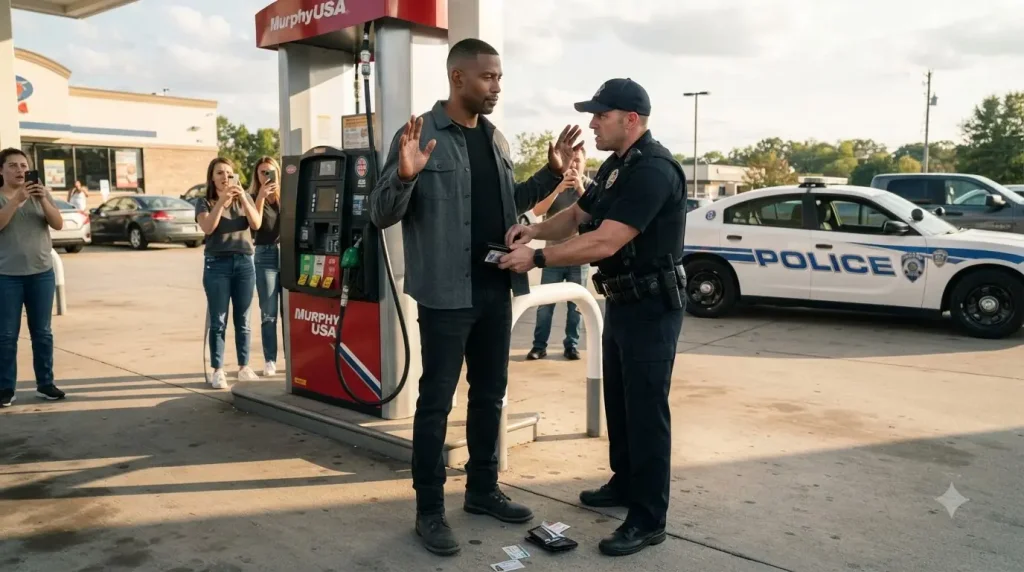
Rourke ignored him. The screen was awake, showing a call timer ticking past nine minutes. Rourke squinted at it. “Who are you talking to?”
Adrian stayed silent.
Rourke thumb-pressed the side button, extinguishing the display. “Unlock it.”
“No.”
Color rose along Rourke’s collar. “You don’t tell me no.”
“I just did.”
Rourke raised the phone. For a split second Adrian braced himself to see it smashed against the pump. Instead, Rourke gave a careless, contemptuous flick of his wrist, slapping the device out of his own hand toward the ground. It hit the concrete, bounced once, and slid underneath the dusty black pickup.
“Hey!” the woman by the SUV called out.
Rourke whipped toward her. “Stay out of this!”
She froze, gripping her phone tightly.
Adrian looked back toward the cruiser. The computer terminal chimed again, louder and more insistent. Mason leaned deeper into the cabin, his posture stiffening. His hand touched the screen; another alert flashed, followed by another.
“Rourke.”
Rourke didn’t answer. He unclipped his handcuffs, letting the steel links clink softly against his belt.
“You might want to check what your partner is seeing,” Adrian said.
Rourke snapped one cuff open. “I think I’m done taking advice.”
“Rourke!” Mason’s voice cracked, sharper than before.
Something in the tone finally pierced through. Rourke turned. Mason was staring at the glowing terminal inside the cruiser, every trace of color drained from his face.
“What?” Rourke demanded.
Mason looked from the screen to Adrian, then down at the ripped black pouch in Rourke’s hand. “His name triggered an integrity flag.”
Rourke’s face went blank. “What did you say?”
Mason swallowed hard. “Integrity flag.”
Rourke took two fast strides toward the cruiser. “Move.”
Mason stepped back out of the way. Rourke leaned through the open window, eyes darting over the illuminated text. The exact wording was angled away from Adrian, though Adrian knew the architecture of the protocol by heart: Restricted credential. Protected operation. Contact supervisory command. Do not alter body-camera state. Preserve all digital evidence.
Rourke stared at the screen. “No.”
“It says Internal Affairs,” Mason whispered.
Slowly, Rourke straightened and turned around. Adrian was standing right where Rourke had left him—hands still open and visible, charcoal overshirt rumpled from the shove, wallet face-down near the pump, cracked phone somewhere beneath the pickup’s front axle. A thin red welt was already rising along the side of Adrian’s neck where Rourke’s forearm had driven him into steel.
Rourke looked down at the key-fob transmitter in his hand, then at the torn pouch, then at the crisp hundred-dollar bills. His thumb shifted away from the edge. A small white-and-silver label came into view along the back of the unit:
IAD EVIDENCE — DO NOT OPEN OUTSIDE CONTROLLED TEST
Beneath it, in smaller type:
PROPERTY OF PROFESSIONAL STANDARDS / SERIALIZED CURRENCY
Rourke stopped breathing.
“Oh my God,” Mason breathed.
Adrian smoothly pulled the front of his overshirt straight. “Good.”
Rourke stared at him, chest rising and falling too fast.
Adrian’s voice stayed quiet, almost conversational. “Now they heard you do it yourself.”
From the direction of the state highway came a low, throaty rumble—two engines decelerating together. Within seconds, two dark, unmarked SUVs swung into the station from opposite driveways, fast and coordinated. One boxed in the rear of the patrol cruiser; the other angled across the front bumper, cutting off any clean exit.
Doors clicked open simultaneously. Plainclothes investigators stepped out in unhurried strides, credentials flashing at waist level. No one drew a weapon. None was needed.
The atmosphere over the concrete shifted in a single breath. Rourke stood frozen with an open handcuff dangling from one hand and six hundred dollars of Internal Affairs currency in the other. Mason quietly took two steps sideways, widening the space between himself and his senior partner. It wasn’t theatrical—just a small, unmistakable distance that both men registered.
A tall woman in a dark charcoal pantsuit reached Adrian first. She was in her late forties, auburn hair pulled back into a neat knot, her face set in calm, unreadable lines. A step behind her walked a Black man around fifty with a closely shaved head, a slate-gray tie, and the unhurried economy of movement that comes from years of watching people lie.
The woman looked at Adrian. “You all right?”
“Fine.”
Her eyes dropped to the red mark along his neck. “That isn’t fine.”
Adrian gave a slight shrug. “Still standing.”
The investigator with the shaved head bent, picked up Adrian’s wallet, brushed a streak of grit off the leather, and handed it back.
Rourke finally found his voice, tight and incredulous. “What is this?”
The woman turned to him. “Lieutenant Harmon. Professional Standards Division.” She held up her badge and credentials.
Rourke stared at the card, then swung his gaze back to Adrian. “You’re Internal Affairs?”
Adrian crouched beside the pickup, reached under the bumper, and retrieved his phone. A spiderweb of cracks ran across the upper-left corner, though the display still lit up cleanly. He stood up and answered Rourke’s question. “Investigator attached to Professional Standards.”
Rourke looked wildly around the lot—at the bystanders holding up phones, at Mason, at the two SUVs, at the torn nylon pouch. “Bullshit.”
Harmon didn’t blink. “You’re welcome to preserve that theory for your attorney.”
Rourke’s right hand twitched toward his chest vest.
“Do not touch your body camera,” the older male investigator said immediately.
Rourke’s hand froze an inch from the strap. Adrian looked at the small lens clipped to Rourke’s uniform. The tiny status light was glowing. That mattered—Rourke hadn’t killed the feed before the stop. Neither had Mason.
“Place the handcuffs on the hood of your cruiser,” Harmon said.
Rourke glared at her. “You can’t be serious.”
“Do it.”
“This was a lawful investigative detention.”
Adrian looked at him. “Was it?”
Rourke jabbed the bills toward him. “He had cash concealed in a sealed bag.”
“Which you discovered after initiating a search,” Harmon noted evenly.
“He was suspicious.”
“How?”





