It was not a hurried, stolen brush of lips. It was a long, deep, devouring embrace, seasoned with the confidence of long practice. The girl went up on the toes of her snow boots, pressing her entire torso against his chest, her mouth moving against his with a soft, greedy familiarity.
Inside Margaret’s chest, something made a sound like dry branches snapping under the weight of wet snow.
The air in the promenade seemed to thin out, losing its oxygen in an instant. Her vision tunneled until the only thing in the universe was the charcoal wool of his coat, the ivory fleece of the girl’s collar, and the slow, rhythmic cadence of their breathing against the white backdrop of the Purcell Mountains.
Her fingers were still inside her pocket. They were gripping the cream envelope with such violent pressure that the embossed gold lettering was biting into the meat of her thumb.
She didn’t plan her feet. Her boots moved of their own accord, heavy and disconnected from her brain, pushing down the brass bar.
The storm doors opened with a soft, pneumatic hiss.
The mountain wind struck her like a slap, carrying needles of ice that cut across her cheeks. The cold was merciless, clean, and entirely indifferent to the woman standing on the cedar decking.
“Robert.”
Her voice was not loud. It was barely more than a cracked whisper, but in the vast, deadened quiet of the snowy terrace, it carried like a pistol shot.
Robert jerked backward as if an electric wire had touched the base of his spine.
The girl gasped, stumbling back half a foot, her boots catching on a snowdrift banked against the low cedar railing. Her hand flew to her lips, wiping away the shine of his mouth.
Robert turned. The blood drained from his face so fast it left his skin the color of skimmed milk, the sharp winter light catching the grey in his temples, the wrinkles around his eyes, and the wild, animal horror that had taken up residence in his pupils.
“Meg,” he breathed.
He didn’t move toward her. He looked down at the snow, then at the French doors behind her, as if calculating the probability of a waking nightmare.
Margaret looked at him. She looked at his parted lips, still red and bruised from another woman’s teeth. She looked at his tie, loosened two inches at the throat—the burgundy silk tie she had knotted for him three mornings ago before his client breakfast.
She pulled her hand from her pocket.
She held out the cream envelope. Her fingers were trembling so violently that the gold foil caught the gray mountain light in erratic, blinding flashes.
“Our anniversary,” she said.
The words were small, dried-out husks. They were all she had brought up the mountain, and now they sounded grotesque, like children’s toys found in the debris of a burned house.
Robert’s gaze dropped to the envelope. He read the calligraphy. He saw the resort logo. He saw the red ribbon dangling from her thumb.
“Margaret… God. Meg, please. Listen to me.” He took an awkward, halting step forward, his hands coming up, palms out, in the posture of a man trying to negotiate with a hostage taker. “You don’t understand what this is. Please, just come inside. It’s freezing out here. Come inside and let me explain.”
“Explain?”
The word tore out of her throat, ragged and foreign.
The girl stepped sideways, trying to melt into the shadow of the covered gazebo where an iron firepit sat cold and choked with gray ash.
“Claire, give us a minute,” Robert snapped without looking at her.
Claire.
The name had a sound. It was crisp, young, and light. It had two syllables that tasted of citrus and clean linen. It was the name of his senior paralegal—the girl whose resume Robert had left on the kitchen island six months ago, remarking casually over his morning toast that the firm needed new energy, someone who doesn’t mind the forty-hour weekend prep for the arbitration hearings.
She’s very capable, Meg, he had said then. A little green, but she learns fast.
Margaret looked at Claire. The girl couldn’t have been more than twenty-six. Her cheeks were pink from the mountain air, her eyes wide, glassy with terror, her small mouth trembling behind her gloved fingers. She wasn’t an abstraction anymore. She was a living, breathing creature who had slept in Margaret’s sheets of imagination, who had taken the hours Margaret had spent waiting dinner, who had taken the husband who was supposed to be growing old on the porch in Calgary.
“Margaret, don’t do this here,” Robert pleaded, his voice dropping into that smooth, measured register he used when a witness was becoming unmanageable on the stand. “People are going to see. The councilors are in the lounge. Let’s go to my suite. We can talk about this like adults.”
“Like adults?”
She looked down at the cream envelope in her hand.
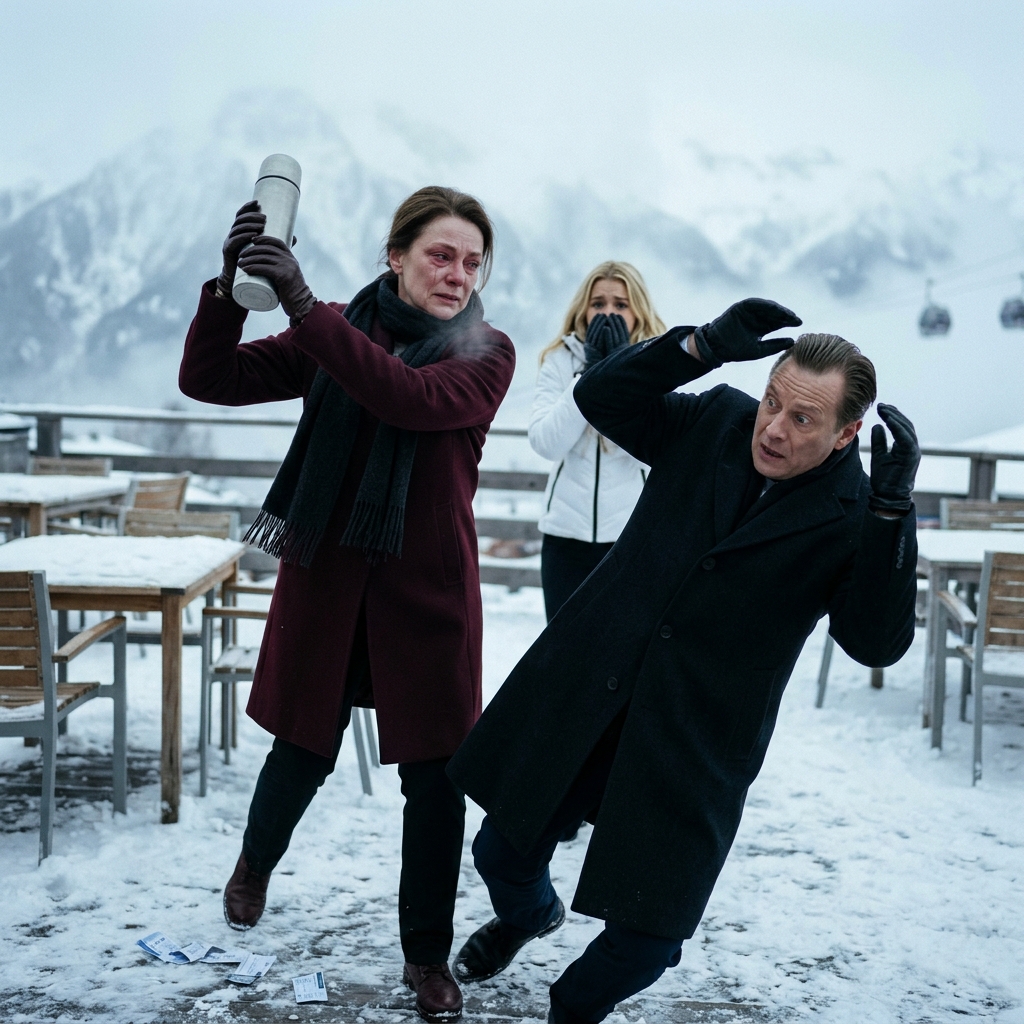
She slid her thumb under the gold seal. The paper tore with a dry, sharp rip that cut through the wind. She pulled out the two stiff, laminated passes. Carriage No. 7. Sunset Crossing.
She placed her thumbs in the center of the cardstock.
“Meg, don’t—”
She tore them.
The heavy fiber resisted for a heartbeat, then split with a sound like bone cracking. She stacked the halves together, turned them ninety degrees, and tore them again, using the full weight of her forearms, her knuckles turning chalk-white against the frost. She tore them until they were small, jagged confetti of red ribbon, gold foil, and shredded linen paper.
Robert reached out, his fingers brushing the sleeve of her coat. “Stop it. Stop it, Meg, you’re being hysterical—”
She opened her hands.





