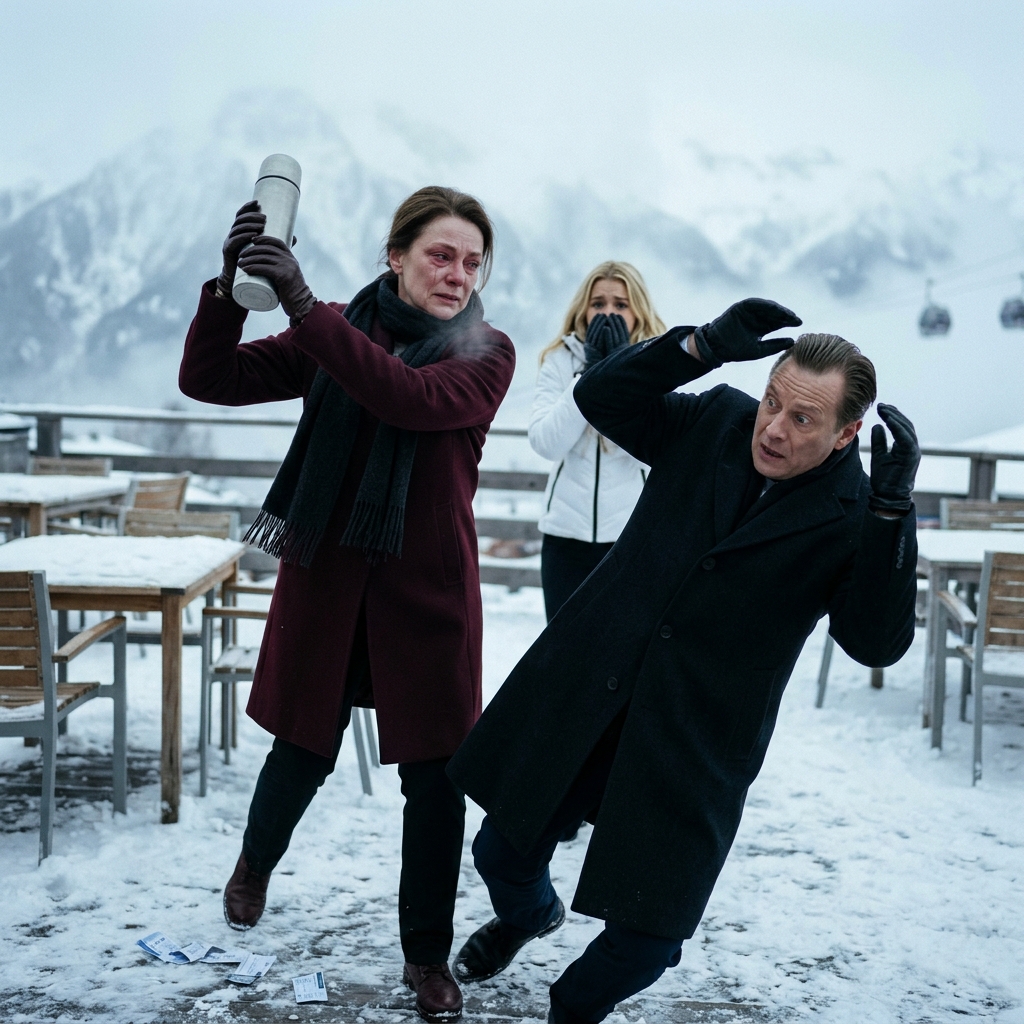
The mountain wind caught the pieces immediately. They didn’t fall straight down; they swirled between them in a small, chaotic vortex, dancing on the air before settling like dirty yellow teeth into the pristine white drift at Robert’s feet.
“Twenty-five years,” Margaret said. Her voice wasn’t shaking anymore. It had gone flat, hollowed out, cold as the granite cliffs rising behind the resort. “You told me you were too tired for the cottage this summer. You told me your back was bothering you.”
“Meg, it was a mistake—”
“You let me buy groceries for one because you said you were working through the evenings,” she whispered, stepping closer to him. “You let me sit by the phone every Tuesday night.”
“It’s not what you think—”
“Shut up.”
The command was so absolute that Robert’s mouth snapped shut.
Beside them, on the heavy cedar dining table that sat under the terrace overhang, rested the items the resort catering staff had left for the afternoon: a tray of unused ceramic mugs, a basket of linen napkins, and a heavy, three-liter commercial thermos of polished stainless steel, still steaming faintly around its rubberized pressure valve.
Margaret’s hand moved without thought.
Her fingers closed around the cold, grooved steel handle of the thermos. It weighed nearly ten pounds, full of scalding water meant for the four o’clock tea service.
She lifted it from the tray.
The metal clattered against the iron stand with a sharp, violent ring.
Robert recoiled instantly. His boots scrambled backward across the snow-dusted cedar planks, his eyes widening in pure, primal panic. Both of his hands went up to shield his face, his shoulder slamming hard against the log pillar supporting the roof.
“Margaret, no! Put it down!” he shouted, his voice cracking into a high, undignified shriek.
Beside the firepit, Claire let out a stifled scream, pressing her back against the railing, her hands glued over her mouth, her eyes darting toward the glass doors as if measuring the distance to safety.
Margaret stood there, the heavy cylinder of boiling steel suspended in her right hand, her arm trembling from the dead weight.
She looked at her husband.
He was cowering. His chin was tucked into his chest, his eyes squeezed half-shut, his expensive coat bunched around his ears. This was the man who had commanded boardrooms, who had cross-examined provincial ministers, who had told her for two decades that she was too soft, too sentimental, too easily wounded by the roughness of the real world.
He was terrified she was going to burn his face off.
He truly believed, in that terrible, crystal-clear second, that she was capable of disfiguring him on an open patio in front of the provincial zoning board.
The realization settled over Margaret not like fire, but like ice water.
He didn’t know her at all.
Nine thousand days of sharing a bed, nine thousand mornings of pouring his coffee, nine thousand nights of listening to the rhythm of his lungs in the dark, and he believed she was a beast who would throw boiling water on a human being because her pride had been nicked.
A long, slow breath rattled through her chest, filling her lungs with the scent of spruce needles and clean snow.
She lowered the thermos.
She didn’t drop it; she set it down on the cedar table with deliberate, agonizing care, until the steel base met the wood without making a sound.
“You really think that little of me, don’t you, Robert?” she asked.
His eyes opened slowly, peering over the defensive wall of his leather-gloved fingers. His chest was heaving, his breath plume-white and ragged in the freezing air.
“Meg…” he croaked.
“You think I’m like you,” she said, her voice dropping into a register that made Claire shiver across the deck. “You think everyone is as cheap as you are.”
She stepped past him.
She didn’t look at Claire. The girl didn’t exist anymore; she was merely an empty coat standing in the cold, an expensive mistake that Robert would have to pay for with the rest of his life.
Margaret walked to the low cedar railing at the edge of the observation deck.
Below her, the valley opened up—a vast, white trough carved by glaciers ten thousand years ago. Through the center of the void, suspended on thick cables that disappeared into the drifting mist, hung the little red cabins of the Alpine Skyway. They moved in slow, stately procession, silent as beetles, carrying tourists who believed they were suspended between heaven and earth.
She reached into her coat pocket again.
She pulled out her wedding ring.
It didn’t come off easily. Her knuckles had grown thicker over the years, swollen from gardening, from cooking, from thirty winters in the Alberta frost. She had to twist it, the cold metal dragging against the bone, leaving a red, raw furrow in the pale flesh where the sun had never touched for twenty-five years.
It came free with a small, dry pop.
She held it between her thumb and index finger. A plain band of white gold, engraved on the inside with six numbers: 06.14.01.
Robert had lowered his hands now. He was watching her, his face gray, his eyes hollowed out by an understanding that had arrived too late.
“Margaret, don’t,” he whispered. “Whatever happens between us… don’t do that.”
“There is no ‘between us,’ Robert,” she said.
She didn’t fling it with theatrical fury. She didn’t scream at the sky.
She simply turned her hand over and opened her fingers.
The ring fell.
It didn’t catch the light; the sky was too gray, too heavy with snow. It simply vanished into the thousand-foot drop below the deck, plunging through the spruce tops, through the mist, into the frozen stones of the canyon floor where no one would ever find it.
Margaret turned around.
The wind had died down, leaving the terrace in a terrifying, church-like silence.





