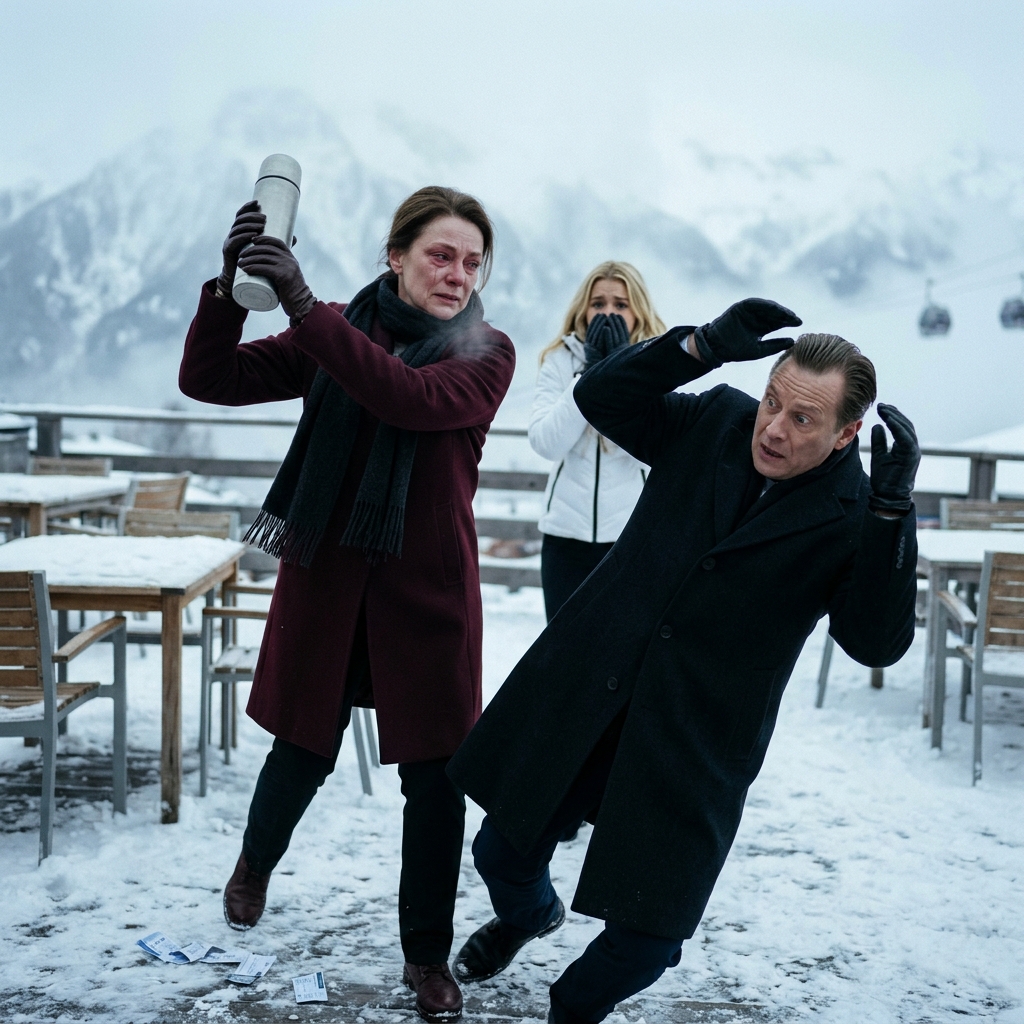
Robert stood in the center of the deck, looking down at the shredded pieces of gold foil at his boots. His coat was still unbuttoned, the wind fluttering the silk of his tie against his ribs. He looked old. He looked like an empty house whose lights had been left on after the furniture was moved out.
“The house is in my grandfather’s name, Robert,” she said, her voice entirely even, as though she were discussing the lawn care schedule with the gardener. “The firm’s line of credit requires my signature on the family trust guarantees. You have until Sunday evening to clear your things from the guest room. Leave the keys on the sideboard.”
“Margaret, we have a life,” he choked out, taking a half-step toward her, his face contorting into an ugly, desperate mask. “You can’t just… after twenty-five years, you can’t just erase everything because of—”
“You erased it,” she said, cutting him off without raising her voice. “I’m just taking out the trash.”
She didn’t wait for him to answer. She didn’t wait for Claire to find her voice.
Margaret walked toward the French doors.
Her boots crunched over the snow, each step firm, heavy, and balanced. She pushed down the brass panic bar, stepped through into the warm, cedar-scented air of the promenade, and let the heavy glass door swing shut behind her.
The pneumatic seal hissed, locking out the wind, locking out the cold, and locking the two of them onto the freezing deck behind her.
In the lobby, the fire was still crackling in the great stone hearth. The bellman nodded to her politely as she walked past, heading toward the heavy oak exit doors where her car was parked in the circle.
Outside, the snow was falling faster now, covering the tracks her tires had made on the way in.
Margaret pulled her keys from her pocket. Her left hand felt light, strange, and entirely unburdened, the cold mountain air whistling over the raw red strip on her ring finger.
She got into the driver’s seat, turned the key in the ignition, and listened to the engine catch with a low, steady purr. She didn’t look in the rearview mirror as she pulled out of the resort gates. She didn’t look at the mountains rising behind her.
She turned the heater up, adjusted the rearview mirror to the road ahead, and began the long drive down the mountain, heading home to an empty house that belonged, for the very first time in twenty-five years, entirely to her.
The frost had formed along the passenger-side glass in the geometry of needles—translucent, serrated, and cold enough to burn.
All through the two-hour ascent into the Kicking Horse Pass, Margaret kept the heater on the lowest click. She needed the mountain air to seep through the weatherstripping, carrying the bitter, clean scents of crushed balsam, road salt, and diesel exhaust. Too much artificial heat made her drowsy, and the mountain highway was not a road that forgave inattention. Every four miles, the yellow diamond signs warned of rockfall and avalanche chutes where the Purcell Range sheared off into the canyon floor.
On the leather seat beside her rested a heavy cream envelope stamped with the gold crest of the Alpine Skyway at St. Jude Ridge.
Inside were two commemorative passes: Silver Anniversary Special Edition, Carriage No. 7, Sunset Crossing.
She had secured them four months earlier, enduring three dropped phone calls with the resort’s archaic reservation desk while Robert was down in the cedar-lined basement workshop, running the table saw to avoid the sound of the evening news. She had pressed the silk lining of her navy wool coat before dawn, when the streetlights in Calgary were still haloed with ice fog. She had baked the shortbread he claimed only she could balance—heavy on the cultured butter, light on the vanilla, packed into a vintage square tin tied with a frayed grosgrain ribbon saved from their 2001 wedding registry.
Twenty-five years was nine thousand, one hundred and thirty-one days. In that span, a marriage ceased to be a romantic proposition and became an architecture. A stone-and-mortar reality. You learned which floorboards in the upstairs corridor creaked after midnight; you learned that his throat grew raspy only when an arbitration panel pushed past five o’clock; you learned how to absorb the brutal, silent stretches of late November when the quarterly partner draws were tallied and his pride felt bruised by younger billable hours.
Before Miller & Sterling had grown into three floors of polished granite in downtown Calgary, it had simply been the Miller firm—founded by Margaret’s grandfather, Arthur Miller, whose bronze portrait still anchored the library. Margaret had been the third-generation litigator, the sharp-tongued junior who had edited Robert’s briefs when he was still an anxious transplant from a Saskatchewan wheat farm with grease beneath his fingernails and an ill-fitting poly-blend suit. When Arthur’s heart had given out on the courtroom steps twenty years ago, and their second child had failed to take hold in her womb, Margaret had made a choice that everyone in their social circle called gracious: she stepped back from active litigation to oversee the Miller Family Trust, the foundation endowments, and the quiet institutional relationships that kept the firm’s credit line unbroken. She made Robert the managing partner. She gave him the corner office, the mahogany desk, and the family name on the brass plate.
When he kissed her cheek at five-fifteen that morning, his skin had smelled of peppermint lozenges and the bay-rum splash she had bought him for his fifty-second birthday. His pigskin weekend duffel—a gift from his partners—was already stowed in the rear of his Audi.
“Just the provincial zoning panel, Meg,” he had murmured into the crown of her hair, his thumb tracing the ridge of her cheekbone with the smooth, unthinking ease of an old habit. “Three forestry liaisons, two local aldermen, and twenty hours of timber-line easement disputes. It’s dry as cedar dust. I’ll be back before seven tomorrow. Don’t wait up, but leave the porch light on.”
“Don’t try the pass if the plows pull back tonight,” she had told him, smoothing the lapels of his charcoal cashmere coat—the heavy, beautiful coat she had ordered from an Edinburgh tailor for their twentieth.
“I won’t. I’m too fond of my skin to play pioneer.”
She had smiled in the darkness of the front hall, harboring her private conspiracy like a warm stone in her palm. The reservation for Carriage No. 7 was for four-fifteen—timed precisely to catch the alpine glow as the sun dipped behind the western peaks, washing the valley in violet and rose. She would arrive at three. She would wait near the stone hearth until his afternoon recess was called. She would catch his eye across the crowded lounge, slip the envelope into his breast pocket, and whisper that the forestry liaisons could survive sixty minutes without him.
Now, the timber arches of the St. Jude Ridge Resort rose against the charcoal sky like an ancient stronghold. Huge, dagger-tipped icicles hung from the cedar eaves, dripping rhythmically onto the heated slate pavers of the porte-cochère.
The valet reached for the driver-side door, but Margaret waved him off with a polite nod, sliding her weekender onto her shoulder. Her gloved hand remained deep in her right pocket, fingers hooked around the stiff edges of the gold-embossed passes. She did not want the cardstock bent. She did not want a single crease in the paper.
The interior of the Great Hall was dense with the scent of burning tamarack and dry pinot noir. A four-sided fireplace built from river boulders dominated the center of the room, sending a column of orange sparks up toward the timber rafters forty feet above. Outside, the blizzard was beginning to organize itself, throwing grains of hard sleet against the clerestory glass.
Margaret stepped to the perimeter of the room, near an antique grandfather clock whose brass pendulum swung with slow, mechanical certainty. She reached into her handbag, took out her phone, and tapped out a brief message.
Are you in conference, or taking air?
She watched the small blue bubble hang on the screen. The clock ticked three times before the gray typing indicator flickered into view.
On the terrace off the observation lounge. Catching five minutes before the afternoon session resumes at four. Cold wind helps clear the head.





