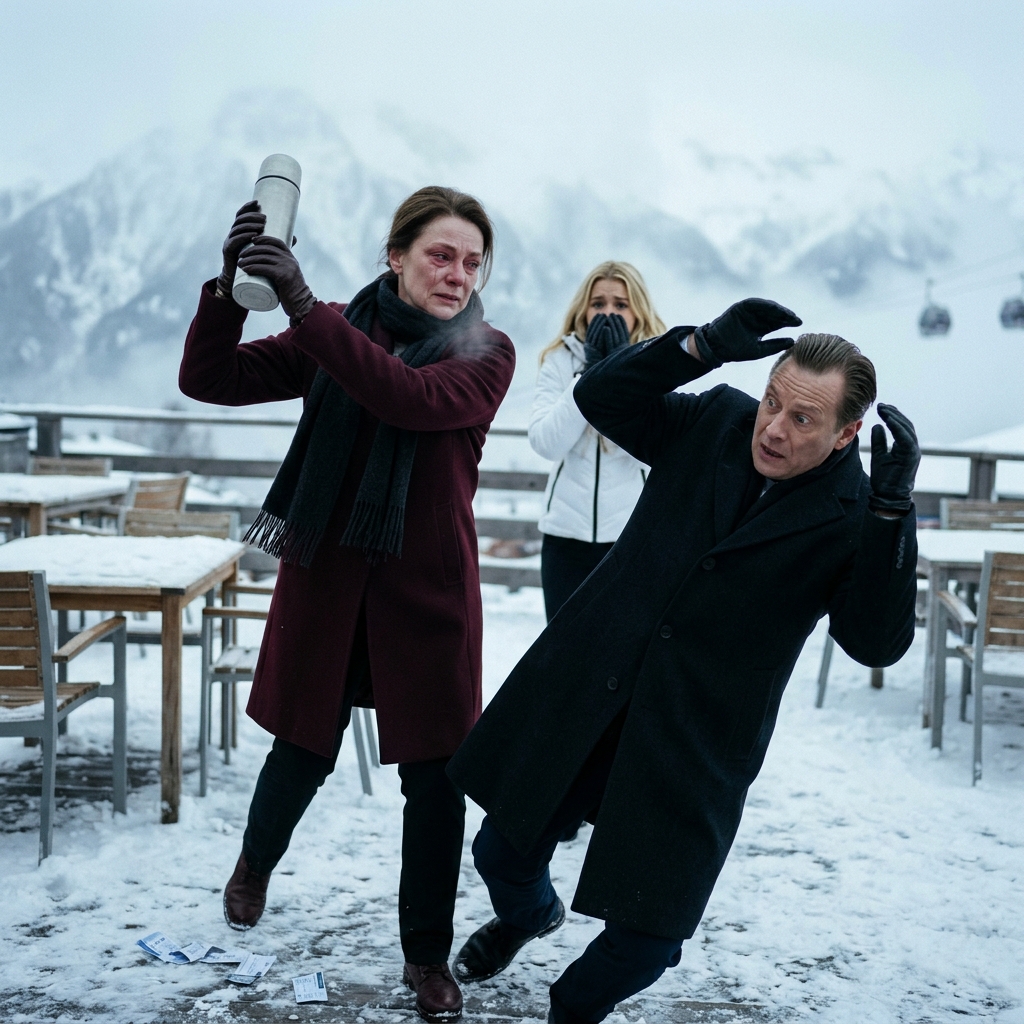
A quiet, secret warmth bloomed in her throat. The observation deck was situated on the western parapet, cantilevered out over the gorge where the Skyway cables vanished into the mist. It was exposed, windy, and largely deserted when the temperature fell below zero.
She turned toward the glass promenade that linked the main lodge to the western wing. Her boots made no sound on the thick wool runner. Through the tall windows, she could see the heavy machinery of the gondola terminal: the massive bullwheels spinning in their grease, the steel cables groaning under the tension of sixty tons of suspended iron.
At the end of the corridor, two heavy storm doors flanked with frosted cedar boughs opened onto the deck.
Margaret paused. Through the soundproof double panes, the silhouette was instantly recognizable.
Robert stood at the far cedar railing, his back to the building. The collar of the Scottish cashmere coat was turned up against the squall, the broad line of his shoulders slightly rounded against the wind.
She smiled, her hand rising to the brass panic bar of the door. The greeting was already formed behind her teeth: You’re five minutes behind schedule, counselor.
Then her breath caught in her windpipe.
Robert was not alone.
Tucked directly within the unbuttoned wings of his coat was a woman. She was petite, wearing an ivory down parka with a hood trimmed in silver fox, her hands buried deep beneath Robert’s suit jacket, resting flat against his chest. Her face was tilted upward into the gale, her eyes squeezed half-shut with laughter.
Robert did not step back. He did not check over his shoulder.
His left hand—the hand bearing the thin band of white gold Margaret had slipped over his knuckle in a stone chapel on a summer morning twenty-five years ago—reached up and cupped the back of the woman’s neck. His leather-gloved fingers burrowed deep into the blonde hair spilling from beneath her knit cap.
He bent his head.
It was not a hurried collision. It was not the clumsy, drunken lurch of an indiscretion born of too many martinis at a convention bar. It was a prolonged, practiced possession. His mouth moved over hers with a predatory, famished familiarity that Margaret had not seen in his face since they were thirty years old and renting a damp carriage house off 17th Avenue. The girl rose onto the rubber toes of her winter boots, pressing her hips against his thighs, her mouth opening against his with an intimacy that tasted of long habit.
Inside Margaret’s ribcage, the world went completely, terrifyingly silent.
The sound was not an explosion. It was the dry, sickening tock of a weight dropping through rotted ice.
The heat in her blood vanished, leaving her veins lined with something cold and chemical. Her peripheral vision collapsed into a tight, dark tunnel whose only contents were the charcoal wool of the coat she had chosen, the ivory fur around the girl’s jaw, and the twin clouds of their mingled breath freezing into the mountain wind.
Her hand was still resting on the brass push-bar.
She did not decide to move. Her body acted with the detached, mechanical autonomy of a witness to an accident. She leaned forward.
The heavy door gave way with a long, pneumatic hiss.
The alpine gale struck her like a frozen sheet of canvas, tearing the breath from her nostrils and driving needles of sleet against her eyelids. The terrace was twenty feet wide, floored in heavy cedar planks grayed by salt and exposure.
“Robert.”
Her voice was not loud. It was thin, stripped of timbre, but in the flat, white silence of the snow, it cut through the hum of the gondola cables like a straight razor.
Robert tore himself away from the girl as though a live electrical conduit had brushed his neck.
The woman stumbled backward, her boots skidding across the frosted planks, her gloved hands flying up to cover her mouth. Her knit cap tilted, revealing the smooth, unlined forehead and wide amber eyes of someone who could not have been older than twenty-seven.
Robert swung around.
The color did not drain from his face; it dropped away entirely, leaving his features the waxy, yellowish gray of lard. The wind whipped a lock of thinning silver hair across his forehead. He stared at Margaret, his jaw dropping slightly, his eyes widening in the absolute, paralyzed horror of an animal that has stepped onto a trigger plate.
“Meg,” he whispered.
He looked at her navy coat. He looked at the weekender bag slung across her shoulder. He looked back at the glass doors through which she had just emerged, as if desperately checking whether this was a projection of his own guilty conscience or a physical human being standing eight feet away.
Margaret did not speak. She could not. Her lungs felt as though they had filled with powdered glass. Her gaze dropped to his chest. His necktie—the heavy silk knit in forest green she had bought him for their last anniversary—was crooked, pulled two inches to the left, revealing the pale, exposed skin of his throat.
She reached into her coat pocket.
Slowly, deliberately, she pulled out the cream envelope. The gold foil of the skyway crest caught the pale, dying light that filtered through the storm clouds.
“Our anniversary,” she said.
The words sounded foreign, like syllables learned phonetically in a language she did not understand.
Robert’s gaze fell to the envelope. His eyes tracked the gold calligraphy: Silver Anniversary Special Edition. He swallowed, a dry, clicking sound that was audible even over the wind.
“Margaret… my God. Margaret, listen to me.” He took a clumsy, tentative half-step forward, his hands rising, palms turned outward in the classic posture of a defense attorney attempting to soothe an agitated judge. “This isn’t… you don’t know what you’re looking at. Please. It’s twenty below out here. Come inside. Just let me get us a private room and we can—”





