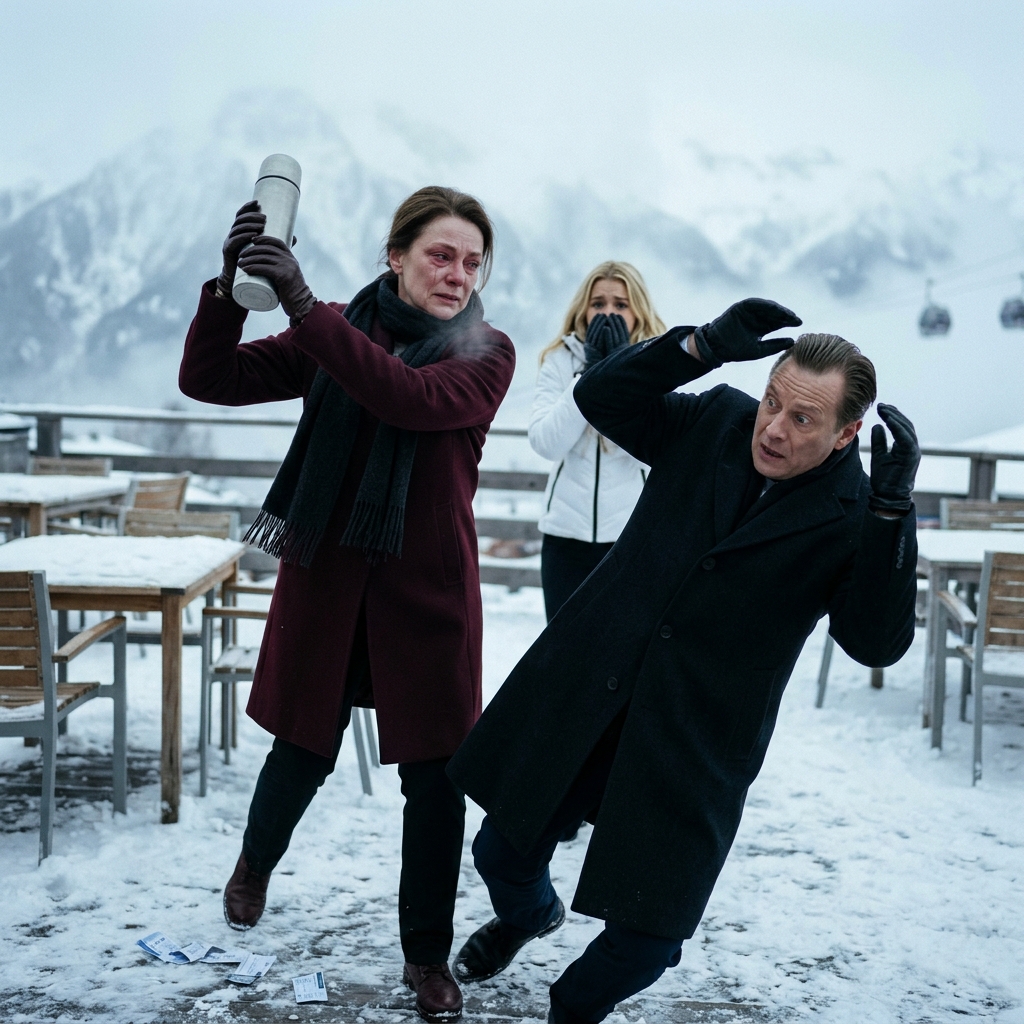
He had not wanted an anchor. He had wanted a ballast tank he could flood and detach before his ship hit the rocks.
“Is this true, Robert?” Margaret asked.
Robert did not answer. He didn’t look at Claire, and he didn’t look at Margaret. He looked out over the railing, into the white, howling nothingness of the valley, his lips moving soundlessly as he calculated billable hours, liability limits, and the criminal code sections on corporate fraud.
“The board meets in the Glacier Room at four, doesn’t it?” Margaret asked.
Robert’s head jerked toward her. “Margaret, don’t. The councilors are in there. The Deputy Minister of Forestry is in there. If you make a scene—”
“I don’t make scenes, Robert,” she said, her voice smooth, level, and deadly as an arctic current. “You know that. My father never made scenes. We make records.”
She reached into her coat pocket for the last time.
Her left hand came out bare.
She looked down at her ring finger. The white-gold band had been there so long that the skin beneath it was pale, slightly flattened, marked by the faint indentation of twenty-five Canadian winters.
She placed her right thumb and forefinger against the metal.
It did not slide off easily. Her knuckles had thickened over the years—from weeding the cold dirt of the perennials in May, from carrying grocery sacks up the brick steps of the house her grandfather had built on Mount Royal, from holding the wheel of the station wagon on thousand-mile trips to legal conventions.
She twisted it. The gold dragged over the knuckle, scraping the dry skin, until it popped free into her palm with a faint, greasy click.
She held it between two fingers.
Inside the band, she knew the engraving by heart: R.S. to M.M. — Non Sibi Sed Omnibus. Not for oneself, but for all. Her father’s favorite Latin maxim. The firm’s motto.
Robert saw the ring.
“Meg,” he whispered. The fight had drained out of him; he looked ancient, his jowls sagging against the collar of his coat, the rain dripping from the tip of his nose. “Please. Think of what people will say. Think of the firm.”
“The firm belongs to the Miller Trust, Robert,” she said softly. “It always did. You were just the tenant.”
She stepped to the edge of the cedar railing.
She did not draw back her arm. She did not curse. She did not offer a gesture to the sky or the woman watching from the timber arcade.
She simply turned her hand over.
Her fingers parted.
The ring did not tumble; it dropped like a plumb line. A tiny glint of pale metal that vanished within six feet into the gray, boiling mist of the canyon, falling through the tops of the lodgepole pines, through the wind, through the thousand feet of empty air until it met the frozen boulders of the riverbed where no human hand would ever disturb it.
Margaret turned her back on the abyss.
“The house on Mount Royal was deeded to me on my twenty-first birthday,” she said, her tone as conversational as if she were ordering breakfast from a room-service menu. “The gate codes will be changed by six o’clock tonight. My cousins at Bennett Jones have already drafted the emergency petition for the trusteeship. They’ll be filing it at the courthouse at eight tomorrow morning.”
She looked at Claire.
“Leave the folder on the concierge desk, Ms. Montgomery. And take the shuttle down to Golden tonight. If you’re still in the firm’s Calgary offices by Monday noon, the Law Society will have a copy of every draft you prepared for him.”
Claire swallowed, nodded once with stiff, terrified gratitude, and backed toward the glass doors without another word.
Robert stood frozen, his back against the wet railing, his arms hanging limp at his sides. “What am I supposed to do?” he croaked. “Margaret… what am I supposed to do?”
“You have a meeting at four, counselor,” she said. “I suggest you go in there and explain why the Miller Trust is withdrawing its guarantees from the Purcell Crest project. I’m sure your arguments will be brilliant. You’ve had twenty-five years to practice.”
She did not wait for his answer. She did not look at his boots, which were still gray with the salt of their ruined afternoon.
Margaret walked toward the glass doors.
Her boots hit the cedar planks with a firm, rhythmic authority. She pushed the brass panic bar, stepped through into the warmth of the carpeted promenade, and let the heavy pneumatic doors swing shut behind her.
The seal engaged with a soft, final hiss.
The wind died instantly. The roar of the blizzard was cut to a faint, harmless murmur behind the double panes of thermal glass.
In the promenade, the air smelled of roasted chestnuts and aged leather. Margaret walked down the long carpeted hall, her posture straight, her chin level, her navy wool coat sweeping around her calves.
As she passed the Grand Hearth in the main lodge, the tall clock struck four. Four long, resonant chimes that rolled through the high-timber ceiling like church bells across an empty field.
The bellman at the entrance bowed slightly as she approached. “Leaving us already, ma’am? The snow is getting quite heavy on the switchbacks.”
“The snow is fine, thank you,” Margaret said, offering him a five-dollar coin from her pocket. “I have winter tires, and the road is entirely clear.”
Outside, the mountain air was brutal, clean, and vast.
Margaret unlocked the driver’s side of the station wagon, tossed her small weekender into the passenger footwell, and climbed inside. She did not look at the tin of almond shortbread sitting on the back seat. She did not look up at the dark timber balconies of the St. Jude Ridge Resort looming against the granite peaks.
She inserted the key into the ignition.
The engine caught with a low, smooth growl that vibrated through the floorboards.





