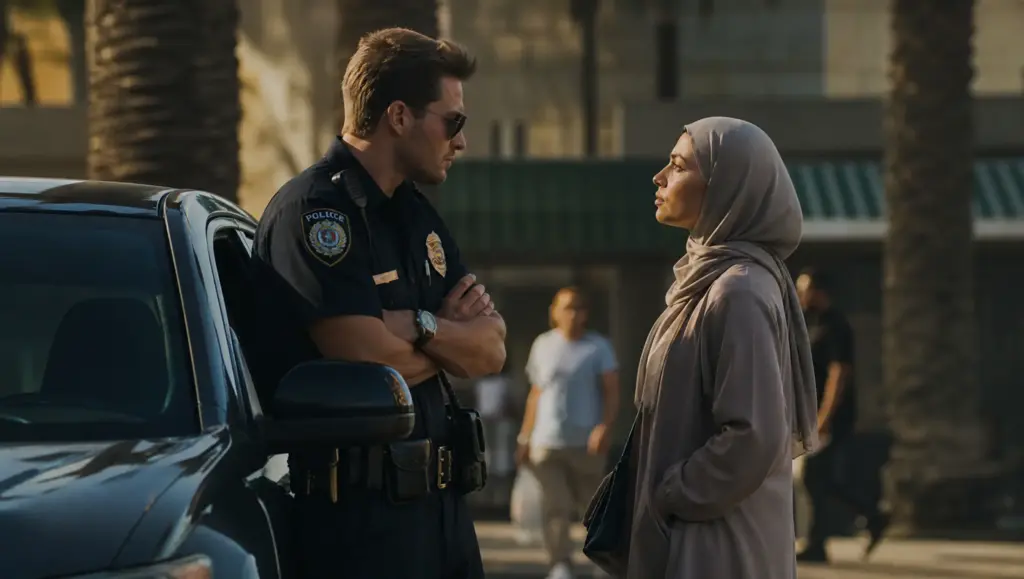
She did not mean to do it. Her hand went up by itself, the way it had gone up when the doctor came out of the room at Barnes two winters ago, and she stood on the pump island with her palm pressed against her lips and her eyes stinging, and she heard her father’s voice in her head as clear as if he were standing beside her with a chamois in his hand, polishing the chrome on a Saturday. Maybe today they come. Maybe today, Selma. Look, I clean it for them.
“Oh,” she said through her hand, in Bosnian, and then, because he could not understand that, in English, “oh. Oh, it’s you.”
The sergeant straightened up. It took him a while. He stood with one hand on the roof of the car, and he looked at her across the open door, and his face was wet. He did not seem to know that it was. He did not wipe it.
“What?” he said.
“You’re J.K.’s son.”
“Joe Kopecky,” he said. “Joseph. He was a letter carrier. Thirty-four years.” He looked at her as if she had done a magic trick after all, as if she had pulled his father’s name out of the air. “How do you know that? How do you— nobody knows that. It’s on the back. You can’t even see it. How do you know what it says on the back.”
“Because my father took it off,” she said, “to change the dash. And then he put it back on.”
“Your name. I didn’t know it.”
“Oh.” He looked at his own name tag, as if checking. “Gene. Eugene. Nobody calls me Eugene.”
“My father lived on Itaska Street,” she said. “When we came. Our first apartment. Nineteen ninety-eight.”
He stared at her. “Which block?”
“Thirty-nine hundred.”
“That was his route,” he said. “That was— he’d retired by then. Ninety-six. But that was his route.”
They looked at each other across the pump island. Selma did not know what to say about that, and he did not seem to either, and after a moment he looked back down at his hands.
“He drove it to the cemetery,” he said. “After my mother. She died in ninety-eight, pancreatic, it was fast, four months. And every Sunday he drove that car out to Resurrection and sat with her for an hour and drove back. Every Sunday for eleven years. I used to go with him sometimes. He’d sit in the car with the door open, right on the grass. He’d turn the key to wait for the light, you know, the—” he made a small circle in the air with his finger— “the glow plug light, and while he was waiting he’d touch it. The medal. Every time. I don’t think he even knew he did it.”
Selma closed her eyes for a moment.
Kenan was on the bench at Carondelet Park when she got there at six-nineteen, the last kid, with his shin guards in his lap and his cleats tied together by the laces and slung over his shoulder, the way the older boys did it. Coach Villalobos was sitting at the other end of the bench with a clipboard and a whistle around her neck, and she stood up when the cream car came around the curve by the boathouse and gave Selma a wave that said, it’s fine, it happens, and then looked at Selma’s face as she got out and stopped waving and said, “Everything okay?”
“Everything’s okay,” Selma said. “I’m sorry. Thank you for staying with him.”
“He’s a good kid. He helped me pick up all the cones.”
Kenan did not get up right away. He sat on the bench with his arms crossed and his chin down and his cleats over his shoulder and looked at her from under his eyebrows, which was the look he had gotten from her father, and which he had been practicing, she was nearly sure, in the bathroom mirror.
“You said you wouldn’t be late.”
“I know. I’m sorry, dušo. Something happened.”
“What happened?”
She sat down on the bench next to him. The park was going blue around them, the trees along the lake gone black at the tops, the lamps on the path coming on one by one. Out on the water two ducks were arguing. In twenty minutes it would be Maghrib, and they would pray it at home, all of them, Tarik too if he could slip away for ten minutes, on the good rug in the living room and on her father’s cheap one, which she had brought home and would bring back to the shop on Monday.
“Do you remember,” she said, “the medal in Dedo’s car? On the dash. The one we don’t touch.”
He uncrossed his arms. “The St. Christopher. That belongs to the other family.”
“That’s right.”
“Dedo said maybe one day they come.” He looked at her. Then he looked past her at the car, sitting in the road with its chrome gone pink in the last light, and back at her, and his eyes got very wide. “Mama. Did they come?”
She thought about how to answer him. She thought about the sergeant’s laugh, the first one, and the third one, and the eleven seconds on the radio, and his finger on the brass. She thought about her father on a Saturday with a chamois, polishing. She thought about the card in her coat pocket.
“Somebody came,” she said. “The son. Of the man who had it first.”
“Is he taking it?”
“I don’t know yet.”
“Is he taking the car?”
“No. The car is ours. Just the medal. And he doesn’t know yet.” She stood up and held out her hand, and he took it, and let her pull him up off the bench, and did not let go right away, which at nine years old he usually did. “He’s going to think about it.”
“Is he nice?”
She opened her mouth and closed it.
“I don’t know that yet either,” she said.
They walked to the car. At the driver’s door she took out the key and looked at it, and then she held it out to him, and his face lit up as if he were five again.
“Can I?”
“Go ahead.”
He fit the key into the lock with great care and turned it, the way she had taught him, gently, and there was the pause, and then all around the car, in the blue evening by the lake, every lock button rose at once, and the car let out its long breath.
“It sighed,” Kenan said, satisfied, as he always said, and ran around to the other side to get in.
She sat behind the wheel. She put the key in and turned it to the second position, and the small orange light came on, and she sat and waited for it in the quiet, with her son buckling himself in beside her and talking already about a goal he had almost scored. The medal sat beside the clock, where it had sat for thirty-seven years, where two men had touched it every day and a third had touched it once, an hour ago, without meaning to.
She had never touched it. She looked at it a long moment, at the dark brass and the one bright rim.
Then she reached out, the way you would reach to touch the shoulder of a guest who has fallen asleep in your house, and laid one fingertip on the edge of it, lightly, just for the length of the light. For them, she thought. Until they decide.
The light went out. She turned the key, and the engine caught on the second turn, the way it always did, and she drove her son home.





