There was the pause. And then, all around the car, every lock button rose at once, with the long soft sound of the vacuum letting go, like a breath held for a long time and finally let out.
Behind her she heard him make a sound. She could not have said what kind of sound. It was very small.
She opened the door and stood in the angle of it with one hand on the top of the frame and turned around.
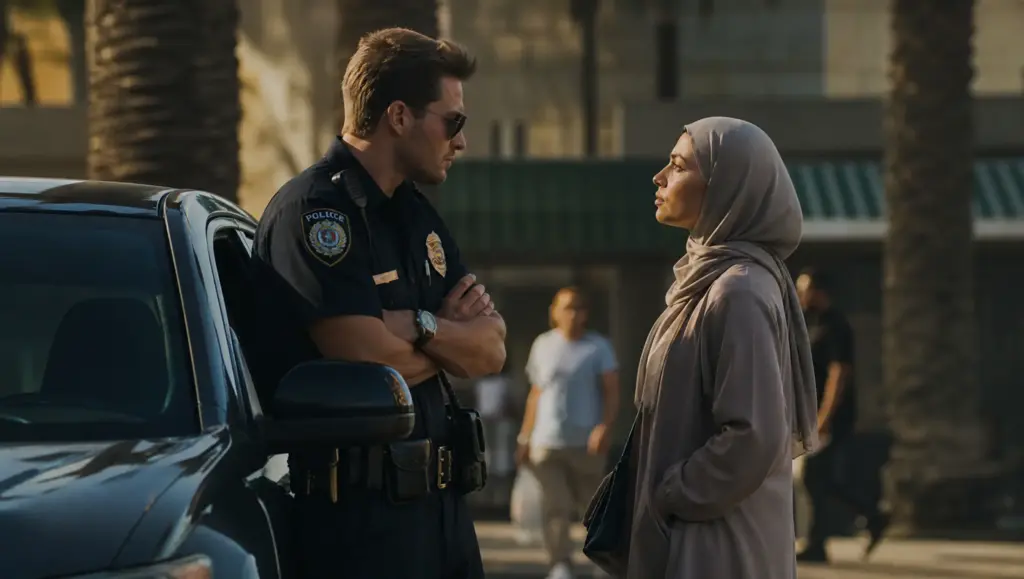
“There,” she said. “That’s my key. That’s my car. Now I’m going to tell you what I see, Sergeant, and then you can decide what you want to do.” She took a breath and kept her voice level. It came out lower than she meant it to. “You sat in your car for four minutes before you came over here. I watched you. You ran my plate, and it came back to me, because if it had come back stolen you’d have called another car and you would not be standing six feet from me with your hands on your belt. You’d have one hand on your gun. You didn’t turn on your lights. You haven’t said one word into your radio since you got out of that car, not my plate, not this location, not anything. You walked around my car before you even looked at me. You put your fingers in the dent. You read the number off the dash like you already knew it by heart.” She watched his face, and his face told her she was right, and she went on. “I don’t know what this is. But it isn’t police work. So go ahead. Pick up your radio. Tell your supervisor what you’re doing.”
He did not move.
She had seen men not move before. She had seen her father not move, at the kitchen table, for two days. She had seen Mr. Chilton not move at the counter that morning with his wallet open. But she had never seen anyone not move like this, all of him at once, the way a car does not move when the engine has seized, a big heavy machine with everything in it suddenly locked. His thumb was on the radio clipped to his vest. It stayed there. He looked at her and his mouth worked and nothing came out of it, and she watched him try, she watched him actually try to imagine pressing the button and saying into it, to whoever sat at the other end, the words for what he was doing, and she watched him find that there were no words for it that he could say out loud.
“My lieutenant,” he said finally, and stopped.
The young man by the pickup shifted his feet. Out on Gravois a bus went by, kneeling and rising at the stop, coughing.
“My lieutenant would—” He stopped again. His thumb came off the radio. He looked down at his own hand as if it belonged to someone else.
And then his eyes went past her.
She was standing in the open door, and behind her the inside of the car was open to the evening, and the smell of it was coming out, the smell she knew so well she had stopped smelling it years ago and smelled it now only because she saw him smell it: old vinyl warmed by a day of October sun, and diesel, and very faintly something sweet and dry that her father used on the dash, an old German cream in a tin. The sergeant’s nostrils moved. His eyes went down, past her shoulder, past her arm on the door frame, to the dash. To the clock. To the small dark coin of brass screwed into the pad beside it, with its one bright rim where a finger had polished it for thirteen years.
He took a step. She did not move out of the way. He stopped.
“Is that—” he said.
She looked at him.
“Ma’am.” It was a different voice. It was so different that for a second she thought someone else had spoken, the young man by the truck or someone behind her; it had come down out of the bigness of him and was small and hoarse and careful. “Ma’am, can I— I’m not going to touch anything. Can I just look.”
She stood still for a long moment. Then she stepped back from the door, two steps, onto the concrete of the pump island, and left the door standing open, and nodded once.
He came forward. He did not get in. He put one hand on the roof of the car and bent down at the open door, slowly, his knees cracking, until his face was level with the dash, and he stayed there, bent, looking at the medal. He looked at it for a long time. She could see his back rise and fall under the vest.
“It’s St. Christopher,” he said, without looking up. “She got it at the gift shop at the Old Cathedral. Down by the Arch. My mother. Nineteen eighty-nine. He’d just bought it, the car, and she thought it was the stupidest thing he’d ever done, six thousand five hundred dollars for a used car, she said, Joe, we have a mortgage, Joe, you deliver mail for the government. And then she went down to the Old Cathedral and bought him that, and she took it to a jeweler on Cherokee Street to get it engraved, and she made him screw it in. Not clip it. Screw it, she said, so it can’t fall off.” He swallowed. “On the back it says J.K. Nineteen eighty-nine. Come home to me. And a P. For Paulette.”
Selma put her hand over her mouth.





