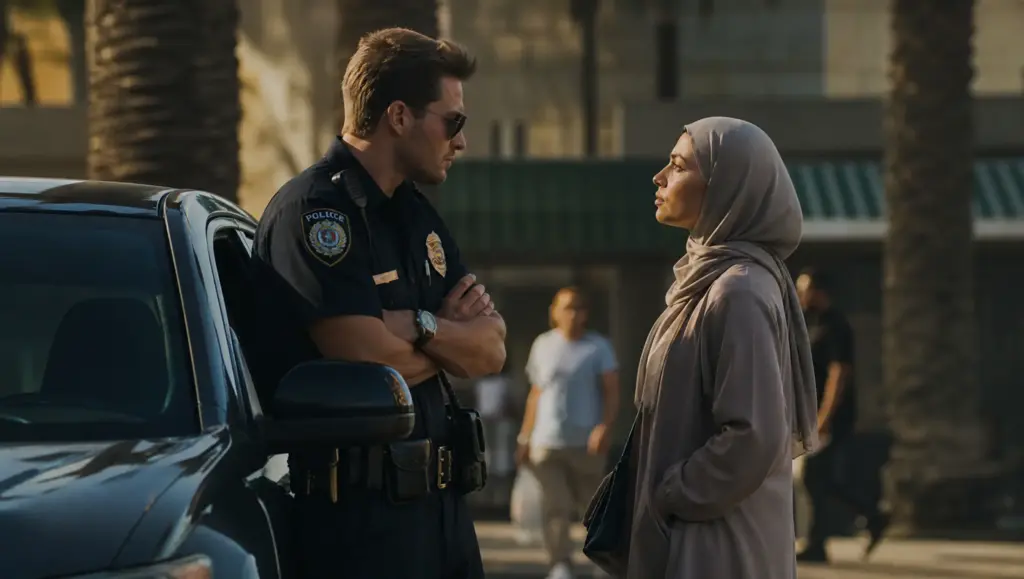
Selma had been here before. Not here, at this pump, with this man; but here, in this place that was not a place but a kind of weather, a kind of light. She had been here at nineteen at a Schnucks when a woman in a fleece vest told her to go back where she came from, and she had said, very politely, Ma’am, I came from Itaska Street, and the woman had looked at her like she had been slapped. She had been here at twenty-six at an airport, in a small room with a table and two chairs and a man from the government who wanted to know why she had traveled to Sarajevo for eleven days, and she had told him it was to bury her grandmother, which was true, and he had asked her the same question four more times in different words, and she had answered it the same way four more times in the same words, until he let her go. She had been here a dozen times at a dozen gas stations and parts counters and parent-teacher nights, every time someone looked at her and arrived at a conclusion, and she knew what it felt like, the heat that came up the back of her neck under the scarf, the way her hands wanted to shake and she would not let them. She knew what to do with it. You set it down. You set it on the floor next to you, like a heavy bag you would pick up again later, and you kept your hands free.
“Officer,” she said. “Is there a problem with the car?”
“You tell me.”
“I don’t think so.”
“No? You don’t think so.” He put his hands on his belt, one on either side of the buckle, thumbs hooked in. “Where’d you get it?”
“It was my father’s.”
“Your father’s.”
“Yes.”
“And where’d your father get it?”
She looked at him. There was something wrong with the way he said it, and she could not decide what. It was not the way police asked questions. She had been asked questions by police, and they asked them flatly, like reading off a form, or they asked them fast, to trip you up. He was asking this one like it mattered to him what the answer was.
“Am I being detained?” she said.
He blinked. “What?”
“I’m asking if I’m being detained, sir. Or if I’m free to go.”
He looked at her for a moment as if she had begun speaking in Bosnian. Then something closed in his face, a door shutting on a lit room. “You’re being asked some questions,” he said.
“I understand. I’m asking if I’m free to go.”
“No,” he said. “You’re not.”
“Then I’m being detained.”
“Then you’re being detained.”
“May I ask the reason?”
He did not answer right away. He looked at the car again, at the dash through the windshield, and she had the sudden absurd sense that he was not talking to her at all, that she was a person who happened to be standing beside the car he was having a conversation with.
“This vehicle,” he said, “matches the description of a stolen vehicle.”
“Which stolen vehicle?”
“A stolen vehicle.”
“From when?”
“That’s not—” He stopped. “Ma’am, I’m going to need to see your license. And the registration on this car.”
“I’ll show you my license,” she said. “It’s in my coat pocket, the inside one, on the left. I’m going to reach in for it now with my left hand. Is that all right?”
He watched her as if she were doing a magic trick and he was trying to see how. “Go ahead.”
She reached in slowly and took out the small leather wallet her daughter had given her on Mother’s Day and opened it and took out her license and held it out across the hood. He had to come around the front of the car to take it. He took it and looked at it and looked at her and looked at it again. Selma Hodžić, the license said, and her address on Neosho Street, and her birthday, and her picture, in the same gray scarf, unsmiling, because the woman at the license office had told her not to smile.
“How do you say that,” he said.
“Hodžić. Like hodge, and then itch.”
“Hodge-itch,” he said. He did not say it unkindly. He said it as if he were filing it.
“The registration is in the glovebox,” she said. “I’d like you to know before you ask that I’m not going to open the car for you to search it. But if you’d like me to get the registration out myself, I’ll do that.”
“I don’t need the registration.”
“I thought you said—”
“I ran the plate,” he said. “I know who it comes back to. It comes back to a business on Morgan Ford.”
“Hodžić Motors. That’s my shop. It was my father’s. Now it’s mine.”
He did not seem to hear her. He was looking through the windshield again, down at the base of it, on the driver’s side, where a small metal plate was riveted to the top of the dash under the glass, and she saw his lips move, very slightly, and she realized that he was reading the numbers on the plate. She realized, a second later, the way you realize you have left the stove on, that he was not reading them like a man trying to remember them. He was reading them like a man checking them against something he already knew.
The color went out of his face. Not all at once. It drained down out of his cheeks and his forehead in a slow wash, like someone had pulled a plug, until the red was only across his nose, and the rest of him was the gray of a sidewalk.





