It was a St. Christopher medal, about the size of a quarter, the saint with a child on his shoulder and a staff in his hand, wading through water. The brass had gone dark everywhere except along the rim and on the raised shoulder of the saint, where her father’s finger had polished it for thirteen years. It was held to the dash by two small brass screws, one above and one below, the kind of screws you would use on a cabinet hinge. When her father had bought the car at the salvage auction in Sauget, it had been stripped of everything worth stripping, and the dash pad had been split down the middle from twenty-five summers of sun, and the medal had still been there, screwed into the split pad, because no thief in his right mind would take the time to unscrew a dollar’s worth of brass. Her father had put a new dash pad in. Before he did, he had taken the medal off the old one with a jeweler’s screwdriver, cleaned the screws, and put it back on the new one in exactly the same place. He had measured. She had watched him measure.
On the back of the medal, which she had seen only once, the day he took it off, there was an engraving in small, slanting letters: J.K. 1989. COME HOME TO ME. P.
“This is not ours,” her father had said, holding it in his palm under the shop light. He had spoken in Bosnian, which he used for things that mattered. “A woman gave this to her husband for his car. She wanted him to come home. You don’t take that out of a car just because you paid the auction.”
“It’s a Christian saint, Babo.”
“I know what it is.” He had turned it over. “Your grandmother had a neighbor in Doboj, a Croat, Mrs. Jurić, she had one of these over her door. When the shelling started, your grandmother hid in Mrs. Jurić’s cellar for three days, under this man with the baby on his shoulder. Nobody asked anybody what they prayed to.” He had put the medal back down on the bench, face up, and pushed it a little toward her with one finger. “We keep it for them. Maybe someday they come for it.”
He had written a letter. She knew that too. He had written to the insurance company whose name was on the salvage certificate, in his careful American English that he had learned from night classes and from the radio, explaining that he had purchased vehicle such-and-such and had found in it an item of personal and religious value belonging to the prior owner, and that he would like to return it, and could they please forward this letter or provide an address. He had shown it to her to check the spelling. The insurance company had written back four months later and said that it was unable to release personal information about prior policyholders but would forward his correspondence to the last address on file. After that nothing had come. Her father had waited a year, and then two, and then he had stopped saying maybe someday they come for it and started saying it as a joke, when he was polishing the chrome on a Saturday: maybe today they come. Maybe today, Selma. Look, I clean it for them.
The glow plug light went out. She turned the key the rest of the way, and the engine caught on the second turn the way it always did, with a rattling shudder that settled after a moment into the loose steady knock of the five cylinders. She let it idle and listened. It sounded good. It always sounded good. She sometimes thought that she drove it on Fridays less to keep the engine alive than to hear that it was still alive, the way her mother still called her every night at nine just to hear her say, I’m here, Mama, everything’s fine.
She checked the fuel gauge. Just above the red. She would have to stop.
She went out the back gate and down the alley to Morgan Ford and north to Gravois, and the car settled into itself the way it always did after the first mile, the knock of the engine smoothing as the oil came up to temperature, the big thin wheel going light in her hands. She drove it the way her father had taught her to drive it, which was gently, as if it were older than she was, which it nearly was. Gravois at five o’clock on a Friday in October was thick and slow. The light had gone the color of honey and lay along the storefronts on the north side of the street, the Bosnian bakery with the three-tiered wedding cakes in the window, the Vietnamese nail salon, the bar with no windows at all. At the corner by the old windmill restaurant, where her parents had taken her to celebrate her high school graduation because it was the fanciest place they could think of within walking distance, a boy of fifteen or so on a bicycle looked over at the car at the light and gave her a thumbs-up. She gave him one back. Old men at gas stations would sometimes come over and tell her about the one their uncle had, the one that ran four hundred thousand miles, and she would let them talk, because her father would have.
The QuikTrip was a few blocks on, on the south side of the street. She swung in and pulled up to the diesel pump on the far end, the one with the green handle, where the big pickup trucks went, and turned off the engine and sat a moment while it ticked.
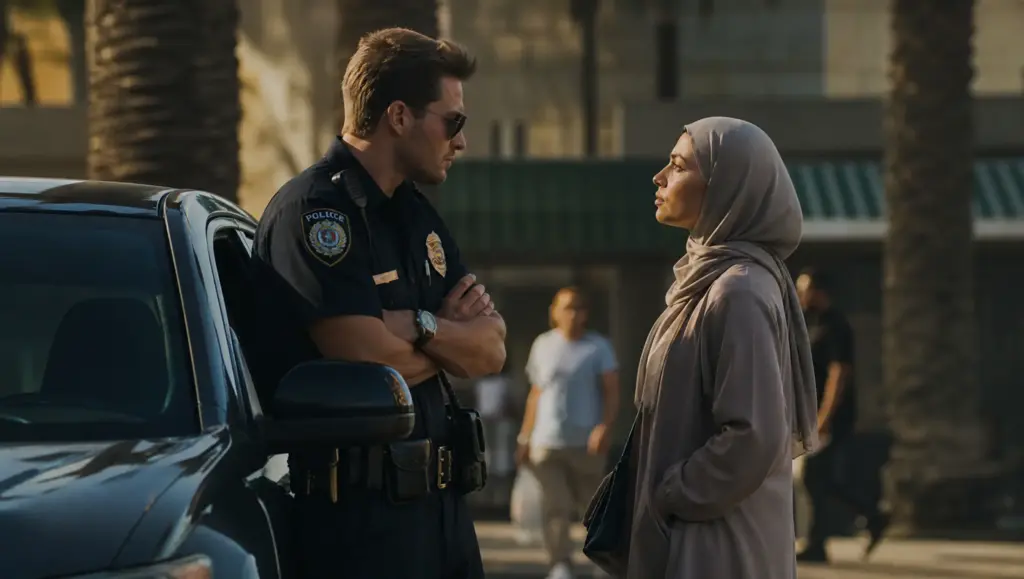
It was when she got out to fuel that she noticed the police car.





