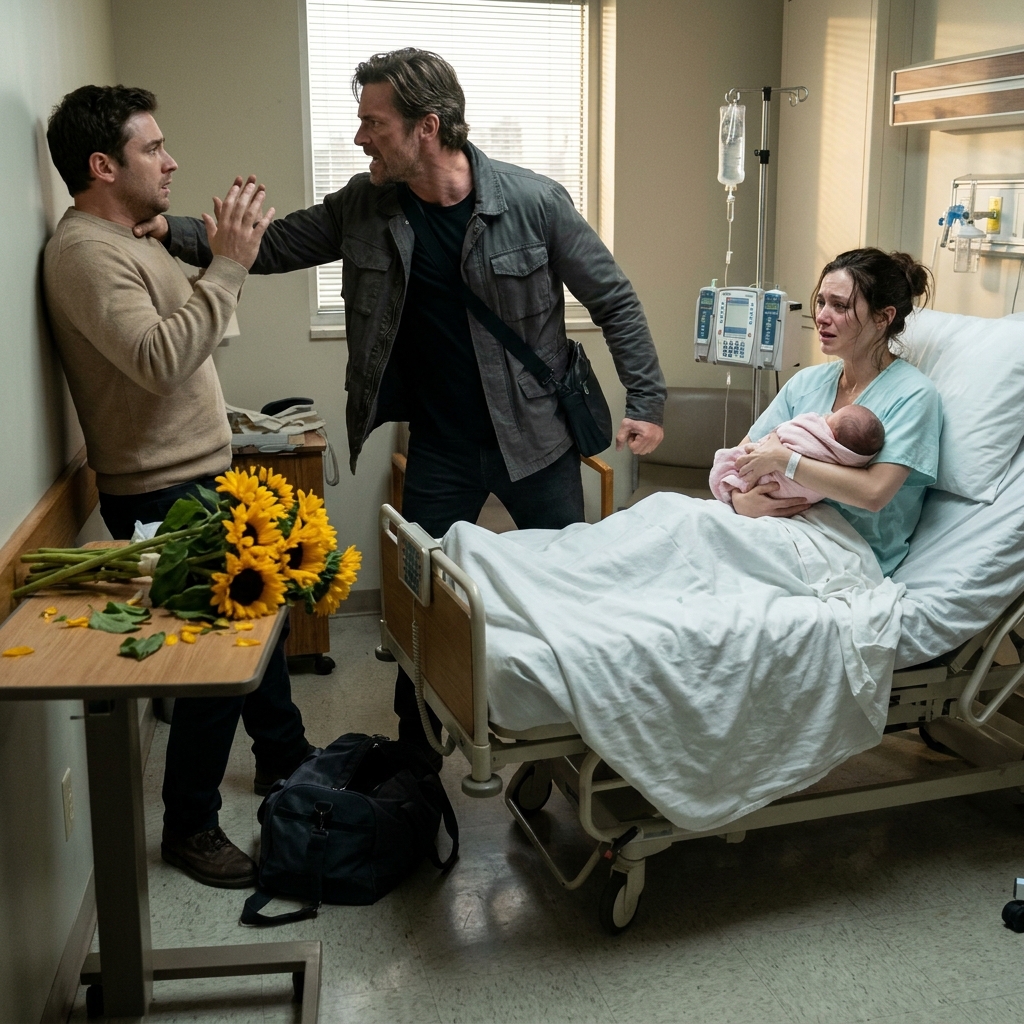
The light in Room 412 of St. Jude’s Maternity Wing had the thin, milk-pale consistency of late October in coastal Maine. Outside the triple-paned acoustic glass, gulls wheeled over the gray slate rooftops of the harbor district, their cries silenced by modern hospital insulation. Inside, the world was reduced to three fundamental sounds: the dry, rhythmic hiss of the wall-mounted oxygen regulator, the low-frequency drone of the traffic below on Commercial Street, and the faint, fluttering sigh of the newborn nestled against my sternum.
She weighed six pounds and fourteen ounces. The birth certificate worksheet, still blank beneath a magnetic plastic clip on the nightstand, labeled her simply Female Infant Thorne.
I had spent twenty-two hours in hard labor, my spine pinned to the mechanical bed, my knuckles bruised from gripping the chrome side-rails until my wedding band bit into the bone. But now, twenty-four hours after the final heave, the room felt suspended in an unnatural, fragile peace. Her skin smelled of vernix, almond oil, and the sterile cotton of the hospital blanket. Her tiny, bird-like fingers twitched against the cotton of my nursing gown, brushing the collarbone where my collar lay hollowed by months of nausea.
When the heavy fire-rated door clicked open, I didn’t startle. I assumed it was Nurse Henderson coming to check my vitals or empty the IV drip.
Instead, it was Daniel.
He didn’t knock. He carried a heavy glass jar stuffed with twenty giant sunflowers—their golden, petal-ringed faces heavy with pollen, their green stems drinking deeply from water that sloshed against the glass with every step. Tucked beneath his left arm was a small box wrapped in handmade silver paper, tied with a frayed velvet ribbon.
He wore his dark wool peacoat unbuttoned, his flannel shirt smelling of cedar shavings, damp wool, and the crisp, salty air of his shipyard workshop down on the wharves. His dark hair was tossed by the sea wind, and on his face was a smile so unguarded, so entirely stripped of his usual defensive irony, that it made the sterile, antiseptic air of the room feel suddenly warm.
“Hey,” he whispered.
The word was barely louder than the oxygen valve. He set the heavy jar of sunflowers on the broad laminate windowsill, where the yellow heads seemed to drink in the pale Atlantic light.
He turned toward me, his hands wiping self-consciously against his canvas work trousers before he stopped himself. He didn’t look at my face. He didn’t look at the dark circles hollowed beneath my eyes or the tangle of my hair.
He looked at her.
His expression didn’t merely soften; it broke open, the hard lines of his jaw dissolving into something so tender, so raw, that it made my breath catch in my windpipe.
“She’s here,” he said softly, stepping closer to the edge of the high recovery bed. “Emily… look at her.”
“She came at dawn,” I said. My voice was hoarse, a dry rasp earned through hours of screaming into a folded washcloth so as not to alarm the maternity nurses. “Seven minutes past six.”
Daniel reached out, his thick, calloused index finger—the knuckle scarred from an old slip with an adze in the boatyard—hovering half an inch above the baby’s cheek. He hesitated, terrified of his own coarseness against that paper-thin skin, before letting the back of his nail graze her downy temple.
The baby stirred. Her tiny mouth made a soft, smacking motion, her lips pursing in a dream of milk.
“She has your chin,” Daniel whispered, his voice trembling slightly. “That stubborn little point. God, Emily. She’s… she’s miraculous.”
For ten seconds, perhaps twelve, the room was an island cut off from the continent of our mistakes. The weight that had crushed my ribcage for nine long months—the dread that had shadowed every prenatal ultrasound, every blood draw, every lonely evening spent staring at the silent telephone in the kitchen of the saltbox house on the point—seemed to loosen its grip. I let my head fall back against the stiff hospital pillow. I allowed myself to believe, just for the space of three quiet breaths, that a child could arrive into the world without the burden of a debt she had not incurred.
Then the latch turned.
The door didn’t swing open wide; it drifted inward with a slow, heavy drag, pushed by someone who had walked a great distance and had nothing left to hurry for.
Marcus stood in the doorway.
He had not called from Logan International. He had not texted from the Portland tollbooth. He was simply there, framed by the cold fluorescent light of the hospital corridor, a ghost in an unbuttoned trench coat.
His olive-drab canvas military duffel hung from his left shoulder by its webbed strap, dragging down the line of his spine. His face was gray with the specific, bone-deep exhaustion that comes from forty hours of commercial transit across four time zones: Singapore to Doha, Doha to Boston, the regional bus up the coast through the rain. His jaw was dark with three days of silver-flecked stubble. His tie was loosened at his throat, the collar of his shirt limp and crumpled.
He looked at Daniel.
Then he looked at me.
Then his eyes drifted to the windowsill, where the massive yellow sunflowers blazed against the gray glass of the bay.
The easy, gentle light in Daniel’s eyes evaporated as though someone had thrown acid across a fresco. His hand froze over the bassinet, hovering in empty air, before slowly, mechanically dropping back to his side.
I could not breathe. My lungs locked, the air in my throat turning to powdered glass. My arms tightened around the bundle in my lap with a sudden, violent instinct that made the baby let out a tiny, reedy whimper against my collarbone.
“Marcus,” I whispered. The word didn’t sound like a name; it sounded like an indictment, dry and foreign on my tongue.





