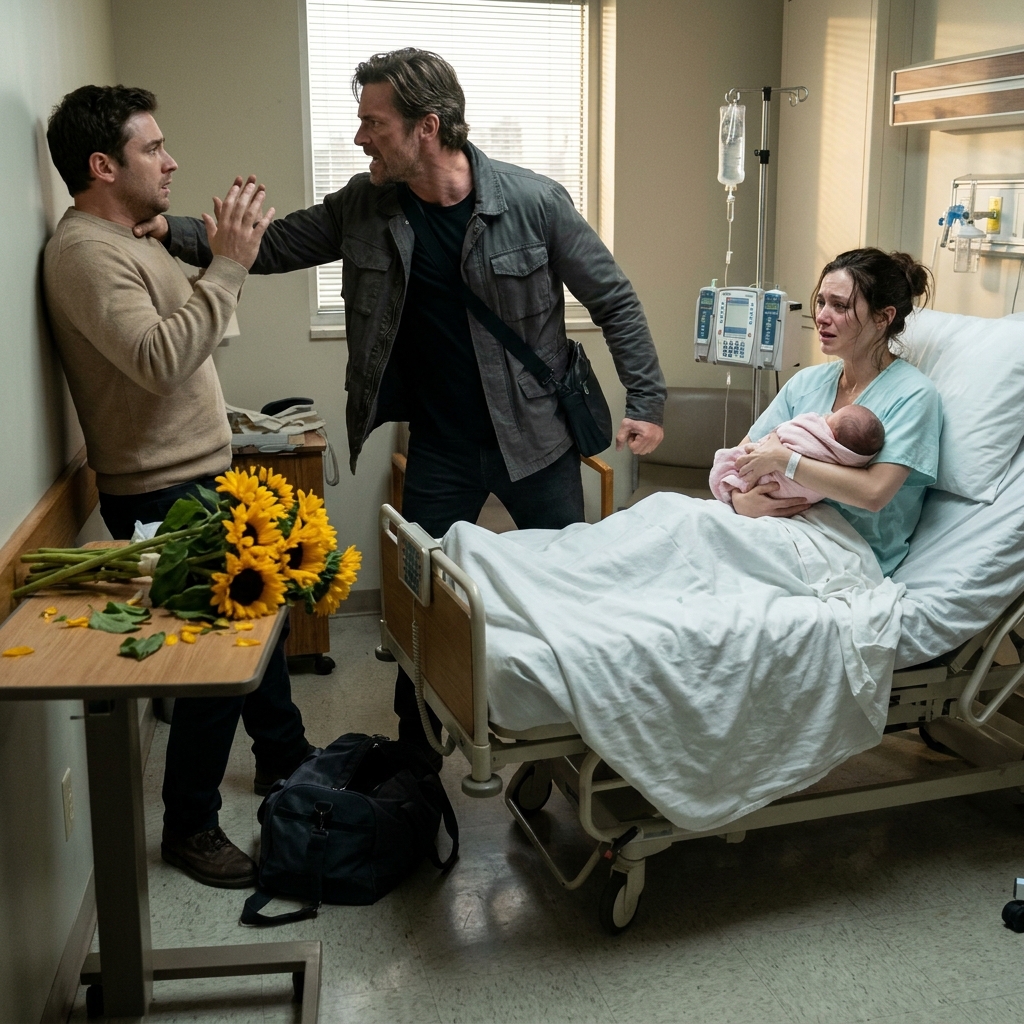
Daniel didn’t answer. His shoulders were set, his chin tucked slightly into his chest, taking the words like blows against an anvil.
Marcus turned his face fully toward me. The light from the harbor caught the film of moisture over his eyes, turning them into silver mirrors that reflected nothing but my own pale, terrified silhouette.
“Marcus, please,” I choked out, the syllables scraping my throat. “Don’t do this here. Not in front of her. Please.”
“In front of who, Emily?” Marcus asked, and his voice finally gave way, cracking right down the center, the sound of an old beam splitting under thirty tons of winter snow. “In front of my daughter? Or his?”
The question hung in the room, toxic and unbreathable.
The clock on the wall had a red sweep-second hand that jumped with a tiny, dry click every sixty seconds. Click. Click. Click.
Seven months ago, in the third week of March, the salt marshes along the Back River had been choked with rotten gray ice.
Marcus had been gone for five months. His emails arrived every Tuesday—efficient, sterile paragraphs detailing salinity tests, soil core samples, and the bureaucratic incompetence of the port authority in Johor. He asked about the furnace oil; he asked about the roof shingles after the February nor’easter; he never asked about the bedroom. When I called his satellite number on our sixth anniversary, the line had dropped twice before he answered from a hotel bar in Singapore, the laughter of three Dutch engineers clinking beer bottles in the background.
“I’m working, Em,” he had said, his voice flat with that specific, distant irritation that husbands use when their guilt exceeds their affection. “We have forty million dollars in concrete curing in a sub-sea trench. I can’t have a domestic audit over a six-dollar-a-minute satellite link.”
Three days later, the nor’easter had taken out the power line on our road.
The house had gone black at five in the afternoon, the radiators growing stone-cold within an hour while the sea wind drove freezing rain through the weathered sashes of the upstairs windows. By midnight, the pipes in the cellar had begun to sing that high, screaming note that precedes a burst.
I had called the only person in the county who knew how to balance an old gravity-fed oil boiler with a pipe wrench and an unbent paperclip.
Daniel had arrived in his battered Ford truck, his yellow oilskins dripping onto the mudroom floor, his toolbox rattling with rusted iron. He had spent four hours in the crawlspace, his back flat in the cold dirt, working by the yellow beam of a carbide lamp while I held the backup lantern and handed him three-quarter-inch galvanized fittings.
When he finally climbed out, his hands were black with soot, his hair soaked with freezing runoff, his knuckles raw and bleeding from an unseated slip-joint.
I had made him tea with clover honey on the gas camping stove. We had sat on the floor of the kitchen, wrapped in two wool moving blankets, our breath misting in the dark while the storm threw frozen salt against the glass like handfuls of buckshot.
He had looked at my face—the hollows beneath my cheekbones, the gray woolen sweater that hung off my shoulders, the ring on my finger that had grown three sizes too loose since the fertility treatments had ended.
“He shouldn’t have left you out here alone, Em,” Daniel had said. It was the first time in six years he had ever crossed that line.
“He’s building something, Daniel,” I had answered, reciting the liturgy I had repeated to my mother, to the bank manager, to the mirror.
“He’s hiding,” Daniel had said, his voice low, rough with the smoke of his pipe. “There’s a difference between building a bridge and running away so you don’t have to look at the dry riverbed.”
He had reached out then. Not with passion; with an agonizing, ancient gentleness that was far more dangerous. His thumb, rough as sandpaper from the shipyard, had traced the bone beneath my left eye, catching a tear that had frozen against my skin.
I had not pulled away.
God help me, I had leaned into it. I had leaned my forehead against the damp, cedar-scented wool of his shoulder and wept until my ribs ached, until the months of clinical failure, the cold sterile needles, the silent meals across an empty mahogany table had washed out of me. And when he kissed me—slowly, tasting of salt and black tea and the bitter cold of the river—it had felt less like a betrayal than like an animal finally crawling toward a fire after three winters in the snow.
It had happened once.
Only once, on the narrow horsehair sofa in front of the cast-iron woodstove, while the house groaned under sixty-knot gusts from the Atlantic. In the morning, before the plows had even cleared the county turnpike, Daniel had gathered his tools, wiped the grease from the sink, and walked out the door without looking back.
We had never spoken of it. When we passed each other at the post office or the marine supply store, we nodded like neighbors who shared a property line and an understanding of the tides.
Five weeks later, standing in the cold white light of the pharmacy bathroom in Brunswick, I had watched the pink line appear on the plastic strip.
Two minutes later, the second line had joined it.
“Emily.”
Marcus took another step forward. His hands left the rail. He reached down, his fingers catching the hem of the flannel receiving blanket that was tucked around her tiny legs.
He didn’t pull it. He just held the cloth between his thumb and forefinger, feeling the thinness of the flannel, as if he could divine her chromosomes through the weave.





