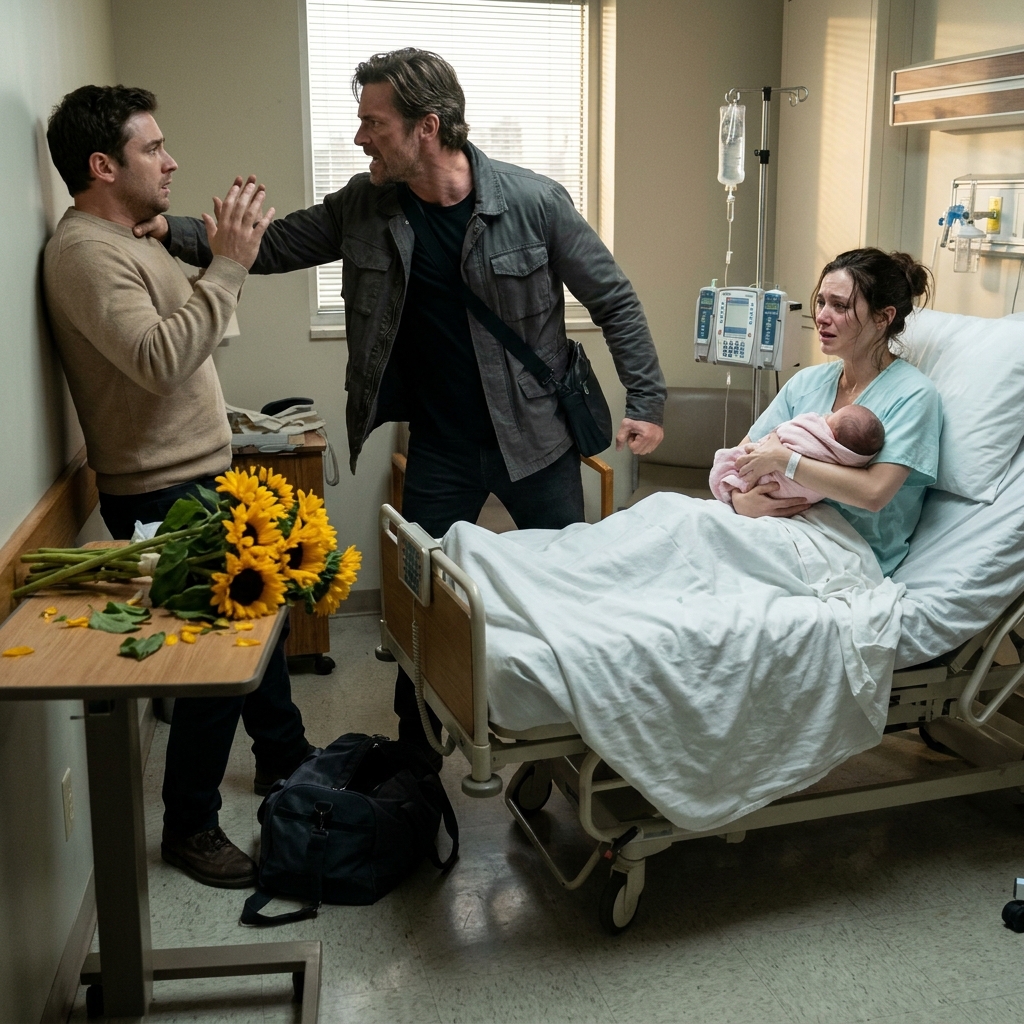
He didn’t move. He stood on the gray linoleum, his hand clamped over the canvas strap of his bag until the tendons in his wrist stood out like cords.
For six years, Marcus Thorne had been my husband. I had known him when he was a brilliant, hungry maritime engineer drafting deep-sea mooring arrays for offshore platforms; I had known him through the three grueling years he spent building his consultancy firm; I had known him through the two failed rounds of in-vitro fertilization that had left our bathroom cabinet smelling of alcohol swabs, discarded syringes, and clinical failure.
I had seen him furious when contracts were breached. I had seen him cold when negotiations soured.
I had never seen him look like this.
His face was hollowed out, the skin stretched tight over the cheekbones, his eyes wide and wet and horrifyingly vacant. He looked like an investigator who had spent months analyzing a structural blueprint, only to arrive at the site and find the foundation had never been poured.
The silence that followed was immense. It swallowed the hum of the refrigerator; it swallowed the distant chime of the nurse’s station down the hall. The room shrank until there were only four objects in the universe: the husband at the door, the friend at the window, the infant in my arms, and the sunflowers drinking from the glass jar between them.
Daniel cleared his throat. It was a dry, papery click.
He took half a step backward, away from the bed, his boots making a soft, scraping sound on the waxed floor. “Marcus. We… we didn’t know your flight was clearing customs today. The firm in Singapore said the arbitration was running through Friday.”
“Clearly,” Marcus said.
The word fell into the quiet like an iron bolt dropped onto stone.
That single syllable broke something behind my eyes. The tears came—not hot, dramatic sobs, but a cold, continuous flood that tracked down my cheeks, dripping from the line of my jaw onto the baby’s receiving blanket. I couldn’t reach up to wipe them away; my arms were locked around the child, my fingers trembling so violently that the blanket rustled against her ribs.
I had not cried when the fertility doctor in Boston had turned his screen away eighteen months ago, gently explaining that Marcus’s morphology scores were functionally zero, that the tissue samples showed irreversible tubular atrophy from an adolescent bout of mumps he had never bothered to mention. I had not cried when Marcus had walked out of that clinic, gotten into his car without looking at me, and spent the next three days in a motel near the docks, leaving me to flush sixteen hundred dollars’ worth of progesterone suppositories down the toilet alone.
I had not cried when he accepted the eleven-month offshore infrastructure contract in the Malacca Strait, kissing my forehead on the tarmac in Portland and saying, “We need the distance, Em. We need to reset the clock.”
I had survived all of it with a dry, stony numbness that my mother used to call character and that I had learned to recognize as despair.
But now, looking at my husband standing in the doorway while another man’s flowers shed yellow pollen onto the recovery table, the numbness shattered.
Daniel took another step toward the corner, his hands rising slightly, palms outward, the instinctive posture of a man trying not to startle a wounded animal in a narrow space.
“Marcus,” Daniel said, his voice dropping into that careful, balanced cadence he used when stepping onto an unstayed boat deck. “Let’s… let’s step into the family lounge. Down the hall. Let Emily have the room. She’s been in labor since yesterday noon.”
“No,” Marcus said.
He didn’t look at Daniel. His gaze was locked on my face, tracing the tears, tracing the red blotches on my throat, tracing the child whose dark down of hair was the exact shade of the curls that fell over Daniel’s collar.
“You should stay, Daniel,” Marcus said. He spoke with an agonizing, deliberate softness that made the hair on my forearms rise. “You’ve clearly been here for the preparations. It would be… rude… to dismiss the guest of honor.”
Marcus reached down and eased his travel bag from his shoulder. He lowered it to the floor. The heavy canvas hit the linoleum with a dull, wet thud that made the glass jar of sunflowers shudder against the windowsill.
He walked three paces into the room. He didn’t come to the bed. He stopped at the foot of it, his hands resting on the curved stainless-steel rail that separated my body from the rest of the world.
He looked down at the baby.
His throat worked, his Adam’s apple bobbing in a convulsive, dry swallow. The stubble along his jaw twitched as he clamped his molars together, trying to arrest the trembling that had begun to shake his lower lip.
“I called your mother from the taxi in Boston,” Marcus whispered. He wasn’t shouting; the quietness of his voice was far more terrifying than rage. “She told me you were in Four-Twelve. She said you’d gone into labor early. She sounded… nervous, Emily. My mother-in-law has never been nervous around me in six years. She usually tells me my shoes are dirty.”
He lifted his right hand from the rail, his fingers curled into a loose, hollow shape, pointing toward the window.
“Sunflowers,” he said, the ghost of a terrible, broken smile touching the corners of his mouth. “You hate sunflowers, Emily. You’ve hated them since that summer your sister planted them along the garden fence and they brought the wasps into the kitchen. You told me they were vulgar. You told me they looked like plates with teeth.”
He looked back at Daniel.
“Daniel likes them,” Marcus murmured, almost conversationally. “Don’t you, Dan? Your mother had them along the slipway at the marina. Every August. Big, ugly things that smelled like kerosene.”





