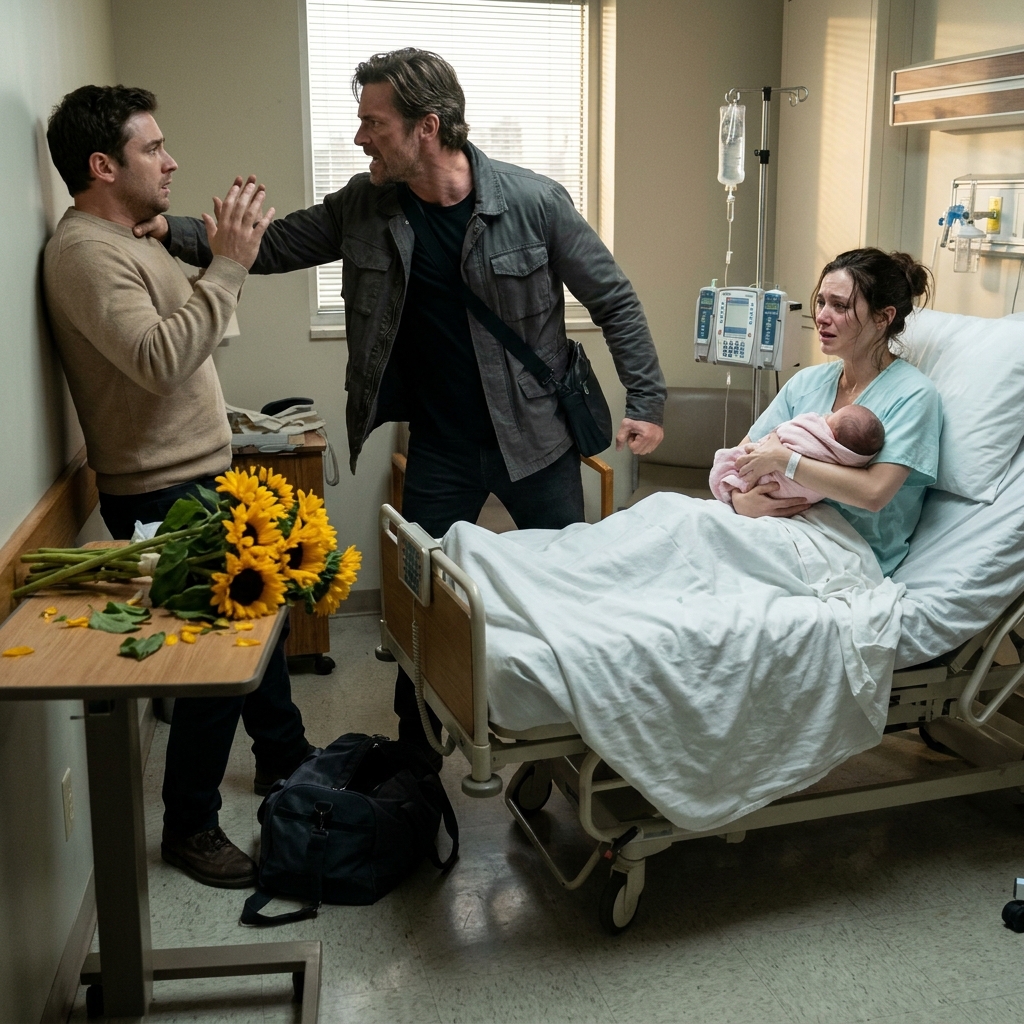
“I need you to tell me,” he said. The anger was gone now, replaced by that hollow, vibrating terror that comes when a man realizes the floor beneath his feet has already dissolved. “Look at my face, Emily. Look at me.”
I lifted my chin. My neck felt stiff, the muscles locked in spasm.
“Marcus,” I whispered. “She was born at thirty-eight weeks. The dates—”
“Don’t give me the dates!” he roared, and the sudden, violent volume of his voice shattered the room like an axe through ice.
The baby shrieked. It was a high, thin, terrifying wail—the sound of an infant whose world had been tilted into the void before she had even seen the sun. She kicked her feet beneath the blanket, her tiny fists flying out against my chest, her face turning an angry, purplish crimson.
Daniel moved.
It was not a calculated intervention; it was the instinctive, reflex movement of a man whose child was screaming. His boots hit the linoleum with two heavy strides, his broad frame inserting itself between the foot of the bed and Marcus’s shoulder, his hand coming down with heavy authority on the stainless-steel rail.
“Lower your voice, Marcus,” Daniel said. His voice was no longer careful. It was low, hard, and gravelly with the ancient, territorial density of an ironworker standing on a beam. “You don’t yell at her. Not in this room. Not today.”
Marcus stopped. He looked at Daniel’s hand on the rail—the calloused fingers, the square nails, the scar across the knuckle.
Then he looked at Daniel’s face.
“You’re protecting her,” Marcus whispered, the realization landing in his gut like an iron slug. “You’re standing between me and my wife.”
“I’m standing between a screaming newborn and an exhausted woman who just survived twenty hours on an operating table,” Daniel replied, not yielding an inch of floor. “If you want to tear your life apart, Marcus, you do it out in the parking lot. You do it down on the docks. You don’t do it over a baby that isn’t twenty-four hours old.”
“My life?” Marcus let out a short, jagged bark of laughter that sounded like a dry cough. “You think this is my life being torn apart? You were in my house, Daniel. I gave you the spare keys to the boat house. I gave you the combination to the tractor shed when your truck threw an alternator. My father helped yours buy his first slip at the marina!”
“This isn’t about the marina,” Daniel said, his voice dropping into a register of cold, agonizing truth. “And it isn’t about the boat house. You left her, Marcus. You were gone for eleven months.”
“I was working!”
“You were gone!” Daniel’s voice rose, cutting through the infant’s cries with the finality of a bell. “You left her with an empty bed and a house that had ice on the baseboards! You spent three years treating her like an incubator that failed its inspection, and then you took a corporate voucher to the other side of the world because you couldn’t stand to look at her without remembering your own blood wasn’t working!”
The room went completely, terrifyingly silent.
The baby’s wailing hitched, dying down to a series of ragged, wet snifflings against my collarbone.
Marcus took half a step backward, his back hitting the doorframe with a dull thud. His jaw hung loose. The blood had drained so completely from his face that the skin beneath his eyes looked like dark purple bruises.
The words had not merely hit him; they had unzipped him from collar to hem.
He looked past Daniel’s shoulder at me.
“Is that what you told him?” Marcus asked. The rage was gone, evaporated into an abyss of pure, unadulterated shame. “You told him… about the clinic?”
“Marcus,” I wept, rocking the baby against my chest, my forehead pressed against her warm, downy skull. “Marcus, no. I never… I never wanted this.”
“Did you take the test?” he asked.
“What?”
“The paternity screen,” Marcus whispered, his eyes wide and hollow. “The genetic amniocentesis. They do it at sixteen weeks now. My partner in Johor… his wife had it done from a blood draw. A simple maternal blood draw. You get the fetal fraction, you get the chromosomal mapping, you get the paternity index to ninety-nine point nine percent.”
He took another step toward the bed, ignoring Daniel now, his gaze boring into my pupils with a desperate, pathetic hunger.
“Tell me you took the test, Emily. Tell me you had the clinic run the panel. Tell me there’s an envelope in the kitchen drawer that says I’m the father.”
I couldn’t look at him.
I couldn’t look at the sunflowers on the windowsill.
I looked down at the child’s small, translucent ear—the delicate, perfectly formed curl of cartilage that was identical to the ear of the man standing between my bed and my husband.
“I didn’t take the test, Marcus,” I whispered.
The words were so small they barely stirred the dust motes in the shaft of morning light.
“Why?” he croaked.
“Because I didn’t want to know,” I said, and the truth tasted like copper and vinegar in my mouth. “Because for seven months, while you were in Singapore and Daniel was bringing split birch to the woodshed without being asked… I needed her to be mine. Just mine. I couldn’t survive another medical report that told me my family was broken before it even started.”
Marcus stood motionless for five long seconds.
He reached up, slowly, and touched his own chest, right over his breastbone, as if checking whether his ribs were still intact beneath his trench coat.
“She isn’t mine,” he said.
It was not a question. It was the conclusion of a mathematical proof he had been running since he saw the silver paper on the bedside table.





