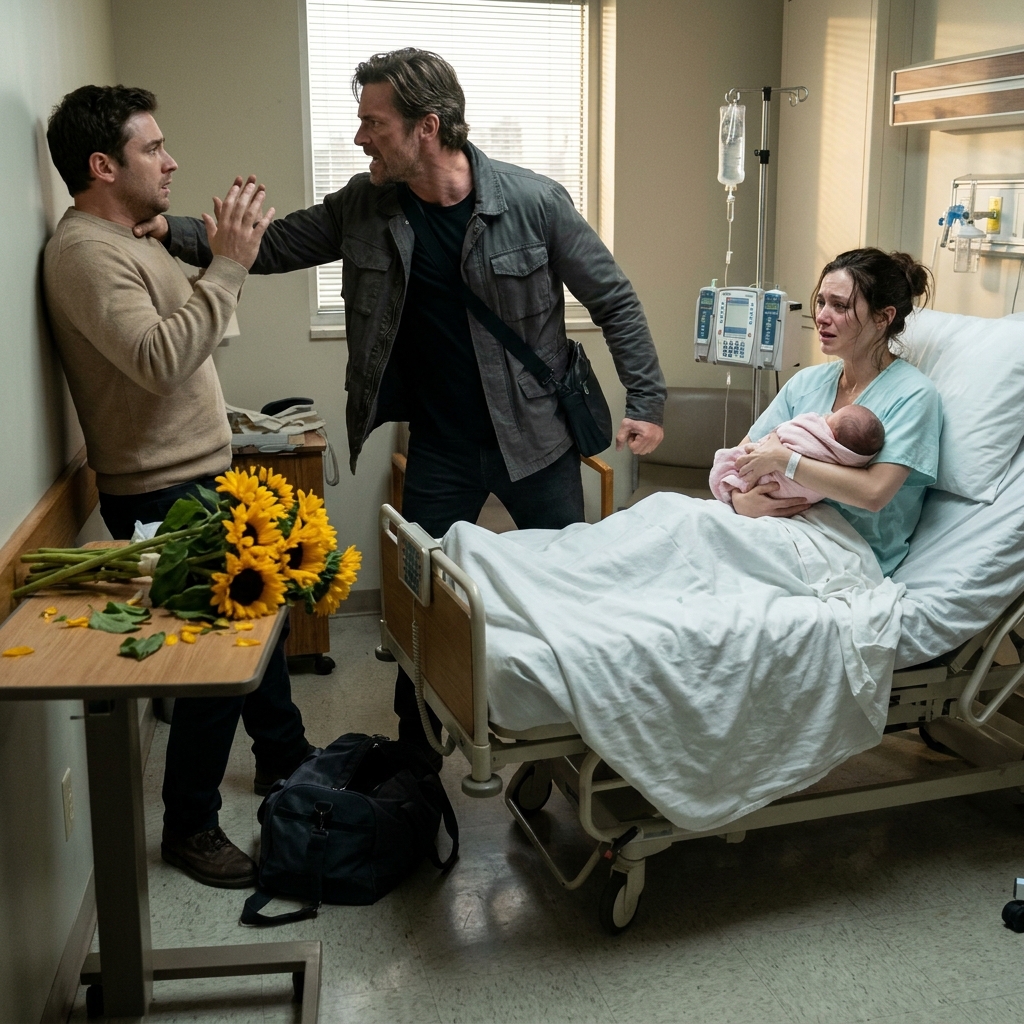
“Marcus—” Daniel began, his voice softening, the instinct to comfort an old friend warring with the territorial iron in his spine.
“Don’t,” Marcus said, lifting one hand, his fingers splayed. “Don’t touch me, Dan. If you touch me right now, I swear to God I’ll kill you on this floor.”
He turned back toward the door.
His movements were heavy, clumsy, like an old man whose joints had seized in the cold. He reached down and caught the strap of his canvas duffel bag, hauling it up with a slow, grinding effort that made his breath catch in his throat.
He paused on the threshold.
He didn’t look at Daniel. He didn’t look at the flowers.
He looked at me one last time—at the white linen gown, at the tears drying on my collarbone, at the child whose face was turned into the hollow of my throat, safe and warm and completely indifferent to the ruin she had wrought by simply drawing breath.
“The lawyers in Portland will call your brother,” Marcus said. His voice was entirely level now, the voice of a man signing an insurance release for a total-loss hull. “I’ll have my things out of the saltbox by Sunday night. You can have the house, Emily. It’s… it’s already paid for.”
“Marcus, please,” I sobbed, shifting the baby to reach out with one hand, my bare arm trembling in the cold air of the room. “Don’t leave like this. Talk to me.”
He looked at my outstretched hand—at the thin, pale band of platinum that still circled my third finger.
“There’s nothing left to talk about, Emily,” he said softly. “The house was empty before I left for Singapore. I just didn’t have the sense to see it.”
He stepped backward into the corridor.
The heavy fire door swung shut between us. The hydraulic arm caught the weight, easing the wood into the frame with a soft, final click that sealed out the noise of the hallway, the noise of the hospital, the noise of the six years we had spent pretending that love was something you could hold together with blueprints and silence.
The silence returned, but it was no longer the fragile peace of the early morning. It was the vast, echoing quiet of a church after the funeral has cleared.
Daniel remained standing at the foot of the bed.
He did not come to my side immediately. He knew better. He stood with his hands hanging at his sides, his shoulders slightly hunched, the scent of the salt air and the cedar shavings still clinging to his wool coat.
The baby had stopped crying. She had tucked her small chin against my chest, her mouth finding the soft cotton of my gown, her breathing settling into that rhythmic, fluttery cadence that belongs only to the very young and the very safe.
On the windowsill, the sunflowers stood tall and bright, their golden petals drinking the gray light from the harbor.
“Emily,” Daniel whispered.
I didn’t answer him. I couldn’t.
I looked at the blank birth certificate worksheet lying on the bedside table beneath the magnetic clip.
Child’s Full Name:
Mother’s Name: Emily Vance Thorne
Father’s Name:
The line was two inches long, printed in clean, black carbon ink that would never fade, waiting for a name that would determine whether my daughter grew up in the light of an honest truth or behind the barricade of a comfortable lie.
I looked at Daniel.
He was watching me with those clear, gray, unblinking eyes—the eyes that had watched the hull of his first boat take the water in the harbor, knowing that once a vessel leaves the slipway, there is no calling it back from the sea.
“Did you know?” I asked him, my voice barely more than a breath against the baby’s hair. “When you bought the sunflowers. Did you know he was coming?”
Daniel looked at the window. He looked at the bright yellow heads standing against the leaden Atlantic sky.
“No,” he said, and for the first time since he had pushed through the door that morning, his voice carried the full, terrifying weight of what he had chosen. “I didn’t know he was coming today, Emily. But I knew that sooner or later, the tide was going to turn.”
He walked around the bed.
He didn’t touch my face. He didn’t offer the easy comfort of an embrace that would have felt like a theft.
He simply reached down, his scarred, calloused fingers closing gently around the handle of the small silver-wrapped box on the table. He set it between my knees on the blanket, right beside the baby’s feet.
“What is this?” I asked, my voice trembling.
“Open it,” he said softly. “When you’re ready.”
I looked down at the box.
I looked at the daughter who had Daniel’s chin and Marcus’s silence, a child born between two men who had spent their lives trying to tame things that couldn’t be held: the sea, the stone, and the woman who had loved them both in the dark.
I reached out with my left hand, the platinum ring cold against my knuckle, and touched the frayed velvet ribbon.
Outside, the gulls wheeled over the salt marshes, screaming their ancient, indifferent hunger into the rising wind, while in Room 412, the clock on the wall clicked forward into the first day of our new, unmapped lives.





