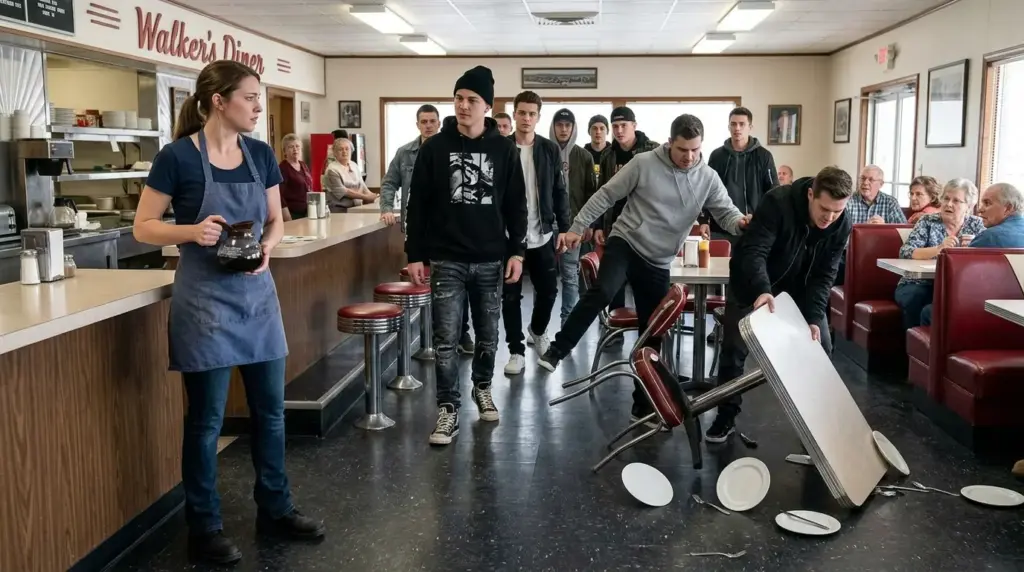
Carile Street was not empty within 20 minutes, but it was closer to empty than it had been, and the people remaining on it were behind closed doors and unaware of what was actually coming. Deacon had been on the phone for most of those 20 minutes. When he put it away, he looked at Jack with an expression that was not alarming, but was not reassuring either. We have three more coming, he said. 2 hours out.
What about Ruiz? Ruiz has seven people. 4 hours. Jack did the arithmetic. 30 men a diner on the main street of a small town and the gap between what was coming and what was available to meet it.
Tell me about Holt’s people, he said. Organized but not professional. Deacon said in the military sense they’re capable and they’re violent but they’re not disciplined the way trained people are. They make noise. They escalate.
They rely on numbers and reputation. So they’ll announce themselves. They always do. Deacon said it’s part of the message. Good.
Jack said. Puller looked at him. We need them to announce themselves loudly enough that there’s a documented record before anyone does anything. Jack said for Carter’s case, for the Billings unit. Deacon looked at him with something that might have been appreciation.
So you want them to walk in first, Deacon said, before we show ourselves. I want them to walk in and make their position clear on the record, Jack said. And then I want to change the record. Puller set his coffee mug down. He looked at Deacon.
Some communication passed between them in the particular noless language of people who have worked together long enough to have a vocabulary that doesn’t require words. All right, Puller said, “What’s the plan? ” They spent 40 minutes on it. Not a plan in the conventional elaborate sense. This was not a situation for elaborate and overplanning in fast-moving situations.
Was a trap Jack had learned to avoid avoid a very long time ago. What they built was a framework, positions, contingencies, decision points, and the specific understanding that any plan would begin dissolving the moment contact happened, and that adaptability was worth more than complexity. Sarah came downstairs at 1:00 in the morning. She had an apartment above the diner, something Jack had arranged years ago as a convenience that had since become more important to him for the simple reason of knowing she was close, that he could hear her moving around above him on evenings when the diner was otherwise empty. She came through the door from the stairwell that connected to the back of the diner and stopped when she saw Deacon and Puller at the counter.
She looked at them. She looked at Jack. “I could hear voices,” she said. “I told you to stay upstairs. ” “You told me a lot of things tonight.
” She looked at Deacon and Puller again at the leather vests they were both wearing, at the specific quality they both had of men who were very comfortable in a situation that most people would not be comfortable in. Are these your people? Yes, Jack said. She looked at them for another moment. Then she looked back at Jack and with something in her eyes that he recognized not fear, not even close to fear anymore.
Something else, something that had resolved over the past hours from uncertainty, into something harder and calmer. “What do you need me to do? ” she said. “Go back upstairs,” Jack. She folded her arms.
I am 25 years old and not 12. I can answer a phone. I can document things. I can be a second set of eyes. Tell me what I can actually do or I’m going to find something to do on my own initiative and you probably won’t like that better.
Deacon across the counter made a sound that was not quite a laugh but lived in the same neighborhood. Jack looked at Sarah for a long moment. The stubbornness in her face was real, but underneath it was also the real thing. Genuine steadiness. The kind that isn’t bravado.
The kind that comes from a person knowing their own limits and not performing beyond them. You have your phone, Jack said. Always. If anything happens that Carter needs to know about you, call him directly. His personal cell, not dispatch.
I’ll give you the number. You stay on the second floor away from the windows. You document everything you can see from the interior without going near the glass. He held her eyes. You do not come downstairs for any reason until I come get you personally.
Not another voice, not the sound of things being resolved. Me in person. Sarah held his gaze. Okay, she said. No argument, no push back.
He wrote Carter’s number on the inside of her wrist with a pen from the counter. An old method. Reliable. She looked at it and then looked at him. And for just a moment, beneath the seriousness of everything, something else moved across her face.
Something more personal, more difficult to categorize. Then it was gone and she turned and went back up the stairs and Jack heard her footsteps crossing above him, stopping and then the particular quiet that meant she was in position. At 217 in the morning, Deacon’s phone buzzed. He looked at it, then at Jack. 20 minutes, Deacon said.
Jack was sitting on a stool at the counter. He’d been sitting there for 40 minutes, very still, doing something that wasn’t quite meditation, but occupied the same inner space, a complete and deliberate settling of everything that could be settled, so that what remained was only the clear surface of attention. He looked at Deacon. Three more of ours, he asked. 40 minutes out, Deacon said.





