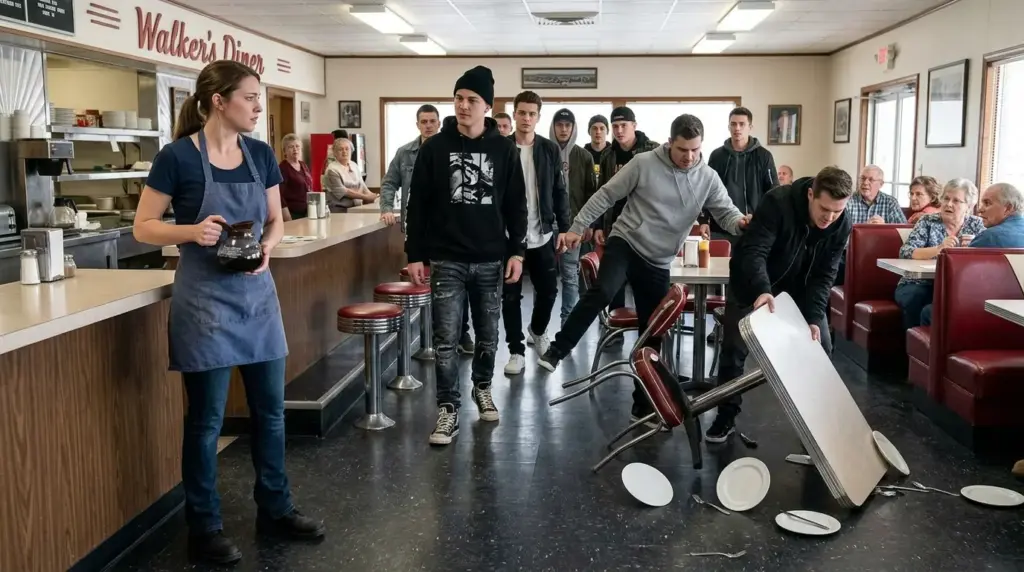
In a restaurant that had been full of people 12 hours ago, the absence of them now had a physical quality. Sound carries differently in empty spaces. The refrigerator hummed in the kitchen. Something settled in the walls. He went to the back of the diner, past the kitchen, through the storage room, to the door that led down three steps to the basement space he used for dry storage and equipment overflow.
And in one specific corner, nothing that had anything to do with the diner. There was a section of the basement behind the water heater where two cases of bulk tomato cans sat against the wall. Jack moved them. Behind them was a section of wall that looked identical to every other section of wall down there. He pressed in two specific places in the panel gave, and behind it was a space roughly the size of a large closet that smelled of dust and old leather and something else, something chemical and cool in particular.
The smell of things that had been stored carefully and kept dry for a very long time. He stood in the opening for a moment, then he stepped in. The box was where he’d left it. He checked it twice in 18 years. Once at the 5-year mark when he was far enough from the old life to check on it without the check, feeling like a return and once 7 years ago when he’d convinced himself he was going to dispose of everything in it and had stood exactly where he was standing now and found that he couldn’t.
He sat on the floor with the box in front of him and opened it. The leather vest was folded on top. He didn’t touch it. He looked at it the way you look at a photograph of someone you used to be with. Recognition, but also with the comfortable distance of the person you’ve become.
The patches on the vest were faded to the point where they were barely distinguishable as specific images, which suited Jack fine. He hadn’t looked at them closely in 18 years and didn’t want to start now. Beneath the vest was the photograph. He picked this one up. Five men standing in front of motorcycles he couldn’t clearly make out, though he remembered them without needing the image to remind him.
The man on the left was him younger by decades, harder in the face, different in some quality that was difficult to name, but that had everything to do with how he held his body in relation to the world around him, like something always ready to happen. He looked at the man standing next to him in the photograph, taller, gray at the temples. Even then, a face that had spent a lot of time in weather and had adjusted to it the way stone adjusts to rain, not softened or more defined by it. His name was Mac. Jack hadn’t thought about Mac in years.
And thinking about him now produced a particular feeling that sat somewhere between grief and guilt and the very specific ache of something you let go of. Not because you stopped caring about it, but because keeping it would have destroyed you. He put the photograph back in the box. Then he reached beneath it, beneath the other things he didn’t look at, and found what he was actually looking for. A piece of paper folded three times increased with age.
He unfolded it. A phone number written in his own handwriting from 18 years ago. The digits slightly faded, but still legible. He sat with it in his hand for a long time. The thing about that number was that calling it meant something.
Not just making contact. It meant acknowledging that the situation was serious enough to require the kind of help that number represented. It meant dropping a flare in a location he had worked very hard to make invisible. It meant letting people know where he was. He reolded the paper and put it in his shirt pocket.
He put the box back, replaced the panel, moved the tomato cans back into position, and then he went upstairs and sat at the counter of his empty diner and listened to the dark outside. And after a long time, he took out his actual phone and the piece of paper and dialed. It rang four times. Five. He’d half decided no one was going to answer when the line connected.
Silence. Then a voice horse with sleep or years or both. Who is this? Not a question. A statement with a specific inflection of someone who screens calls and means for unknown numbers to understand they’re on trial.
It’s ghost. Jack said. The word felt foreign in his mouth, like speaking a language he’d stopped dreaming in. Another silence, different quality this time. Then ghost.
Yeah, ghost is dead. The voice was flat. Careful. I was at the service. There wasn’t a service.
No. A pause. No, there wasn’t. And in the breathing on the other end of that line, Jack could hear something shift. The careful flatness opened just slightly.
Where are you, Paul? Montana. How long? 18 years. Jesus.
A long exhale. 18 years. Mac. Jack said. I need to know if the name Dylan Cross means anything.
The pause that followed was short, but it was the kind of short pause that comes not from not knowing something, but from deciding how much of what you know to say. Where’d that name come from? Mac asked. He walked into my place tonight, brought 12 men, tore it up. He know who you are.





