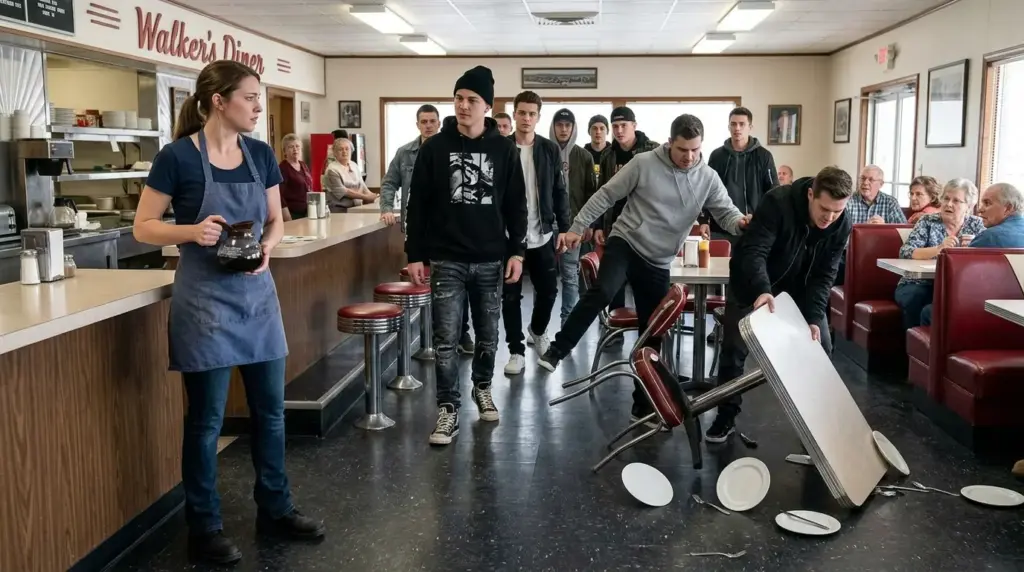
He hadn’t planned to bring it with him, but some instinct had moved him back down there, past the storage room to the panel behind the water heater, and his hands had found the box and opened it and taken out the leather vest, and he’d carried it upstairs without entirely deciding to. He laid it on the counter between himself and Carver. The faded patches, the worn leather, the thing that had once meant something specific in a world Carver would understand. Carver looked at it. He looked at the patches.
Even faded, certain things were recognizable to someone who knew what to look for. Then he looked up at Jack and the expression on Carver’s face changed in a way that was both immediate and total. “Jesus,” Carver said. His voice had dropped. Jesus, you’re I used to be Jack said a long time ago.
Carver stared at him and Jack watched the man do the arithmetic, put together the three men on the floor, the name that had been attached to the situation, the thing he was looking at on the counter, and the number of people Vernon Holt had sent to handle. What Carver was now understanding was not what Vernon Holt had been told. Vernon doesn’t know, Carver said. No, Jack said. Dylan doesn’t know.
Vernon doesn’t know. And nobody needs to know if this ends tonight without anyone getting hurt. He held Carver’s eyes. But I need you to do something that requires you to make a choice between your boss and your own judgment. Carver looked at him.
What? He said, “I need you to call Vernon. ” Jack said, “Right now with me in the room, and I need you to tell him exactly what you found here, not what Dylan told him. What you found. ” He paused.
Because what’s happening here is that your boss is about to walk into a situation based on bad information and the outcome of that situation is not going to be what he’s expecting. And I think you’re smart enough to know that Carver was very still. Outside his 29 men were waiting on the street. In the kitchen, Deacon and Puller were in positions Carver didn’t know about. Three more of Jack’s people were 20 minutes out.
Ruiz and seven others were now closer to 2 hours than four. Carter was two blocks south with two deputies and a radio line to Billings. And on the second floor of the building, a 25-year-old woman was pressed back from a window with her phone recording everything she could see and Carter’s number written on the inside of her wrist. Carver looked at the vest on the counter. He looked at Jack.
“If I make that call,” Carver said slowly. “I’m telling Vernon to stand down. That’s not something he takes well. ” I know, Jack said, but it’s better than the alternative, which is Jack picked up the vest from the counter and folded it carefully the way you fold something that has weight beyond its physical mass. The alternative, Jack said, is that 30 men try to make a point in a town where I know every person, every building, and every exit, and where people I trust are already in position, and Vernon finds out who I actually am, not from his research of people, but the hard way.
He set the folded vest on the counter. That’s not a threat. It’s an assessment. Carver looked at him for a long, long moment. In his face, Jack could see the man running it, running the numbers, runner, running the scenario, running the thing Carver clearly had more capacity for than his employer had given him credit for.
Then Carver reached into his jacket and took out his phone. “I’m going to need you to tell me something first,” Carver said. “A name? The real one, not Jack Walker. ” He looked at the vest.
“The one on those patches. ” Jack met his eyes. Ghost Rider, Jack said. Carver stopped breathing for a half second, the phone in his hand, the name in the air between them. I heard that name, Carver said very quietly.
When I was coming up, people talked about it. They said he stopped. I know what they said, Jack said. Carver looked at him with something in his face that had moved well past the calculation of the situation into something more personal. Something that was almost, if you could believe it, in a man who had walked into this building with 29 other men to make a point, something that was almost wonder.
He dialed. It rang twice. Carver. Vernon Holt’s voice came through the phone, audible in the quiet of the empty diner. Sharp controlled the voice of a man who was accustomed to people using his name with care.
What are you looking at? Carver took a breath. A problem, Carver said. But not the one you think. Vernon Holt’s voice through the phone had the quality of a man who had not been surprised by anything in a very long time and had come to regard that as one of his defining characteristics.
Carver, he said, I sent you there to make a statement. What I’m hearing is that you’re making a phone call instead. Yes, sir. Carver said he was standing at the counter of Walker’s diner with the phone to his ear and Jack Walker directly across from him. And the specific quality of Carver’s voice in that moment was the quality of a man navigating something he hadn’t been briefed for.
I need to give you information before we proceed. Then give it. Dylan’s report was inaccurate. Carver said there’s no operation here, no group. The diner is a diner.
He paused. And the man who put Dylan’s people down. He’s not who we thought he was. A silence on Holtzen. The particular silence of a man recalibrating.





