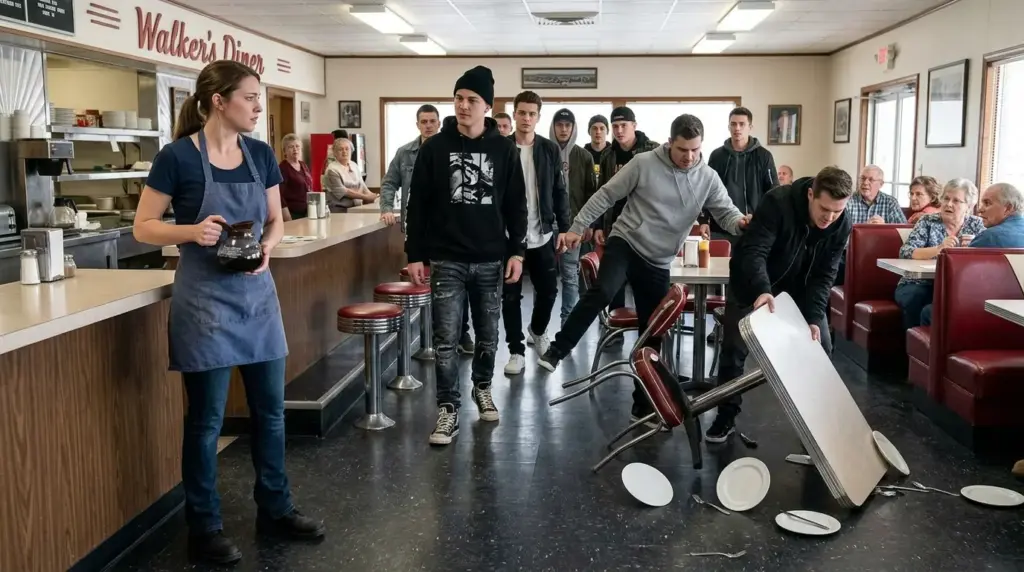
A kind of collision of noise, multiple voices at once, and then something breaking the specific percussive crash of something made of glass hitting something made of floor. Then another crash, different pitch. Then a sound he recognized even through the walls of the kitchen and across 18 years of deliberate distance laughter that meant something was being destroyed and the people doing the destroying were enjoying it. He came through the kitchen door and stopped. There were 12 of them young men early 20s wearing the kind of clothing that was meant to signal money and menace simultaneously.
They had moved into the diner the way a tide moves filling the space pushing the existing atmosphere out in front of them. Two of the center tables had already been overturned. The sugar dispensers and napkin holders that had been on those tables were now on the floor. The two highway department men were on their feet, backing toward the wall with the particular body language of men who understood they were heavily outnumbered. The elderly couple by the window had gone very still.
The teenager at the counter had his hands flat on the surface in front of him and was staring straight ahead. The one doing the most talking, he one who was clearly the axis around which the others orbited, was leaning against the counter with one elbow like he owned the place, like he’d always owned it. He was maybe 23 with a face that might have been handsome if it hadn’t been arranged into an expression of contempt so habitual it had started to leave marks. He was looking at Sarah. Sarah was behind the counter, very still, holding a coffee pot with both hands.
We’re not looking for trouble, the young man was saying in the particular tone of someone who is looking for exactly that, but wants the pleasure of having the other person pretend otherwise first. We just want some service. Is that so hard? He reached out and picked up the coffee pot from Sarah’s hands, not grabbed it, picked it up slowly, watching her face while he did it. Sarah’s eyes moved to Jack when he came through the kitchen door.
The young man followed her gaze and turned. Well, he said, “There he is, the famous Jack Walker. ” He said it with a smile that didn’t reach anywhere near his eyes. “I’ve heard about you. ” Jack looked at him without expression.
“I’m going to need you and your people to leave,” Jack said. His voice was level, conversational, the way you’d ask someone to pass the salt. “That right. ” The young man set the coffee pot down on the counter with exaggerated care. See, I’m Dylan Cross, and my people don’t leave places when old men ask them to.
Dylan turned back to the room and swept his arm in a wide theatrical gesture. “Trash it,” he said, and that was when everything changed. Three of the men moved toward the nearest table. One of them picked up a ketchup bottle and threw it against the wall. The sound was enormous in the enclosed space glass and ceramic, and a wet red explosion across the painted surface.
Two more swept their arms across a table, sending plates and cups and silverware flying. The elderly couple by the window. The woman cried out one sharp sound like a small bird, and the man in front of her opened his arms to put himself between her and the chaos, which was something Jack registered in the part of his mind that was still taking in information, that old habit of tracking the room that he had tried to leave behind. The two highway department men were frozen against the wall. The teenager at the counter had his head down and his arms over his head.
Dylan Cross watched all of it with the satisfied expression of someone watching a fireworks display they had arranged. Then one of Dylan’s men, big, broad- shouldered with a neck that suggested serious time spent in serious gyms, moved along the counter toward Sarah. He reached across the counter and grabbed her wrist. Sarah made a sound that wasn’t quite a word, just involuntary. The sound that escapes when something frightens you before your mind has had time to process what’s happening.
Jack moved. He wasn’t aware of making a decision. Something in him that had been dormant for 18 years simply engaged the way a machine that has been in storage will run when you put power to it hesitatingly for just a moment. Then with the full force of everything it was designed to do. What happened in the next 11 seconds was difficult to reconstruct afterward.
Even for the people who witnessed it, it was too fast. Not film fast, not Hollywood choreographed real fast. The unsettling fast of someone who had spent years learning to move through the bodies of other people. The way a river moves through landscape, finding the angles and the leverage points and the places where force applied with precision does much more than brute strength can achieve. The man holding Sarah’s wrist was the first.
Jack was behind the counter before anyone fully registered that he’d moved. He didn’t throw a punch. He applied pressure, a specific grip on a specific point on the man’s forearm, and the man’s hand opened involuntarily purely as a function of nerve response. And then the follow-through of the same motion carried the man’s center of gravity backward and down, and he hit the floor behind the counter hard enough to shake the mugs hanging on their hooks above the station. Sarah stepped back.





