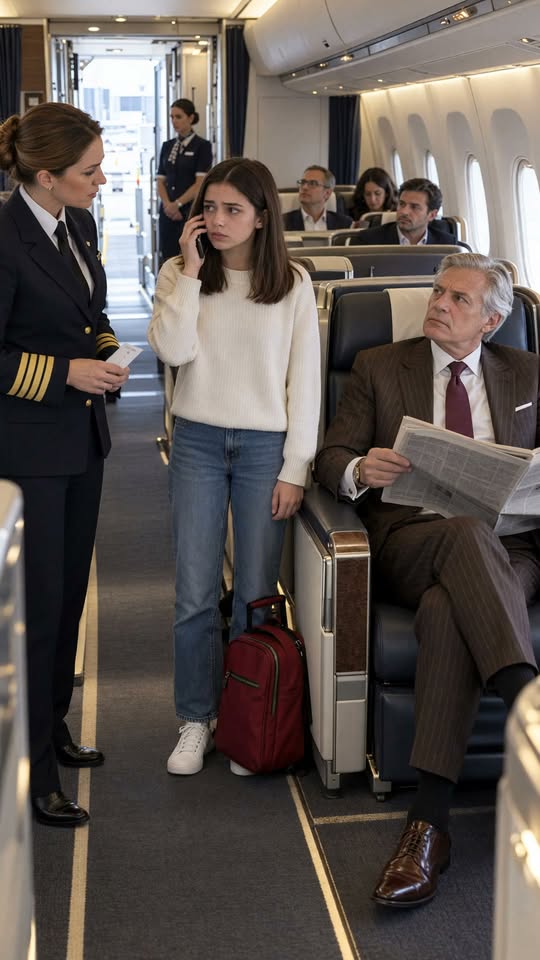
Zara tightened her grip on her small red travel bag. “Excuse me, sir, but you’re sitting in my seat.”
The silver-haired man finally looked up, studying her plain sweater and clean sneakers before glancing at her ticket. His tailored brown pinstripe suit seemed untouched by the discomfort of travel.
“It may say 2A,” he replied, “but you clearly don’t belong in First Class.” Several passengers turned, and Zara felt heat creep up her neck.
Her father’s advice returned before the embarrassment could silence her: becoming calm mattered most when someone wanted to frighten you. She held out her boarding pass.
“I have a valid ticket,” she said. “Please check your seat number.”
“My name is Richard Bennett,” he announced, waiting for recognition. Zara simply waited for him to check.
“Do you understand what that means?” he demanded. “It probably means your company buys a lot of airline tickets,” she answered.
Across the aisle, a businessman lifted his coffee to hide a smile. Richard’s expression hardened as Captain Elizabeth Hart entered the cabin to investigate the stalled boarding.
“This child is confused,” Richard told her immediately. “She thinks my seat belongs to her.”
Elizabeth examined Zara’s boarding pass, then checked the cabin tablet. “Mr. Bennett, your assigned seat is 2B.”
Richard gestured toward the empty aisle seat beside him. “We’re sitting next to each other anyway, so what difference does it make?”
“The difference is that you took mine,” Zara said. A quiet murmur traveled through the surrounding rows.
“Please move to 2B,” Elizabeth instructed. Richard folded his arms and refused.
He mentioned his corporate account, his meetings in London, and the business he brought the airline. Elizabeth listened without changing her answer.
“There is no booking error,” she said. “Seat 2A belongs to this passenger.”
“I’m not rearranging myself because a teenager wants the window.” Richard reopened his newspaper, apparently considering the conversation finished.
Zara stood motionless, then bent to lift her red bag. “Fine,” she said quietly, “keep 2A.”
His satisfied smile appeared immediately. It faded slightly when she stayed beside the row and reached for her phone.
“What are you doing?” he asked. “Calling my father.”
Elizabeth glanced down at the boarding pass still in her hand. This time, her eyes stopped on the surname: Coleman.
She looked at Zara again, suddenly pale. Zara tapped a favorite contact labeled DAD — OPERATIONS, and her father answered after one ring.
“Dad, a passenger took my seat,” she said. “The captain checked both tickets, but he still refuses to move.”
Richard gave an impatient laugh. Then Zara added, “He told me I don’t belong in First Class.”
Her father asked a brief question. “Flight 212,” she answered, “New York to London.”
At the front of the cabin, a flight attendant began drawing the boarding door inward. Elizabeth watched Zara listen to her father’s next words, her hand tightening around the boarding pass.
Zara looked directly at the captain. “Dad wants to speak with you.”
Elizabeth raised her arm so sharply that the nearest attendant froze. “Hold the door!”
Richard lowered his newspaper completely. For the first time that morning, he looked uncertain who would be leaving Seat 2A.
The Voice on the Phone
The flight attendant stopped with both hands against the door, then looked to Elizabeth for confirmation. The captain gave one firm nod and stepped out of the aisle so another passenger could pass.
“Keep boarding paused,” she said, taking Zara’s phone. “Captain Hart speaking.”
The answer was quiet enough that Richard leaned forward without appearing to do so. Elizabeth recognized the voice immediately, although she had heard it only at operational briefings and on company calls.
Daniel Coleman was the airline’s chief operating officer. He was also, apparently, the father of the girl still standing beside a seat the captain had already confirmed belonged to her.
For a moment Elizabeth saw the entire encounter from outside herself: an adult refusing instructions, a child holding proof, and several people waiting for the child to make the problem disappear. Her embarrassment was sharp, but Daniel’s first question left her no room to hide inside it.
“Is my daughter safe?” he asked. “And are you able to speak privately?”
“She’s safe,” Elizabeth answered, moving toward the forward galley. “We are still at the gate, and the seating dispute is unresolved.”
Zara watched her go, suddenly wishing she had stayed on the call. She had wanted her father’s familiar voice, not the strange silence spreading through the cabin now that people suspected his name mattered.
Richard folded his newspaper along its original crease. “Surely we aren’t delaying an international flight over this,” he said to the attendant nearest him.
The attendant, whose name badge read Maya, did not answer his question. She looked at Zara instead and asked whether she would like some water.
Zara nodded, grateful for something ordinary to do. When Maya returned with a cup, Zara discovered that her hands were shaking enough to disturb the surface.
In the galley, Elizabeth gave Daniel a brief account. She included the assigned seats, Richard’s repeated refusals, and the fact that he had invoked his company’s business relationship with the airline.
“Have you begun your refusal-of-instructions procedure?” Daniel asked. Elizabeth looked toward the cabin, where Richard was checking his watch.
“I was attempting to resolve it without removal.” She paused, then added, “I allowed that conversation to go on too long.”
Daniel did not raise his voice. “Your authority to resolve this was already there before you knew whose daughter she was.”
The words hurt because they were accurate. Elizabeth had insisted on the correct seat, but she had kept explaining after Richard made it clear he understood and simply did not care.
“I understand,” she said. “I’ll have the station supervisor attend.”
“Good,” Daniel replied. “I’m in the operations office at this airport, and I’ll come to the gate as her parent.”





