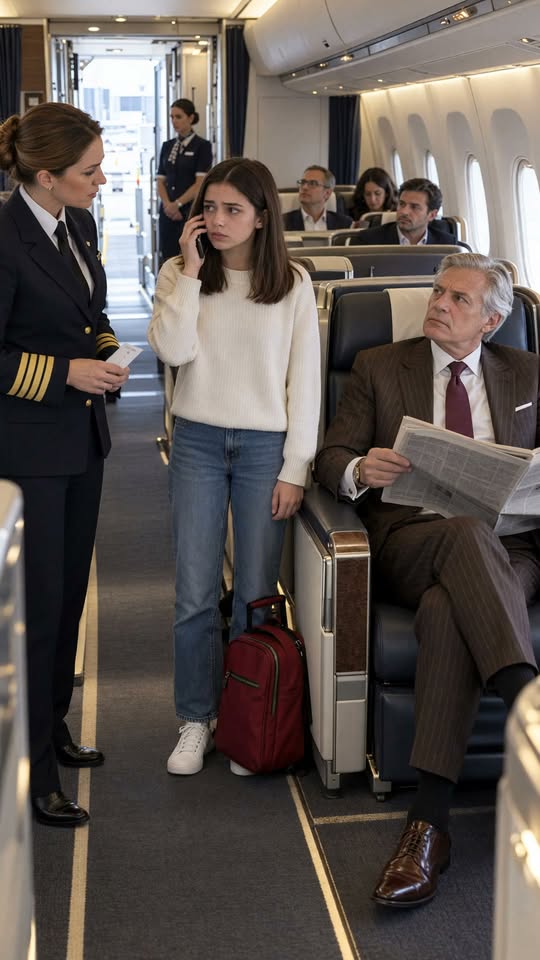
Nora saw the clip while making toast in her kitchen. She turned the phone facedown before Zara could read the comments, then asked whether she wanted to know what was circulating.
Zara said yes and wished, a minute later, that she had said no. A stranger had called her spoiled, and another had written that important people always found reasons to remove ordinary passengers.
“He wasn’t ordinary,” Zara said, then stopped. She heard the problem in her own answer almost as soon as she spoke.
Nora sat across from her. “His job doesn’t prove he was wrong, either.”
Zara pulled her knees onto the chair. “The ticket proves which seat was mine.”
“Yes,” Nora said. “And the people who were there can describe the rest.”
Daniel called while Zara was still looking at the toast she no longer wanted. He asked whether she had seen the clip and listened without interrupting when she told him about the comment.
“Can you make them take it down?” she asked. She hated the pleading sound of the question but needed to ask it anyway.
“We can ask for your image to be removed or obscured,” he said. “We can’t control every copy or make strangers understand by arguing with each one.”
The answer was less comforting than she wanted and more useful than a promise he could not keep. He asked Nora to help preserve only the material needed for a privacy request and then put the phones away.
“Am I going to have to tell everyone what happened?” Zara asked. “Like an interview?”
“No,” Daniel said. “You can give your account privately, and we’ll handle the adults’ responsibilities.”
After they hung up, Zara opened her sketchbook again. She drew an oversized mouth on the mechanical arm, then crossed it out so vigorously that Nora looked up from the kettle.
“Bad design?” her aunt asked. Zara gave a reluctant laugh.
“Too much talking,” she said. This time the hinge on the next page came out almost right.
The airline’s first public response was brief and did not name her. It said a passenger had been removed after repeated refusal to follow crew instructions and that a review was underway.
Richard released a statement through his company that evening, saying he regretted an uncomfortable misunderstanding. He did not mention taking the wrong seat or speaking to a child as if she needed his permission to occupy it.
Zara read that sentence once when Nora showed it to her. Then she shut the phone cover and asked whether they could walk to the workshop building the next morning so she would know the route.
Outside, London traffic moved through the rain under yellow streetlights. For the first time all day, Zara thought about where she was going instead of where someone had told her to stand.
The Whole Account
Thursday morning, Elizabeth arrived for her scheduled review with a notebook containing more crossed-out lines than notes. She had tried to write an account that was both accurate and free of excuses, and discovered how often excuses hid inside accurate sentences.
The review was led by Priya Shah from the airline’s safety and service standards team. An employee representative sat beside Elizabeth, and Lena joined by video from the airport.
Priya began by explaining that the purpose was to establish what had happened and what needed to change. She asked Elizabeth to start before she entered the cabin, rather than at the moment Richard became openly defiant.
Maya had first brought the seating issue to her attention while boarding was nearing completion. Elizabeth had expected a routine correction and had gone forward without asking the attendant to move Zara somewhere more comfortable.
“Why did you keep discussing it after confirming the seats?” Priya asked. Elizabeth turned her pen between her fingers and made herself stop.
“I thought I could get cooperation without delaying departure,” she said. “He kept introducing reasons the decision should be different, and I kept answering them.”
Priya asked whether his corporate account had influenced that choice. The question was direct enough that Elizabeth could not mistake it for an accusation she was meant to evade.
“It made me anticipate a complaint,” she answered. “I didn’t change the seat decision, but I spent longer trying to make him accept it.”
She described recognizing Zara’s surname and then hearing Daniel’s voice. Her face warmed again as she explained that she had suddenly understood how exposed Zara must have felt.
“Would you have stopped the door without that call?” Priya asked. Elizabeth looked down at the notebook and then back up.
“I should have,” she said. “I cannot honestly tell you what I would have done another thirty seconds later.”
No one rushed to fill the silence. Priya wrote down the answer and thanked her for making the distinction.
They reviewed the warning, Richard’s eventual movement, his remark to Zara, and Elizabeth’s decision to remove him. The available accounts agreed on the assigned seats and his repeated refusals, while witnesses described his final tone somewhat differently.
Priya recorded the differences rather than forcing them into one perfectly matching story. Elizabeth found that strangely reassuring, because the truth had not felt perfectly arranged while she was living it.
Maya spoke after her, describing how Zara’s hands had shaken around the water. She also mentioned that crew had learned to anticipate complicated follow-up whenever a high-value corporate traveler complained.
“Are you saying there’s an instruction to make exceptions?” Priya asked. Maya shook her head.
“There’s an instruction to apply the rules,” she said. “Then there are all the conversations afterward about whether we could have avoided upsetting someone.”
Lena nodded on the screen. She had seen agents spend more time documenting a reasonable refusal than processing the passenger’s original request.





