The distinction mattered to Priya, who asked for examples they could examine separately. A single cabin argument could not prove a whole company’s culture, but neither should a narrow incident review prevent them from noticing a repeated pressure.
In London, Zara gave her account from Nora’s kitchen table with her aunt beside her. The interviewer explained that she could stop, take a break, or say she did not remember something.
At first Zara tried to make each sentence sound mature. Then she forgot the exact order of two remarks and felt panic rise, as though one uncertainty might make everything else disappear.
“I don’t remember whether he said that before the captain came,” she admitted. The interviewer simply marked the uncertainty and moved to the next question.
When asked why she had told Richard he could keep the seat, she looked at Nora. Her aunt waited, letting the answer belong to her.
“I wanted the argument to stop,” Zara said. “I thought if I gave up, at least I could stop feeling embarrassed.”
“And why did you call your father afterward?” the interviewer asked. Zara ran her finger along the seam of the table.
“Because giving up didn’t make it feel better.” She took a breath and added, “And I didn’t know what else I was allowed to do.”
Afterward she was exhausted in a way that seemed unreasonable for a twenty-minute conversation. Nora made lunch, and they went to find the workshop without discussing the flight on the way.
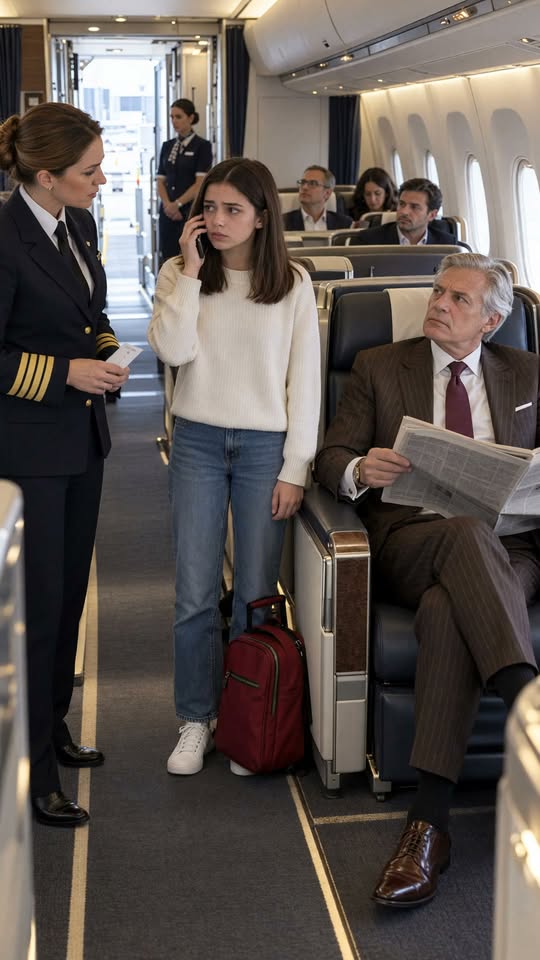
Richard’s own review took place Friday morning with his company’s chair, Helena Ward, and its human resources director. He arrived with a prepared summary that described a service dispute amplified by incomplete social media coverage.
Helena let him finish, then placed two printed reservations on the table. One showed his assigned seat, while the other confirmed the booking information his assistant had sent him before departure.
“You knew you had 2B,” she said. Richard adjusted the edge of the pages until they aligned.
“I preferred the window, and the situation became absurd.” He glanced at the human resources director, who was taking notes.
“At what point?” Helena asked. “When the passenger arrived, or when the captain confirmed the seat?”
Richard said the child had been insolent. Helena asked him to repeat the words he believed justified that description.
He repeated Zara’s comment about his company buying airline tickets. Heard in the quiet meeting room, after his own introduction had been read back to him, it sounded much less like provocation than he remembered.
“You were traveling on company business and repeatedly used the company’s purchasing power,” Helena said. “That makes your conduct relevant to us without requiring the airline to complain.”
He began explaining the importance of the London presentation. She reminded him that a colleague had delivered it remotely because he had missed the original flight.
“An inconvenience,” she said. “One you had several opportunities to avoid.”
Richard leaned back, finding no familiar opening in her tone. She was neither shouting at him nor offering the easy route of blaming the internet for everything that followed.
The company would complete its process before deciding on disciplinary action. In the meantime, another executive would handle the airline renewal, and Richard was not to contact Zara or her family through company channels.
“So I’m to be punished because her father runs the airline?” he asked. Helena’s expression tightened for the first time.
“You keep returning to him,” she said. “I’m asking you about what you did when you thought she had nobody important to call.”
Richard looked at the reservations again. For a long moment the only sound in the room was the soft ventilation above the door.
At the workshop that afternoon, Zara’s first mechanical gripper dropped a wooden block before lifting it clear of the table. A boy across from her suggested more motor power, but she shook her head and adjusted the hinge instead.
On the next attempt, it held. She called Nora over to see before remembering that she had not checked her phone for almost three hours.
The Apology That Asked for Nothing
The workshop ended the following week with a demonstration for families in a bright room overlooking a courtyard. Zara’s mother arrived carrying a raincoat over one arm and an expression that made Zara suddenly want to cry.
They had spoken every evening, but a voice through a speaker had not prepared her for the relief of being held. Her mother said nothing about the plane until Zara loosened her arms first.
“Show me what you built,” she said. Zara led her toward the table and explained the hinge before explaining the motor, because she had learned which part actually mattered.
The gripper lifted three wooden blocks and placed them in a shallow tray. It dropped the fourth, and Zara laughed instead of apologizing for ruining the demonstration.
Nora recorded a short video with Zara’s permission. When Daniel watched it later, he replayed the laugh more often than the successful lift.
The airline’s review concluded the next Monday. It supported the captain’s decision to remove Richard from the flight and identified the prolonged unresolved confrontation as a failure to give Zara timely support.
Elizabeth received formal feedback and was assigned additional scenario work with an instructor. Maya and Lena were included in the follow-up so the changes would reflect what happened in a cabin and at a gate, rather than only what looked sensible on a slide.
The airline also reviewed how complaints from major accounts reached frontline employees. Priya had found examples where staff believed a correct decision might still count against them if a valuable customer objected loudly enough.
No single email told them to ignore the rules. The pressure lived in delayed assurances, repeated explanations, and the absence of a clear response when they had applied the rules properly.





