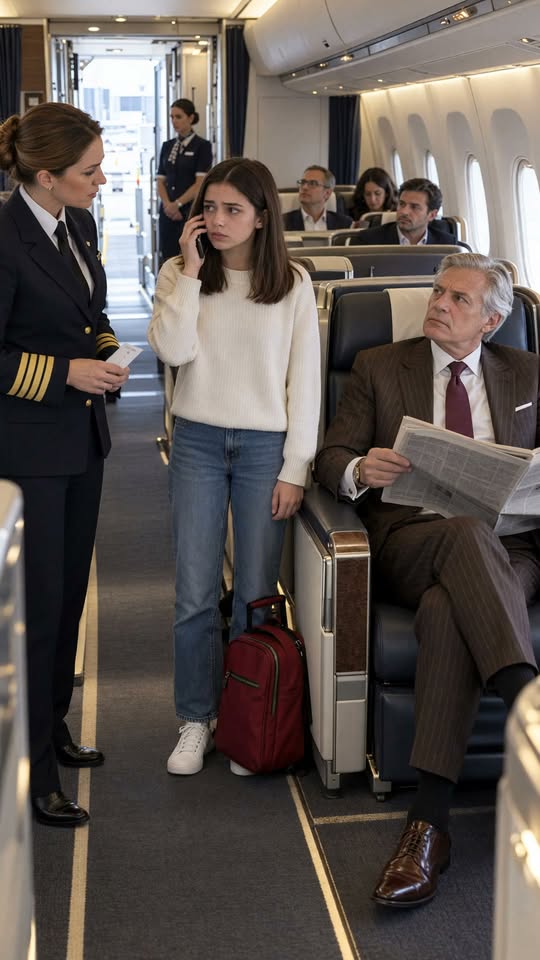
Richard was still at the desk when she passed. He shifted as if he might speak, then looked away when she met his eyes.
Back in the cabin, no one applauded. Zara was grateful for that kindness before she had words to describe it.
The businessman across the aisle moved his cup so she could pass without squeezing sideways. Maya helped stow the bag, checked that she had everything she needed, and left her with the window.
Zara fastened her seat belt and watched the ground crew finish their work. The glass held a faint reflection of her face, still flushed, still recognizably her own.
Elizabeth’s announcement came a little later, thanking passengers for their patience with a matter that had required resolution at the gate. She named no one and offered no version of the story for the cabin to repeat.
When the aircraft finally moved, Zara laid her boarding pass flat on the armrest. The printed number had not changed once that morning, although almost everything around it had.
What the Camera Missed
By the time lunch arrived, Zara had stopped checking the empty seat beside her. Maya placed the tray on her table and asked whether she wanted the window shade adjusted against the bright water below.
“It’s fine,” Zara said. Then, because the question had been asked without any special significance, she managed to smile.
She opened her sketchbook after eating and tried to draw the gripper for her mechanical arm. Every version came out too rigid, as if her pencil had learned something unpleasant from the morning.
Across the aisle, the businessman closed his laptop. “I’m Martin,” he said, keeping his voice low enough that she could choose not to answer.
Zara introduced herself and waited. She expected him to mention her father, but he looked down at the untouched coffee beside his computer instead.
“I should have said something earlier,” he told her. “I saw your ticket when you held it out.”
She remembered the smile hidden behind his cup. It had made her feel briefly less alone, although now she wondered why amusement had been easier for him than help.
“You weren’t the captain,” she said. Martin nodded, accepting the limit without trying to turn it into absolution.
“No, but I could have offered to be a witness.” He took a business card from his wallet and wrote a personal email address on its back.
He asked Maya to give it to the station team if a statement was needed. Zara was glad he had given himself something useful to do instead of asking her to tell him he had done nothing wrong.
For the next few hours the flight became ordinary in small, welcome stages. A child farther back spilled juice, someone laughed at a film through poorly fitted headphones, and Zara finally drew a hinge she liked.
As they descended toward London, the cabin lights softened against the evening sky. She watched roads become thin bright lines beneath the wing and felt excitement return without entirely replacing what had happened.
Her aunt Nora met her beyond arrivals, waving so vigorously that Zara laughed before reaching her. Nora hugged her, took the red bag, and asked whether she wanted food or quiet first.
“Quiet,” Zara said. “And then food.”
On the train into the city, Nora let her watch the dark windows until she was ready to talk. Zara told the story badly at first, jumping from the newspaper to her father’s voice and then backward to the seat number.
Nora did not correct the order. When Zara finished, she asked what part was still bothering her most.
“Everyone became serious when they knew about Dad.” Zara rubbed the edge of her boarding pass between two fingers.
“Do you mean the captain?” Nora asked. Zara considered the question rather than immediately agreeing.
Elizabeth had checked the tickets before recognizing her surname. She had told Richard to move, but the moment of recognition had still changed the air, and Zara could not pretend she had imagined it.
“I don’t know exactly,” she said. “I think I hate having to wonder.”
Nora looked at her for a moment, then nodded. “That makes sense.”
Back in New York, Daniel was wondering about the same thing. He had returned to operations after leaving the gate, but the image of his daughter holding that paper cup kept interrupting the ordinary demands on his screen.
He asked for an independent review through the airline’s established customer and crew process. Because his daughter was involved, another executive would oversee the findings, and Daniel would provide his account as a parent and witness.
The commercial director called before lunch. Richard had complained to her office, describing an unnecessary removal orchestrated by a senior executive for a family member.
“There’s an account renewal next month,” she said carefully. Daniel looked at the aircraft movements on the monitor beyond his desk.
“Then whoever reviews the incident needs the records before the renewal discussion,” he answered. “Including my call and my presence at the gate.”
He did not ask her to cancel the company’s agreement or call Richard’s board. The review would be meaningless if his own anger decided its outcome in advance.
That afternoon, however, the story began moving without either man’s permission. A passenger had recorded a short section of the cabin exchange and posted it after landing.
The clip started with Richard standing in the aisle holding his briefcase. It showed Elizabeth telling him to leave, but not the repeated refusals that had preceded her decision.
Richard’s name was audible, and someone soon identified his company. By evening, people who had never seen Zara’s boarding pass were confidently arguing about what she and her father must have done.





