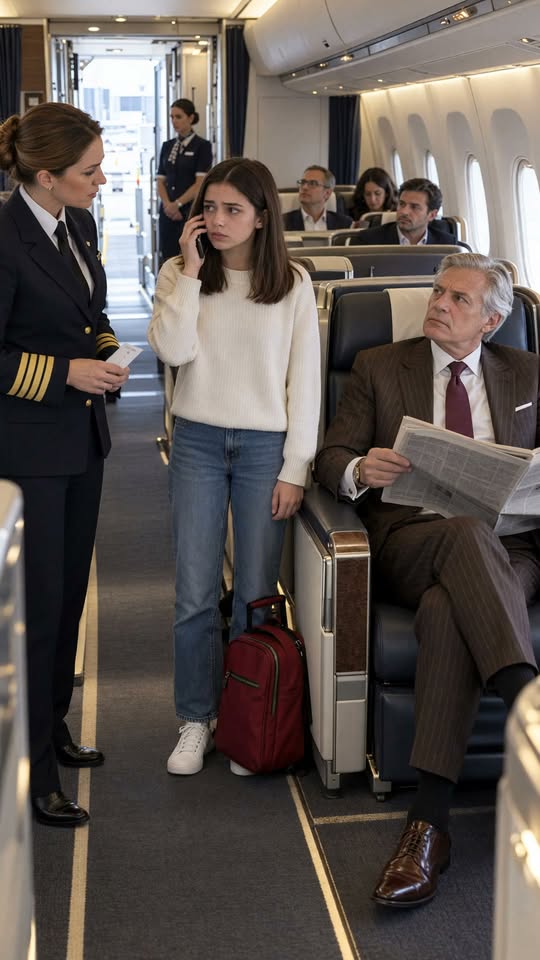
Richard remained standing across the desk. “We’ve known each other for years,” he told Daniel, as though that should settle something.
They had met at business reviews twice and exchanged brief greetings at an industry dinner. Richard’s company, Bennett Strategic Systems, purchased substantial corporate travel and was negotiating its annual agreement with the airline.
“We’ve worked together,” Daniel said. “That doesn’t change what Captain Hart needs to do.”
Richard loosened his tie. “I have a board presentation in London tomorrow morning.”
“The station team will discuss your available travel arrangements,” Daniel replied. “I’m here because my daughter called me.”
For the first time Richard looked directly at Zara without judging her clothes. The glance lasted only a second before his attention returned to the adult he believed could undo the consequences.
“Had I known she was yours, naturally I would have—” He stopped when Daniel’s expression changed.
“She told you the seat was hers,” Daniel said. “What else did you need to know?”
Lena placed a blank incident form on the desk and asked Richard to describe the encounter in sequence. Her tone stayed courteous, even when he began with the size of his company’s account.
“We can include that you mentioned the account,” she said. “Please start with the seat you were assigned.”
He said his assistant had booked the wrong side of the row. Lena asked whether he had requested a change from a member of the crew before sitting in 2A.
“The cabin was practically empty when I boarded.” He looked at Daniel, who offered no rescue from the question.
“So you did not request a change?” Lena asked. Richard said no, with the irritation of someone being made to confess that rain was wet.
She recorded his answer and asked when he first saw Zara’s boarding pass. Slowly, the account became simpler as the questions removed the speeches around it.
Across the gate area, Maya handed Zara’s bag to another attendant who had brought the cabin tablet. The attendant asked whether Zara wanted to continue traveling or would prefer to remain with her father.
Zara thought of her aunt waiting in London and the student engineering workshop beginning Friday. For months she had been saving sketches of a little mechanical arm she wanted to build there.
Her mother, away at an engineering conference in Europe, would join them over the weekend. Zara had insisted she was old enough to make the flight with the airline’s agreed arrangements, and her parents had taken that insistence seriously.
“I still want to go,” she said. Then she looked at Daniel to see whether he thought that was brave or foolish.
He asked whether she wanted a different seat. The question made her picture herself spending seven hours farther back, wondering why she had agreed to disappear after proving she was right.
“I’d like the one we booked.” She paused, then added, “But I don’t want everyone staring.”
Maya nodded as though both wishes were perfectly reasonable. “We can walk back together, and I can help you settle in.”
At the desk, Richard had reached the end of his explanation. He was now arguing that his final remark had been a comment about the airline’s delay costs, not a threat toward Zara.
Lena recorded his account without adopting it. Elizabeth, who had stepped into the terminal after consulting her first officer, confirmed that he would not travel on this departure.
“Am I banned from your airline?” Richard demanded. “Is that what this is?”
“You’re being removed from this flight,” Lena said. “Any further review will be communicated separately, after the facts are considered.”
The distinction seemed to irritate him because it gave him less to argue with. He could not accuse them of destroying his life when they were carefully describing what would happen that morning.
His checked bag would have to be located and handled before departure. A ground agent was already coordinating that work while another spoke to him about later travel options.
Richard looked at the clock, then at Daniel. “You realize this could affect our agreement.”
Daniel felt the familiar pressure behind the sentence. It was the language of meetings where reasonable people were expected to make one small accommodation because a great deal of money was involved.
“Our commercial team can discuss the agreement with yours,” he said. “It will not determine whether a passenger follows crew instructions.”
Zara watched him say it and wondered how often people asked him to make that choice. Until then, she had imagined important work as making decisions other people immediately obeyed.
Elizabeth came to stand beside her chair. “I owe you an apology,” she said.
“You told him it was my seat.” Zara did not want the person who had helped her to feel blamed for everything.
“I did,” Elizabeth answered. “Then I let him keep debating it while you stood there.”
She explained that she should have separated Zara from the confrontation sooner and made the consequences clear. She did not ask Zara to reassure her or accept the apology immediately.
Zara looked down at her cup. “I thought being calm meant I had to keep standing there.”
Daniel leaned forward, his hands resting on his knees. “Sometimes being calm means leaving the argument and asking someone else to do their job.”
“That’s what you did,” Elizabeth added. “You gave us the information we needed.”
When it was time to return, Zara hugged her father hard enough to wrinkle his jacket. He whispered that she could call again from London, from the workshop, or from anywhere else she needed him.
“Even if it’s something small?” she asked. Daniel smiled, but his eyes remained serious.
“Especially before you’ve spent an hour deciding you aren’t allowed to ask.” He handed her the red bag, and she walked beside Maya toward the jet bridge.





