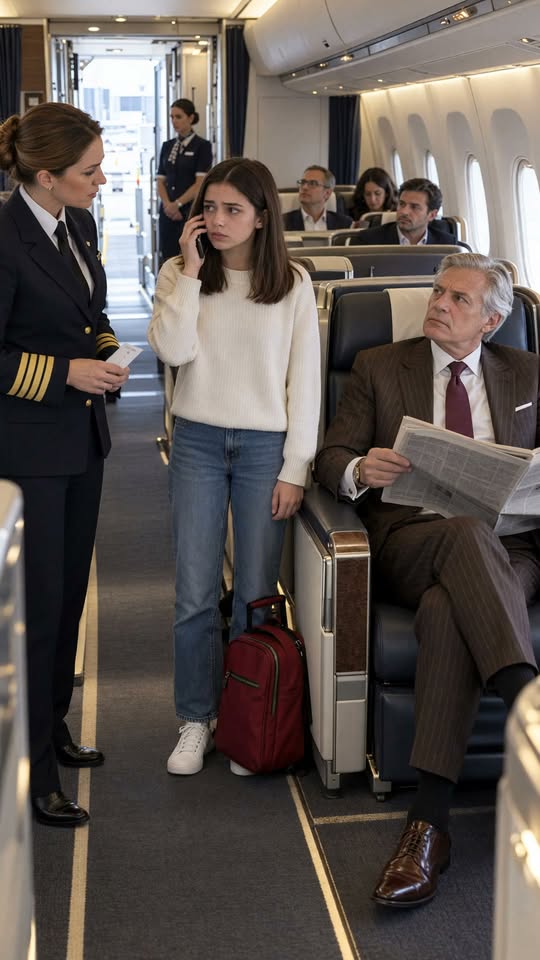
Daniel read the findings at his kitchen table after returning home late. Beside the report lay an old photograph of Zara wearing an oversized pilot’s cap during an airport family day.
He remembered giving a speech that afternoon about making travel easier for everyone. The photograph made him wonder how many speeches he had delivered without asking employees what made a simple decision difficult.
At the next operations meeting, he did not describe Zara’s fear for emotional effect. He described the process failure, acknowledged his involvement, and asked the independent reviewer to present the findings herself.
When she finished, the commercial director raised a practical concern about handling expensive customer disputes quickly. Daniel asked her to stay with that concern long enough to separate inconvenience from exceptional treatment.
An agent could help a traveler find another seat when one was available and the change was approved. An agent should not have to persuade the person with the valid assignment to surrender it because the other person brought more business.
They revised the escalation guidance and the way related complaints were recorded. Over the following months, Priya’s team would check actual cases to see whether staff experienced a difference.
Daniel knew a revised document could become another forgotten attachment. He asked for a date to review the results and put it on his own calendar before the meeting ended.
That evening, Zara called from Nora’s living room with her mother beside her. She asked whether Elizabeth had lost her job.
“No,” Daniel said. “The review found things she needs to improve, and she’s taking responsibility for them.”
Zara was quiet, tracing a loose thread on the sofa cushion. “She looked frightened when she saw my name.”
Daniel told her that Elizabeth had acknowledged the moment herself. He explained the review as simply as he could without turning someone else’s employment record into a family conversation.
“I don’t want people afraid of me,” Zara said. “Or afraid of you because of me.”
“Then we need to keep asking whether the same help would be there for someone else,” he answered. “You don’t have to solve that for the airline.”
She nodded, but he could see that the question would stay with her. It would stay with him, too, which he suspected was useful even though neither of them enjoyed it.
Richard’s company completed its review several days later. He received a formal disciplinary warning, lost responsibility for the travel agreement, and was required to complete a conduct program before resuming certain external duties.
He remained employed, although the decision did not feel small to him. For years he had treated access and influence as evidence of his judgment, and now colleagues were separating those things in front of him.
Helena refused his first draft of an apology. It described an interaction that had become unfortunate and expressed regret that Zara had felt uncomfortable.
“Who took the seat?” she asked, handing it back. Richard said nothing.
“Who refused to move?” she continued. He looked at the page as though the missing words might appear if he waited long enough.
His second draft was shorter and worse in a different way. It promised a substantial donation to a youth engineering charity, which Helena crossed out with a single line.
“You can support a charity separately,” she said. “An apology to a child should not arrive carrying a transaction.”
Richard took the pages home that night. In his apartment, with no audience to impress or colleague to interrupt, he tried to remember Zara’s expression when she first held out the boarding pass.
He could remember her sweater more easily than her face. That discovery unsettled him enough to keep him at the desk after he had switched off the lamp.
The next morning he wrote that he had occupied a seat he knew was not his. He wrote that he had judged her appearance, dismissed her valid ticket, refused the captain’s instructions, and made an unnecessary remark after finally standing up.
He did not say that travel stress had caused it. He did not mention her father except to acknowledge that discovering his identity should never have mattered.
The letter ended by saying that she owed him no reply, meeting, or forgiveness. Helena’s office asked the airline to forward it only if her parent agreed to receive it.
Daniel read it before offering Zara the choice. He told her who had written it and asked whether she wanted it now, later, or not at all.
She asked to read it with her mother. They sat beside the kitchen window while Nora washed dishes slowly enough to remain nearby without pretending she was not listening.
At the line about judging her appearance, Zara stopped. Until then, part of her had continued wondering whether she should have worn the blue dress her mother had suggested for dinner in London.
“He says that was wrong,” she said. Her mother nodded without looking over her shoulder at the paper.
“It was wrong before he wrote it down.” Zara read the line again anyway.
The letter did not make her like him, and it did not erase the cabin. What it removed was the small exhausting task of imagining that she might have caused his behavior by arriving dressed as herself.
Two days later she decided to reply. Her mother asked whether she wanted help, and Zara said only with the spelling if anything looked wrong.
She wrote that she had received the apology and appreciated his naming what he had done. Then she wrote the sentence she had been thinking about since the train ride from the airport.
“Please remember that the next person may not have someone you recognize to call.” She signed her name without mentioning her father’s title.





