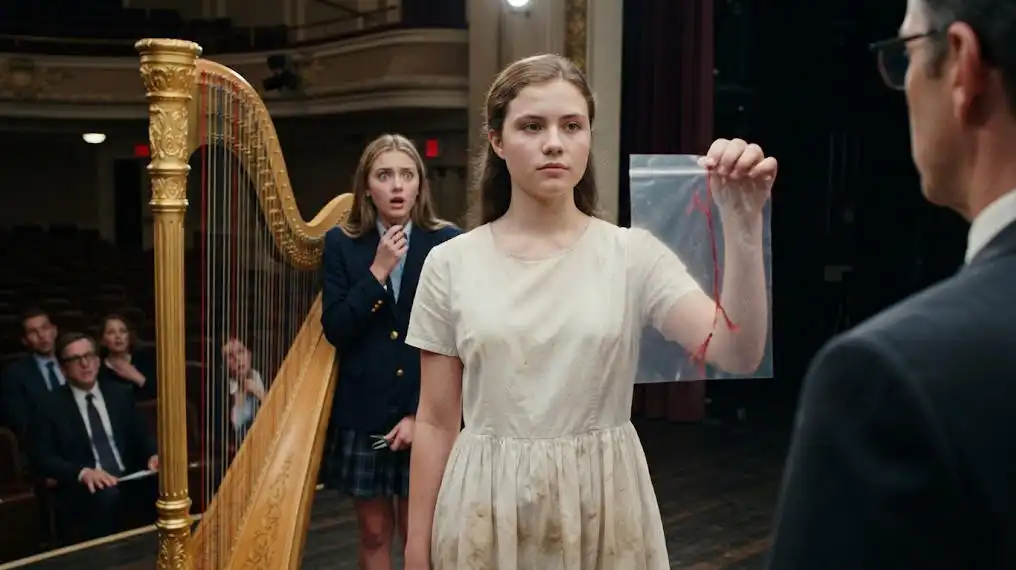
The school’s wardrobe mistress had brought her a clean performance dress—a simple, floor-length column of ivory silk from the archival costume collection, its fabric smelling faintly of cedar and dry lavender.
Her right hand was still wrapped in clean white linen, but the throbbing had receded to a dull, honest ache. Her left forearm, treated with burn ointment and covered in sterile gauze, rested lightly against the polished maple of the column.
She reached out with her bare left thumb and touched the fourth-octave C.
The note rose into the darkness of the empty hall: 261.6 Hertz.
It did not waver. It did not drift. It stood in the cool air like a monument carved from red stone, firm and immovable.
She touched the F.
It answered with that deep, oceanic blue clarity that had carried through her grandmother’s kitchen, through the shipyard dooryards of Gloucester, through the cold grease of the basement vault.
“It will need another quarter-turn by tomorrow morning,” a voice said from the shadows of the rear aisle.
Dr. Evelyn Hart walked down the rake of the hall, her walking stick silent on the carpet runner. She did not climb the stage steps; she stopped at the edge of the pit, resting her elbows on the rail, looking up at the girl and the gold wood.
“The humidity is going to climb after the rain stops,” Nora said without looking up. “The spruce will swell three millimeters across the lower ribs. It will pull the bridge pins sharp.”
“Then you’ll adjust them,” Hart said.
“Yes, ma’am.”
Hart looked at Nora’s wrapped fingers, then at the quiet, unlined stillness of her face.
“You could have stopped when the tea hit your eyes, Nora,” Hart said softly. “Any judge in the country would have granted you a rescheduled date. You had the law on your side. You had the evidence.”
Nora’s hands rested on the strings, feeling the delicate, microscopic vibrations of the dying notes against the pads of her fingers.
“A rescheduled date is a favor, Dr. Hart,” Nora said. “And when you take a favor from people like Vanessa Mercer, they spend the rest of your life reminding you that they were the ones who let you play.”
She tilted her head, her fingers closing gently around the fourth-octave chords, and drew a single, quiet progression from the heart of the instrument.
“I didn’t want their favor,” Nora said, her voice rising into the high, vaulted shadows of the ceiling where the Saint Cecilia window caught the last blue light of the evening. “I wanted the note.”
Dr. Hart stood in the dark for a long time, listening while the girl from the basement played the Tournier from memory, every chord ringing true, every pedal clean, every string holding its pitch against the gathering night.





