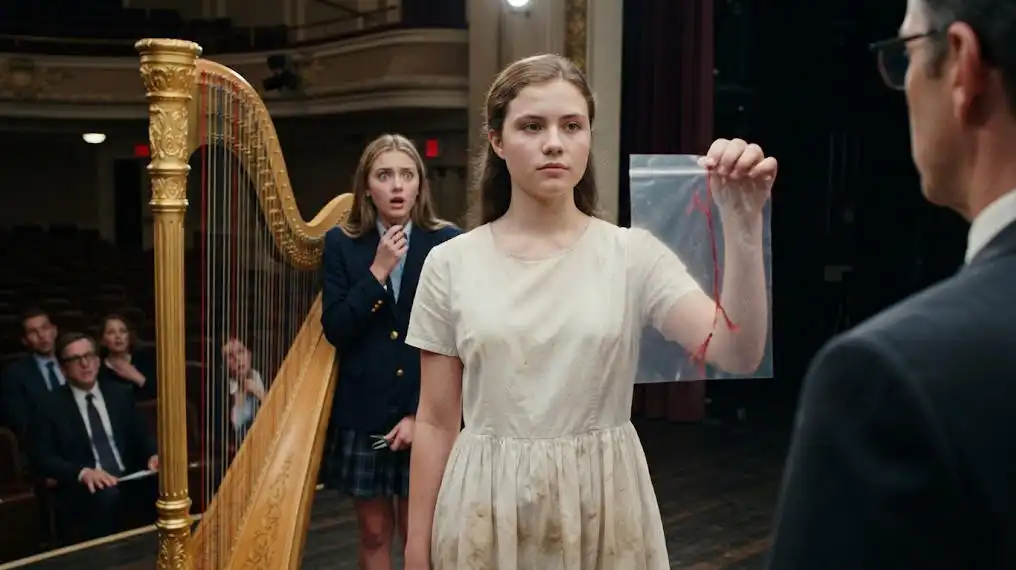
Instead, she asked to speak with the school safety officer.
“Something happened in Practice Room No. 3 before the audition,” she said. “I need the school to document it properly.”
Officer Caleb Rourke listened without interrupting.
Nora did not demand that Vanessa be punished. She did not call her names or make threats.
She asked for a formal record.
Caleb photographed the damaged strings and the harp’s condition before touching anything. Using clean tools, he recovered the broken sections lodged near the soundboard and placed them in separate labeled evidence sleeves.
He recorded the time, the location, and every transfer of the evidence.
He photographed Nora’s stained dress and collected a sample of the liquid residue. He also secured the abandoned cup from the practice room.
Nora provided a written account of the assault and identified the two students who had been present.
Caleb contacted the selection panel and requested an emergency hearing.
Vanessa initially insisted that Nora had damaged the instrument herself.
“She was panicking,” Vanessa claimed. “She probably snapped the strings while trying to tune them. Then she spilled her own tea.”
Dr. Whitmore supported that explanation.
“New strings can be unstable,” she said. “The school cannot treat every unsuccessful audition as misconduct.”
But Dr. Hart refused to dismiss the matter.
“The performance was not unsuccessful,” she replied. “And the damage needs to be examined independently.”
That was how everyone ended up in the hearing room, staring at the UV lamp.
The officer moved the light slowly across the jaws of Vanessa’s manicure pliers.
The special carmine beeswax used on the school’s red C strings contained a traceable marker that fluoresced under ultraviolet light.
The same marked residue appeared on the cutting edge of the pliers.
A matching trace was found in the creases of Vanessa’s right index finger.
Beside the lamp lay the recovered red string.
Its cut surface was unusually clean, with the characteristic compressed, angled marks associated with a sharp metal cutting tool.
Natural gut that breaks under excessive tension generally shows irregular, fibrous tearing.
This was different.
Mr. Grant Ellison, the school’s harp conservator, examined the string under magnification. He compared the cut surface with the geometry of the pliers and documented the matching characteristics.
“The damage is consistent with a deliberate tool cut,” he told the panel. “It is not consistent with the ordinary tension failure she is describing.”
Vanessa’s expression hardened.
“That proves nothing about who held the tool!”
Caleb placed another sealed item on the table.
The liquid sample from Nora’s dress had been compared with the residue recovered from Vanessa’s abandoned cup. Both contained a matching profile of roselle-derived pigments consistent with the hibiscus tea.
The findings supported Nora’s account of the drink being thrown on her before the audition.
Then Dr. Hart turned to the two students who had accompanied Vanessa into the room.
One of them stared at the table.
The other began to cry.
“I saw her cut the strings,” she admitted. “I thought she was just trying to scare Nora. Then she put the greasy cream on the other strings.”
The room fell silent.
Vanessa turned toward her.
“You said you wouldn’t tell!”
The words escaped before she could stop them.
Officer Caleb looked up.
Dr. Hart folded her hands.
“Thank you,” she told the witness. “Your statement will be recorded separately.”
Nora stood quietly at the opposite side of the table.
She had not needed to shout.
She had not needed to threaten anyone.
The evidence had been preserved, the technical findings independently documented, and the witnesses heard.
The story Vanessa had invented was falling apart under the weight of facts.
Dr. Whitmore finally spoke.
“This has been blown out of proportion. Vanessa is young, and she was under pressure. We should consider her family’s longstanding support of the music program.”
Dr. Hart looked directly at her.
“Financial support does not grant a student permission to damage another student’s instrument.”
“And it does not give a department chair the right to pressure a candidate into withdrawing,” Caleb added.
The hearing panel reviewed the evidence and the witness statements.
Vanessa’s actions were no longer a dispute between two competing musicians.
They were a documented act of deliberate sabotage, accompanied by physical intimidation and an attempt to conceal what had happened.
The school canceled Vanessa’s eligibility for the selection, imposed a major disciplinary sanction, and suspended her from the music program pending the required disciplinary process. Her conduct was referred to the school district’s arts-program integrity review.
Dr. Whitmore was removed from selection duties and placed on administrative leave while the school investigated her handling of the incident and her conflict of interest.
Her position could no longer shield her goddaughter from the rules she was responsible for enforcing.
Vanessa looked at Nora.
“You could have ruined my entire future,” she said.
Nora’s expression remained calm.
“I didn’t cut your strings,” she answered. “I just asked them to look at the evidence.”
Nobody in the room had an answer to that.
The hearing concluded with the panel confirming Nora’s scholarship result and first solo appointment. The evidence was retained under the school’s formal procedures, and the incident became part of the disciplinary record.
When Nora returned to the concert hall stage, the room was nearly empty.
The golden harp stood beneath the warm lights.
Her old white dress had been stained beyond repair, and her fingers still hurt. She was exhausted in the way only a person who has fought for every second of an opportunity can be exhausted.
A school staff member brought her a clean white performance dress from the costume collection.
Nora changed and returned to the stage.
She sat beside the harp and placed her hands gently over the strings.
For a moment, she remembered Vanessa’s words.
You don’t get to tell me no.
Nora had spent so much of her life believing that poverty meant she had to be grateful for whatever opportunity someone powerful chose to give her.





