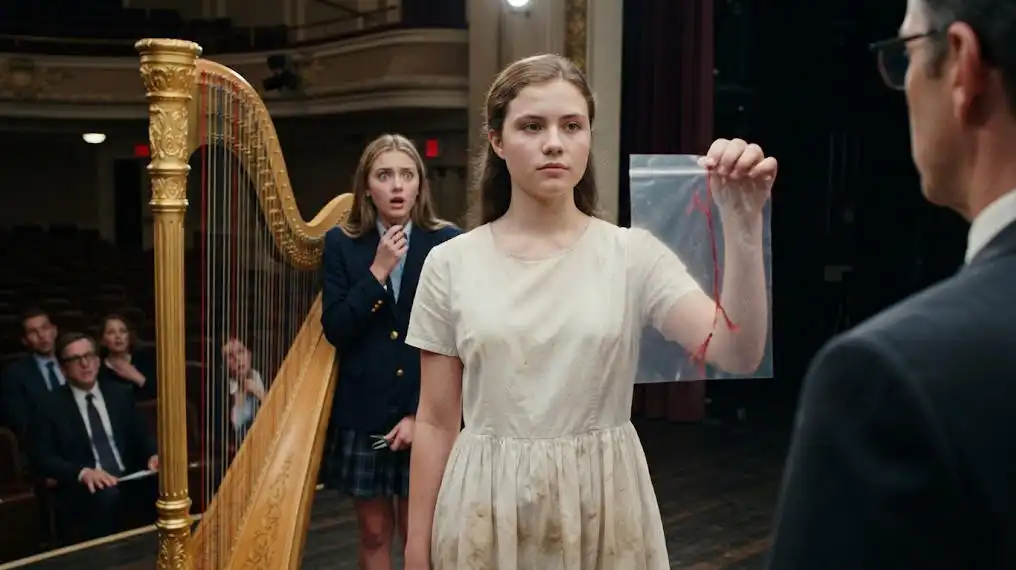
Nora took a breath.
Then she did something Vanessa had never expected.
She stopped thinking like a humiliated student and started thinking like a harp technician.
First, she pulled her orchestra shawl around her shoulders to cover the worst of the stain. She rinsed the tea from her eyes and dried her face.
Then she hurried to the school’s temperature-controlled string room.
Inside the cabinet, she selected two replacement gut strings of the correct gauges. She also took medical microcrystalline talc, a measured amount of anhydrous alcohol, lint-free cloths, a sheepskin pad, and a brass roller.
She had spent years studying the delicate relationship between temperature, tension, and the natural stretch of gut strings.
Ordinarily, a new string required repeated tuning and many hours of settling. Under high tension, its collagen fibers continued to creep, causing the pitch to fall.
Vanessa was counting on that behavior.
Nora could not change the nature of gut.
But she knew a specialized emergency technique that could control its initial stretch far more quickly than ordinary installation.
She returned to the harp.
The first problem was the grease.
She worked on the affected high strings using the absorbent powder and carefully controlled cleaning method she had practiced in the workshop. She used the alcohol only in measured applications on the cloth, avoiding the careless saturation that could damage natural gut.
She lifted the oily residue from one string at a time.
Three minutes.
That was all she could afford.
Next came the replacements.
Nora threaded the new red C string through the appropriate opening and tied a secure locking harp knot. She repeated the process for the blue F string, checking the knots twice before bringing either string up to tension.
Her hands moved quickly, but not recklessly.
She adjusted the tuning pins in small increments.
Then she wrapped the sheepskin pad around the brass roller and began her three-point pre-tensioning sequence, using controlled friction and warmth to condition the strings while monitoring their response.
She brought the pedals through the required positions, allowing the mechanism to apply the appropriate tension changes. She held the strings under controlled load for the prescribed interval, then released and retuned them.
The technique was demanding.
The margin for error was almost nonexistent.
At one point, a sharp flare of pain shot through Nora’s right hand. The pads of four fingers had developed fresh blisters.
She paused for a single breath.
Then she continued.
She could not afford to treat her pain as the most important thing in the room.
At 2:57 p.m., the replacement strings were installed and stable enough for a final check.
Nora played the central C.
The note rang clear.
She played the F.
It answered with a clean, steady pitch.
She ran through the most demanding section of the audition piece, checking the seven pedal positions and listening for any sign of slippage.
The strings held.
At 2:58, she completed the final tuning check.
At 2:59, she rolled the golden harp toward the concert hall stage.
Her right fingertips throbbed beneath the thin protective tape.
Her dress was still stained.
And she had no idea whether the judges would believe her if anything went wrong.
But she was going to play.
At exactly 3:00 p.m., the selection began.
Vanessa sat in the audience beside Dr. Whitmore.
She had changed into a fresh performance dress and arranged her expression into one of practiced concern.
When Nora appeared onstage with her stained dress partially covered by the orchestra shawl, Vanessa leaned toward her godmother.
“She should withdraw,” she whispered. “Those strings are new. She’ll embarrass the school.”
Dr. Whitmore studied Nora for a moment.
Then she sent a message to the selection panel asking whether the candidate should be permitted to proceed with an instrument that had just been repaired.
Dr. Hart read the message.
She looked at Nora.
“Are you prepared to perform?”
Nora placed her hands above the strings.
“Yes, ma’am.”
Dr. Whitmore leaned forward.
“Perhaps you should consider withdrawing. A poorly stabilized instrument could reflect badly on you and the school.”
Nora met her eyes.
“Please judge my playing, not my dress.”
The hall became quiet.
Dr. Hart nodded.
“Proceed.”
Nora began.
The opening arpeggios rose through the concert hall with a clarity that made several audience members lift their heads.
Her right hand moved across the strings. Her left answered with precise, controlled patterns. The seven pedals shifted through the chromatic passages without the distracting clicks that had plagued Vanessa’s performances.
The central C rang exactly where it belonged.
The F remained steady.
Nora moved through the first demanding sequence, then the second, then the third.
The new strings did not collapse into the falling pitches Vanessa had predicted.
Nora’s technique was so controlled that the audience heard the music rather than the struggle behind it.
She reached the most difficult passage.
Two hundred rapid arpeggio attacks and a continuous chain of pedal changes demanded absolute coordination.
Her fingertips burned.
She could feel the blisters beneath the tape.
But she did not rush.
She did not tense her shoulders.
She trusted the work she had done in the string room.
The final chord filled the hall.
For a moment, nobody moved.
Then Dr. Hart rose to her feet.
The audience followed.
Applause swept through the concert hall.
Vanessa stared at the stage.
“That’s impossible,” she muttered.
Nora stood and bowed. Her face was pale, and the stain on her dress remained visible beneath the shawl.
But her performance had not failed.
Dr. Hart addressed the audience.
“That was an exceptional demonstration of musicianship, technical control, and composure under pressure.”
She turned to the selection panel.
“Based on today’s audition, I recommend Nora Bennett for the full Juilliard Summer Program scholarship.”
The panel unanimously approved the award.
Nora was also named the school’s first harp soloist.
For the first time that afternoon, she allowed herself to smile.
Then she remembered the broken strings.
She could have accepted the applause and walked away.





