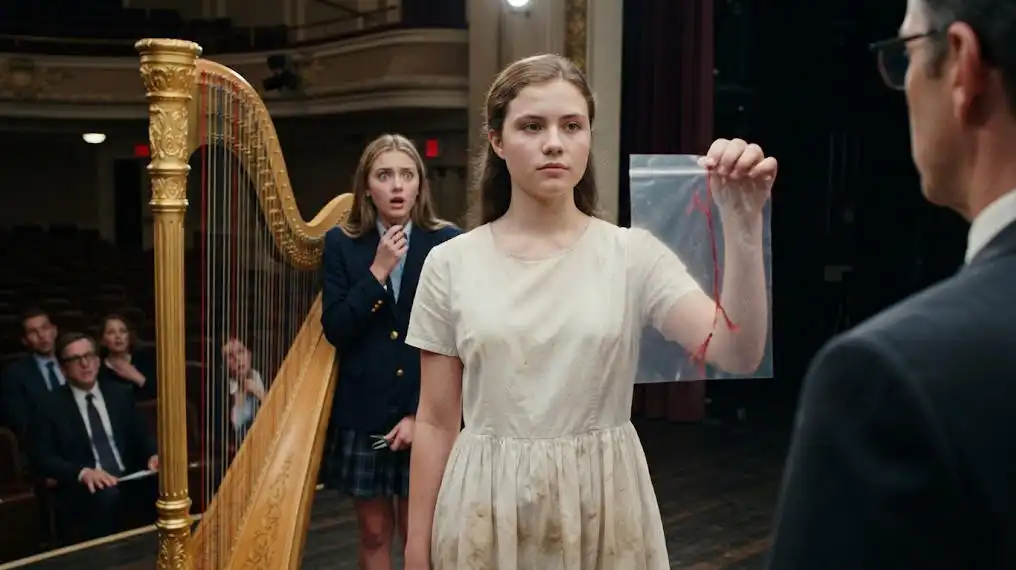
Nora did not look like an applicant for a prestigious Manhattan fellowship. The heavy black wool orchestra shawl was wrapped around her torso like an ancient battle mantle, held at her throat by a tarnished steel clip. Beneath the hem of the dark wool, the edges of her white skirt showed dark, irregular water-stains. Her feet were bare within her simple black leather flats, and her right hand was wrapped from the wrist to the second knuckle in coarse white athletic tape she had scavenged from the first-aid box in the wings.
Vanessa leaned forward, her lips parting in an involuntary, sharp smirk. She leaned toward her godmother’s ear. “Look at her, Elaine. She’s disheveled. She’s tracking something onto the stage. She’s clearly had some kind of breakdown.”
Dr. Whitmore frowned, her hand rising to signal the stage manager. She reached for the microphone on the desk before her. “Nora? Miss Bennett? If you are experiencing technical difficulties or… personal distress, the committee is prepared to grant an administrative postponement until tomorrow morning’s general assembly.”
Nora adjusted the harp’s angle, settling the heavy maple column against the hollow of her right shoulder. The balance was familiar, cold, and true.
She looked down from the stage, her dark eyes locking directly onto Dr. Whitmore’s face, then shifting three feet to the left to settle upon Vanessa Mercer.
“I do not require a postponement, Dr. Whitmore,” Nora said. Her voice was neither loud nor thin; it had the clear, bell-like resonance of an uncracked soundboard. “My instrument is ready. I am ready.”
Dr. Hart leaned toward the microphone on her side of the desk. “Miss Bennett, what is that black wrap you are wearing? Conservatory protocol requires the standard audition dress.”
“My dress suffered an environmental contamination in Practice Room Three twenty minutes ago, Dr. Hart,” Nora said calmly. “I am wearing the wrap to ensure the committee’s attention remains focused on the score, rather than on the state of my linen.”
Hart’s eyebrows arched behind her spectacles. She glanced sideways at Dr. Whitmore, whose throat had suddenly flushed a pale, mottled red.
“A sensible musician respects the score above her vanity,” Hart said softly. She settled back into her cushions, her silver pen poised over the clean page of her ledger. “Whenever you are prepared, Miss Bennett. Marcel Tournier’s Féerie.”
Nora closed her eyes for two seconds.
Inhale four counts. Hold four counts. Exhale six.
The pain in her right fingers was intense—a sharp, throbbing heat where the skin had split under the talc. Her left forearm burned where the sheepskin roller had taken the surface layer of dermis.
She laid the pads of her fingers across the strings.
The gut was dry. The talc had done its work; there was no oil, no grease, only the velvety, matte grip of clean sheepskin.
She played the opening measure.
The sound that erupted from the Lyon & Healy was not the polite, tinkling chime of an academic rehearsal. It was an explosion of pure, resonant light.
The opening of the Féerie is a technical nightmare: an undulating cascade of seventy-two notes in thirty-second-note groupings, sweeping from the deepest wire-wound bass strings to the paper-thin gut of the seventh octave, requiring the harpist to execute nineteen chromatic pedal changes in the span of twelve bars.
Nora’s right hand moved like a swallow skimming the surface of an estuary.
Her fingers didn’t pluck; they danced with that terrifying, effortless economy of movement that only comes from knowing the exact tensile resistance of every inch of gut under her touch. Her left hand provided the deep, thunderous harmonic support, her palm catching the soundboard vibrations and transferring them into her chest.
Down in the audience, Dr. Evelyn Hart’s pen did not touch the paper. The woman sat with her mouth slightly open, her head tilted at an acute angle, her eyes fixed not on Nora’s face, but on the golden pillar of the harp.
She was waiting for the drift.
Every professional harpist in that room knew the sound of a new string: after six bars of heavy arpeggios, the pitch would sag, the clean intervals of the fourth octave would curdle into sour, flat dissonance, and the performance would dissolve into an embarrassing struggle against physics.
Nora hit the ninth measure.
The passage demanded seven consecutive strikes on Middle C, followed by a rapid, descending trill on the blue F.
Clang. Clang. Clang.
The notes rang true as church bronze. The carmine C did not yield a single cent of pitch. The blue F answered with the crisp, bell-like bite of high-carbon steel. The molecular chains, forged under the violent heat of the brass roller fifteen minutes earlier, held their ground against the seventy-pound pull of the pins.
Behind the committee desk, Vanessa Mercer’s hands began to shake.
She gripped the velvet armrest of her chair, her nails digging into the plush upholstery. Her breath came in short, dry hitches. “No,” she whispered, so low that only Chloe heard her. “That’s impossible. She didn’t have time. It takes two hours to knot a bottom gut…”
Nora did not look at the house. She had entered that deep, limestone cellar within her own mind where there were no committees, no emerald earrings, no tea stains, and no poverty. There was only the architecture of Tournier’s vision: a world where water became light, where stone became wind, where every note had to be purchased with absolute, unyielding precision.
She reached the final cadenza.
Two hundred rapid-fire arpeggio attacks across three octaves, executed while both feet danced across the seven brass pedals in a complex, counter-intuitive sequence of flats, naturals, and sharps. Her right index finger throbbed; the white athletic tape had turned dark with a tiny spot of fresh blood where the fissure had reopened under the velocity of the attacks.
She did not flinch. She did not slow the tempo by a fraction of a metronome mark.





