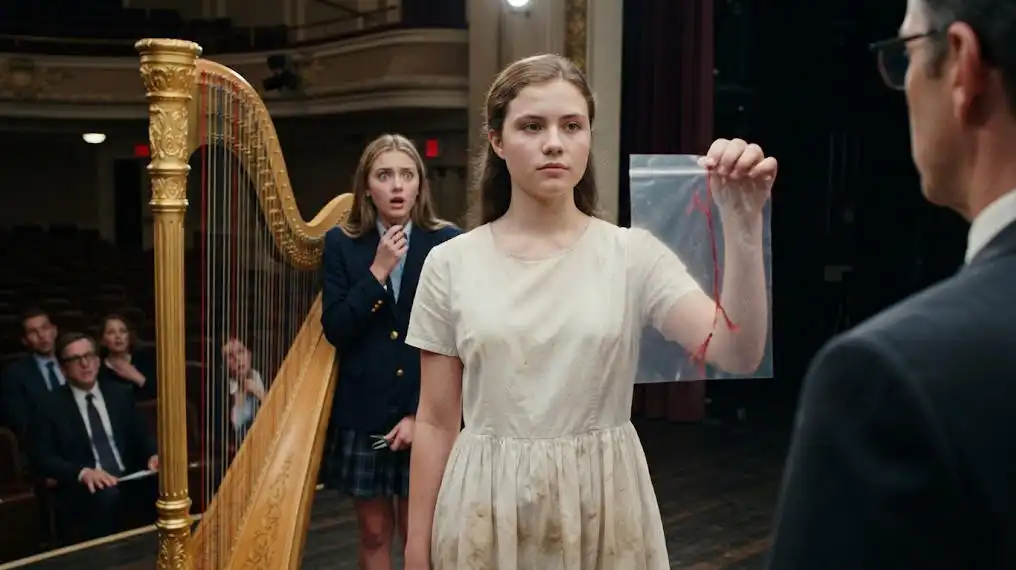
The viscous hydrocarbon spread across the porous, twisted sheep gut, soaking into the winding, filling the microscopic grooves that Nora’s calluses needed to grip.
Vanessa stood back. She wiped her grease-slicked fingers on the velvet skirt of the bench cover, looking down at Nora, who was kneeling in the puddle of hibiscus tea, her knuckles pressed against the floorboards.
“New gut takes thirty-six hours to stretch past its primary creep phase, Bennett,” Vanessa said, her voice dropping into a conversational, almost affectionate purr. “Even if you had the replacements, you couldn’t keep them at pitch for eight bars. And the rest of the harp is like butter.”
She checked the diamond-encrusted watch on her slender wrist.
“Two forty-two. Auditions begin at three sharp. My godmother is already in the green room with Dr. Hart.” She leaned down, her face inches from Nora’s wet, tea-streaked forehead. “Let’s see how your crystal arpeggios sound when your fingers can’t find a purchase.”
She turned toward the door. “Abbie. Chloe. Let’s go get our seats.”
The heavy oak door swung shut. The latch fell into its brass strike plate with a final, tomb-like click.
Nora sat on the floor for three seconds.
In those three seconds, her heart beat eighteen times against her ribs. The hibiscus tea was cold against her throat, smelling of dried rose hips and vinegar. A thin trickle of sticky crimson liquid ran into the corner of her mouth. Her grandmother’s linen dress was ruined, soaked through to the skin, clinging heavy and cold to her thighs.
Her eyes drifted to the harp.
The fourth-octave C and F hung like severed arteries from the bridge pins. On the treble strings, the greasy sheen of the cold cream caught the gray window light, an oily film that would cause any fingertip to slide off the gut without catching the tone, producing only a muffled, dull plink instead of a round, projecting voice.
A wave of nausea rose in her throat—the blind, helpless instinct to drop her forehead to the floor, pull her knees to her chest, and let the clock run out. If she stayed here, Dr. Whitmore would announce her absence with a regretful sigh. Vanessa would take the stage, her godmother would nod from the front row, and Nora would spend her junior year polishing brass pedals in the basement until her tuition waiver expired.
No.
The word didn’t come from her mind. It came from her hands.
Her grandfather had been a master carpenter in the shipyards at Gloucester; her mother spent nine hours a day repairing double-needle seams on industrial sewing machines. In Nora’s family, when a tool broke, you did not weep over the iron. You fixed the balance, or you starved.
She pushed herself up from the floor. Her joints were cold, but her breathing had already begun to slow, dropping into the rhythmic, four-count measure of the string room.
Two forty-three. Seventeen minutes.
She ran to the corner washstand, wrenched the cold water tap, and buried her face in the basin. She scrubbed the sticky sugar from her cheeks and eyelids, blinking away the stinging acid until her vision was razor-sharp. She reached for her heavy black wool orchestra shawl hanging from the coat hook—the thick, double-knit wrap mandated for outdoor commencement ceremonies—and draped it diagonally across her torso, pinning it at her right shoulder with an iron music-clip from her stand. The black wool completely concealed the tea-soaked front of her linen dress, leaving only the clean white collar visible beneath her throat.
She turned to the door, pulled it wide, and sprinted down the service stairs to the basement vault.
Her fingers did not shake as she punched the digital keypad to the string storage room: 4-7-2-1.
The door unlocked with a pneumatic hiss. Nora bypassed the student bins and walked directly to the locked master technician’s cabinet behind the humidity chamber. In the upper drawer lay two unopened envelopes from Bow Brand in Norfolk, England: 0.042 gauge, Red C, 4th Octave; 0.036 gauge, Blue F, 4th Octave. Both were natural sheep gut, cured with sulfur and finished with a thin micro-layer of carmine-tinted beeswax.
She grabbed them. From the chemical rack, she took three items: a glass flask of ninety-nine-percent anhydrous isopropyl alcohol, a wide-mouthed jar of medical-grade microcrystalline talc, and a heavy brass burnishing roller wrapped in split sheepskin.
She had seven minutes.
Standard conservatory practice dictated that a gut harp string required twenty-four to forty-eight hours to stabilize. The collagen fibrils within the sheep intestine were elastic polymers; when brought under seventy pounds of static tension, they exhibited profound viscoelastic creep. The pitch would drop a half-step every ninety seconds as the fibers elongated, until the molecular chains aligned and stabilized.
Vanessa was banking on that physics.
What Vanessa did not know—because Vanessa had never spent a Sunday morning rebuilding the pedal-box of an eighty-year-old concert harp with an old craftsman from Bavaria—was that there existed an emergency method known among orchestral technicians as thermal-stress stabilization.
Nora burst back into Practice Room No. 3 at 2:48.
First: the petroleum grease.
She didn’t use water; water would penetrate the gut core and cause the strands to swell and delaminate within ten minutes. Instead, she took two handfuls of the microcrystalline talc and cast it directly over the middle and upper octaves. The ultra-fine silicate powder bloomed into the air like white smoke, settling across the oily strings.
The talc was an aggressive lipid adsorbent. Instantly, the white powder clung to the petroleum cream, turning the slippery grease into dry, clotted crumbs.
Nora took a clean square of unbleached linen, dampened it with three drops of the anhydrous alcohol—just enough to act as a solvent without wetting the gut—and clamped the cloth around the first greased string between her thumb and forefinger. She dragged the cloth down the length of the string in a single, continuous, high-velocity motion.





