The friction produced a sharp, whistling hiss. The talc and grease peeled away in gray, dry flakes onto the parquet.
She repeated the motion: G, A, B, C, D, E. String by string, twenty-two times, her fingers moving with the mechanical cadence of a shuttle on a loom. By the tenth string, the skin of her right palm was raw and burning from the dry heat of the friction. By the fifteenth, the sharp edge of the high E string had sliced a clean, paper-thin fissure through the callus of her right index finger.
She didn’t stop to look at the blood. She smeared the wound with a pinch of dry talc, wiped the remaining strings clean, and dropped the cloth.
Two fifty-two. Eight minutes.
Nora knelt at the base of the soundboard. She tore the paper envelope of the fourth-octave C with her teeth.
She threaded the stiff red gut through the eyelet in the lower belly. Beneath the soundboard, inside the soundbox cavity, her left hand tied the traditional harp knot: a figure-eight loop with a split wooden peg inserted into the bight to prevent the knot from pulling through the soundboard veneer under high tension. She pulled the knot home with an iron wire-puller until she heard the spruce take the load with a tiny, dry creak.
She brought the string up to the neck. She threaded the upper end through the small hole in the brass tuning pin, left exactly three fingers of slack for the coil, and gave the tuning key three rapid, clockwise revolutions.
The red gut tightened, groaning as the pitch climbed: F… G… A… B… C.
She didn’t stop at C.
Nora engaged the mechanical pedal for the fourth octave, dropping the disc into C-sharp. She brought the tuning key a quarter-turn past the note, deliberately over-tensioning the fresh gut by nearly fifteen percent.
Then came the burnishing.
She took the brass roller wrapped in sheepskin, clamped the new string between the roller and her bare left forearm, and dragged the tool violently up and down the thirty inches of vibrating gut.
The friction generated intense, localized heat—nearly one hundred and thirty degrees Fahrenheit. The warmth caused the microscopic hydrogen bonds within the collagen chains to soften momentarily, forcing the initial structural creep to occur along the entire length of the string in sixty seconds rather than over thirty-six hours.
Her forearm screamed with pain as the sheepskin grew searing hot against her skin. Blisters—small, water-filled beads—rose along the edge of her wrist.
Nora’s teeth clicked together. She didn’t let go of the roller. She worked the red string until the heat penetrated the core, then reached down with her left heel and kicked the brass pedal back into its natural C slot.
She struck the string with her thumb.
C.
The electronic tuner on the stand registered the frequency: 261.6 Hertz. The needle wavered, drifted five cents flat, then locked.
She turned to the Blue F.
Two fifty-five. Five minutes.
Her fingers were blistering now, the raw skin of her index finger leaving faint, pale-pink smears along the blue dye of the gut. She tied the knot. She set the wooden peg. She wound the coil. She over-tensioned the line to F-sharp. She took the brass roller, ignoring the fresh burns on her arm, and drove the heat deep into the fibers until the blue gut hummed with an angry, vibrating drone.
She dropped the pedal to natural. She struck the string.
F. 349.2 Hertz.
At 2:58 p.m., Nora sat on the bench.
She did not play a scale. She did not play a chord. She reached beneath the soundboard with both hands, took the two fresh strings between her thumb and forefingers, and executed three massive, full-body pulls, yanking the gut four inches out of the vertical plane to test the knots.
The instrument groaned. The soundboard flexed.
The knots held.
She brought the tuning key to both pins, made two micro-adjustments of less than three degrees each, and stood up.
Her white linen skirt was wet beneath the black wool shawl. Her right hand was covered in white talc, red dye, and the sticky, half-dried residue of hibiscus tea. Her left forearm was an angry, mottled streak of second-degree friction burns.
She unlocked the brass wheels of the instrument’s transport base.
The clock in the corridor struck 2:59 p.m.
Nora tilted the two-hundred-pound golden harp back against her right shoulder and rolled it through the door.
The Great Hall of St. Jude’s was an exercise in high Victorian gothic architecture: four stories of ribbed oak vaults, stained glass windows depicting Saint Cecilia and King David, and a horseshoe balcony of tiered crimson velvet.
At three o’clock, the hall was populated by fewer than thirty people, but every seat carried the weight of an empire.
In the center of the parterre sat the selection committee. Dr. Elaine Whitmore occupied the central armchair, her gray silk blouse pinned with a heavy gold brooch in the shape of a treble clef. To her left sat Dr. Evelyn Hart, her legal pad resting across her knees, her silver hair pulled into a severe chignon that looked as though it had been drafted with an architect’s T-square.
Two rows behind them sat Vanessa Mercer. She had refreshed her lipstick; her hair fell in golden silk across her shoulders, and her hands rested loosely in her lap with the easy, indolent grace of an heiress waiting for a private carriage. Beside her, Chloe and Abigail sat with their spines rigid, their eyes fixed on the empty stage with a mixture of terror and morbid fascination.
The heavy velvet stage curtain parted.
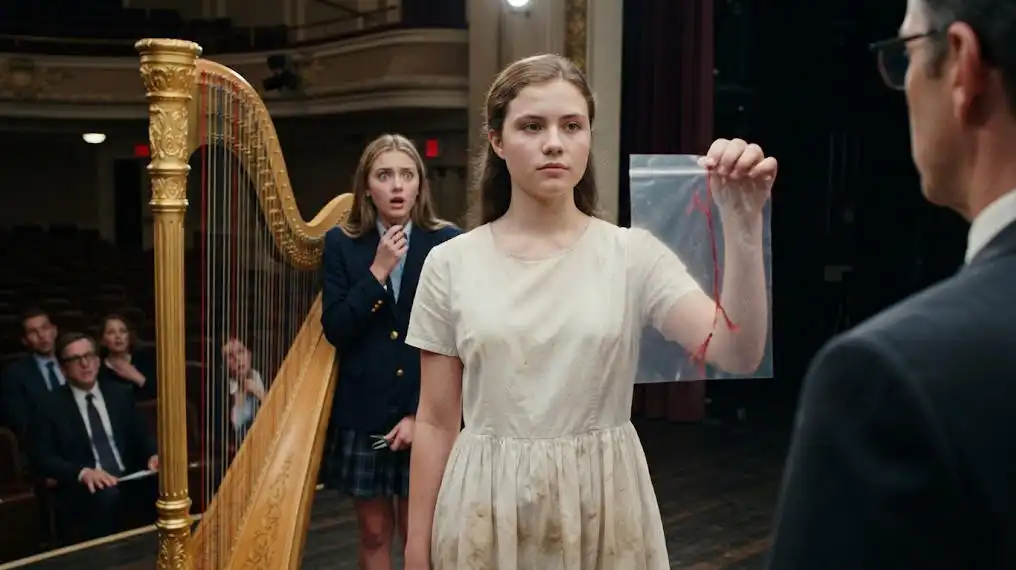
Nora rolled the Style 23 into the center of the acoustic shell, beneath the white glare of the overhead arc-lamps.
A collective murmur stirred through the scattered faculty members in the lower stalls.





