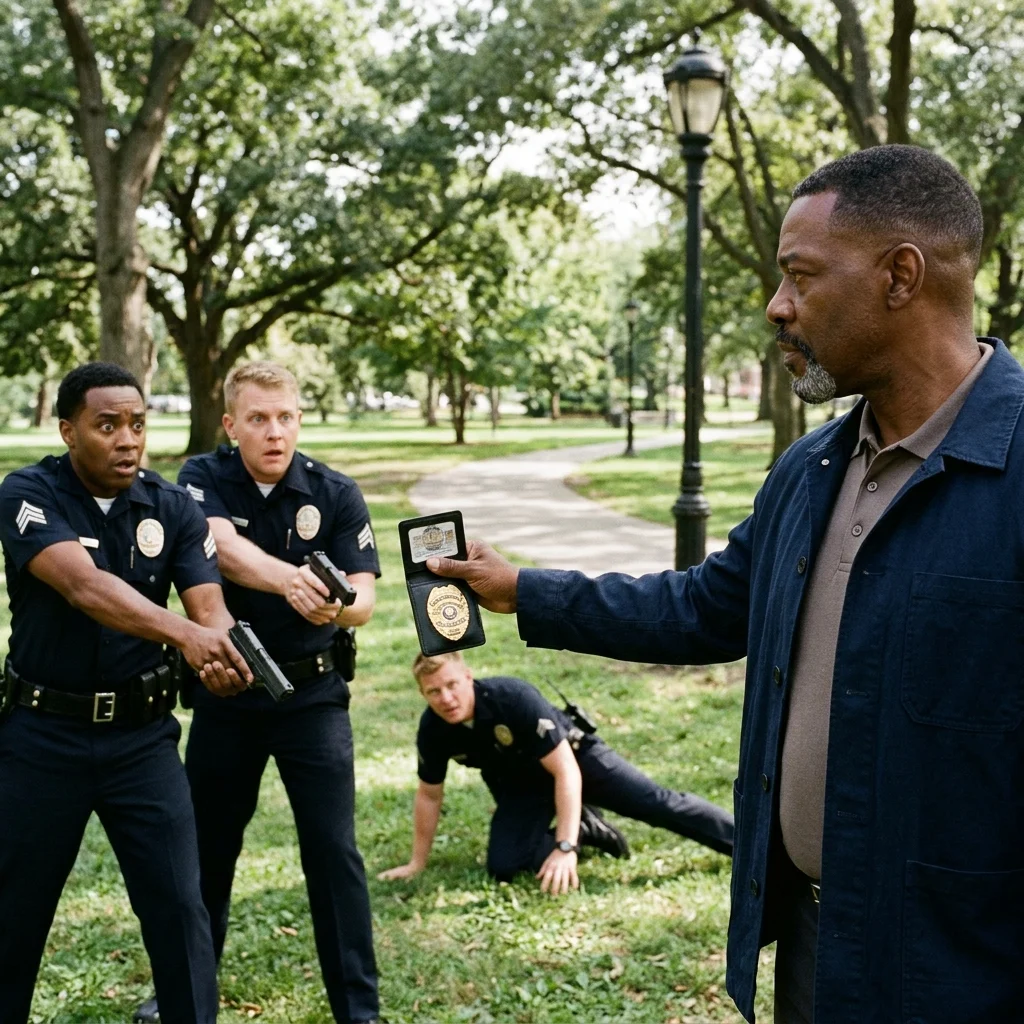
“A mistake is forgetting to sign a report, Everett.”
His voice remained calm.
“Leaving a young man begging for an ambulance while you protect yourself is a choice.”
Voss looked away.
Marcus walked on.
Eleven weeks after the investigation became public, Reuben Brooks’s conviction was vacated following the discovery of false evidence and serious misconduct in his case.
A judge ordered his release.
Talia waited outside the correctional facility beside her mother.
She wore the same faded denim jacket she had worn in Riverside Park.
Her hands shook as the doors opened.
Then her father stepped outside.
He looked older than she remembered.
His hair had gone gray near his temples.
His shoulders seemed narrower.
But when he saw Talia, his face broke into an expression she had dreamed about for six years.
“Baby girl?”
Talia ran.
“DADDY!”
Reuben dropped his small belongings.
He caught her in his arms.
For several moments, neither could speak.
Leah joined them, wrapping both in an embrace.
They stood together beneath the morning sunlight, crying without embarrassment.
Marcus watched from a respectful distance.
He had attended medal ceremonies.
He had stood before governors.
He had received standing ovations from rooms filled with powerful people.
But nothing he had accomplished in uniform felt as meaningful as watching a daughter embrace the father she had nearly lost.
Talia eventually approached him.
“General Hale?”
“Yes?”
She wiped her cheeks.
“Thank you for believing us.”
Marcus looked toward Reuben.
Then back at Talia.
“You shouldn’t have needed a general to make people listen.”
Talia smiled through her tears.
“Maybe someday they won’t.”
Marcus nodded.
“That’s what we’re going to work toward.”
The independent review of Marcus’s conduct concluded several months later.
Investigators found no evidence that he had knowingly participated in the corruption scheme.
They did, however, identify failures in his oversight and his handling of the concerns raised after Caleb’s death.
Marcus accepted the findings.
He publicly acknowledged that his signature had enabled dangerous exceptions to evidence safeguards.
He also supported new requirements for independent custody audits, external review of misconduct allegations, and stronger protections for witnesses.
Then he announced his retirement.
Reporters gathered outside State Police Headquarters.
One asked whether he regretted giving up his position.
Marcus looked at the cameras.
“For years, I believed the highest responsibility of my career was protecting the reputation of the institution I served.”
He paused.
“I was wrong.”
The reporters fell silent.
“My highest responsibility was protecting the people who depended on that institution.”
He looked toward Imani, standing beside Elena Ruiz and Talia Brooks.
“And sometimes protecting people means admitting that the institution failed them.”
Another reporter asked whether he felt humiliated by the footage from Riverside Park.
Marcus shook his head.
“I felt frightened.”
He continued.
“I felt angry.”
“And when the officers recognized my badge, I felt something even more troubling.”
“What was that?”
“Relief.”
The reporters waited.
Marcus’s voice hardened.
“Because I realized that my rank had protected me in a situation where an ordinary citizen might never have been given the same chance.”
He paused.
“That is not a reason to celebrate my authority.”
“It’s a reason to demand change.”
One year later, Riverside Park looked much as it had on the afternoon everything began.
Children played near the fountain.
Couples walked beneath the oak trees.
A violinist performed beside the rose garden.
But a new wooden bench had been installed near the eastern path.
Its plaque read:
IN MEMORY OF CALEB HALE.
HE HELPED WHEN OTHERS LOOKED AWAY.
The bench had been funded by the Fourth Witness Project.
Marcus stood before it holding a small bouquet of white roses.
Imani waited beside him.
Elena Ruiz stood a few feet away.
She was no longer the frightened child inside the steel cabinet.
She had become a confident young woman, still committed to serving the public, but determined never to confuse obedience with integrity.
Marcus placed the flowers beneath the plaque.
For a moment, he imagined Caleb standing beside him.
Young.
Smiling.
Holding that little recorder.
Full of questions.
Full of hope.
Then Elena approached.
“General?”
Marcus smiled gently.
“I’m retired, Elena.”
“I know.”
She looked at the plaque.
“I’ve wanted to tell you something for a long time.”
Marcus waited.
She took a breath.
“When I was inside that locker, I thought nobody was coming.”
Her voice trembled.
“I thought my mother had forgotten me.”
Marcus listened.
“Then Caleb opened the door.”
She smiled through her tears.
“He didn’t ask whether I had done something wrong.”
“He didn’t ask who my parents were.”
“He didn’t even ask why I was there.”
Her voice broke.
“He just saw a little girl who needed help.”
Marcus’s eyes filled.
Elena continued.
“I became a police officer because of him.”
“Not because of what happened afterward.”
“Because for a few minutes, he showed me what a good person with courage could do.”
Marcus reached out and embraced her.
For fourteen years, he had grieved a son he believed had died in disgrace.
Now he understood that Caleb’s final actions had shaped another person’s entire life.
And that knowledge gave his grief somewhere to go.
As the afternoon light softened, Imani handed Marcus one final envelope.
“Margaret found this among Mom’s things.”
Marcus opened it.
Inside was a photograph taken many years earlier.
Caleb stood between his parents in their backyard.
He was laughing.
Evelyn’s arm rested around his shoulders.
Marcus was looking at his son with unmistakable pride.
On the back, Evelyn had written a sentence.
“The measure of a life is not how much power a person holds, but how much kindness remains after that person is gone.”
Marcus read it twice.
Then he looked toward the bench.
Toward Elena.
Toward Talia, who had arrived with her parents to lay another bouquet.
Toward the families whose lives were beginning to recover.
He finally understood why Evelyn had named her organization the Fourth Witness Project.
The fourth witness had been the child nobody expected to matter.





